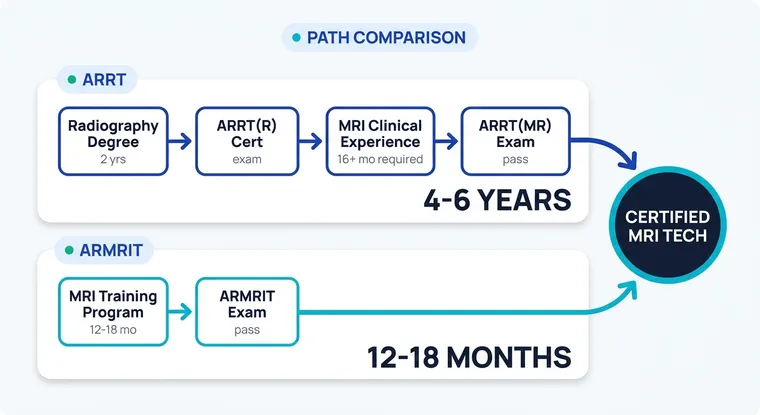
“Accredited MRI tech certification program” means two different things, because MRI technologists in the United States are certified by two different bodies. ARMRIT approves MRI-specific programs and publishes the list itself. ARRT does not approve programs at all. It sets eligibility rules, and the school’s own institutional accreditor does the accrediting.
That distinction decides which programs you can actually enter. If you already hold an ARRT credential in radiography or another modality, the ARRT post-primary route is short and cheap. If you are starting from a high school diploma or a non-imaging healthcare job, the ARMRIT route is the only one that does not send you through a two-year radiography degree first.
This guide lists every ARMRIT-accredited program as of September 2026, verified against armrit.org, and the main ARRT-path options, then compares them on the things accreditation does not tell you.
Two paths, two meanings of accredited
| ARMRIT path | ARRT path | |
|---|---|---|
| Who certifies you | ARMRIT (American Registry of Magnetic Resonance Imaging Technologists) | ARRT (American Registry of Radiologic Technologists) |
| Who accredits the program | ARMRIT reviews and lists each program directly | The school’s institutional accreditor (regional, ABHES, ACCET); JRCERT optional for MRI |
| Entry requirement | High school diploma or GED; no imaging credential | Primary: associate degree or higher. Post-primary: an existing ARRT credential such as R.T.(R) |
| Program type | 12 to 18 month certificate, or 18 to 24 month associate degree | 4 to 12 month post-primary certificate, or 24 month associate degree |
| Typical total cost | $11,500 to $15,000 certificate; $35,000 to $47,500 associate | $2,000 to $8,000 post-primary (on top of a prior degree); $20,000 to $55,000 degree |
| Clinical hours | 1,000 hours is the norm | Varies; ARRT post-primary requires documented procedures, not hours |
| Best fit | Career changers, MRI aides, CNAs, medical assistants | Registered radiographers, CT and nuclear medicine techs adding MRI |
For a deeper look at the credentials themselves, see ARRT vs ARMRIT. For state licensing, the five states that license MRI technologists (North Dakota, New Mexico, Oregon, Washington, West Virginia) all accept ARMRIT alongside ARRT.
ARMRIT-accredited MRI programs
This is the complete list published at armrit.org as of September 2026. Programs are listed by campus, so schools with several locations appear more than once. Verify current status on the ARMRIT program list before you enroll; the list changes.
| Program | Location | Credential | Format |
|---|---|---|---|
| Tesla MR Institute (listed as Tesla Institute of MRI Technology) | Fairfax, VA; clinicals nationwide | 18 month certificate | Online coursework, in-person clinicals at 334+ sites in 38 states |
| AIMS Education, College of Health Sciences | Piscataway, NJ | Associate degree | Hybrid; on-campus labs and NJ-area clinicals |
| AMG Medical Institute | Bloomfield, NJ | 18 month certificate | Not published; check program |
| Apprenticeship (US Department of Labor) | Registered nationally | 18 month certificate | Employer-sponsored on-the-job training |
| Aquarius Institute | Des Plaines, IL | 18 month certificate | Evening classes two nights a week, in-person clinicals |
| Casa Loma College | Nashville, TN | Associate degree | Hybrid; in-person and online classes, in-person externship |
| Casa Loma College | Sherman Oaks, CA | Associate degree | Hybrid; in-person and online classes, in-person externship |
| CNI College | Santa Ana, CA | Associate degree | Evening and weekend classes, Southern California clinicals |
| JVS SoCal | Los Angeles, CA | 18 month certificate | Not published; check program |
| Med College | Hialeah, FL | Associate degree | Hybrid; in-person and online, in-person externships |
| Midwestern Career College | Chicago, IL | Associate degree | Hybrid; 810-hour in-person externship |
| Midwestern Career College | Naperville, IL | Associate degree | Hybrid; 810-hour in-person externship |
| National Polytechnic College | Lakewood, CA | Associate degree | Blended; in-person and live-streamed lectures, in-person externship |
| Pulse Radiology Institute | Saint Augustine, FL | Associate degree | Hybrid; online coursework, in-person clinicals |
| Smith Chason College | Los Angeles, CA | Associate degree | Not published; weekday, weeknight, and weekend schedules |
| Smith Chason College | Ontario, CA | Associate degree | Not published; weekday, weeknight, and weekend schedules |
| Smith Chason College | Phoenix, AZ | Associate degree | Not published; weekday, weeknight, and weekend schedules |
| Smith Chason College | San Marcos, CA | Associate degree | Not published; weekday, weeknight, and weekend schedules |
| Valley View School of Radiology | Stockton, CA | 18 month certificate | Hybrid; evening online classes, daytime in-person clinicals |
Program, location, and credential are as ARMRIT publishes them. Format is taken from each school’s own website as of September 2026; “not published” means the school does not state it online.
Three things stand out from the list.
Geography is thin. Eleven of the nineteen entries are in California, Illinois, or New Jersey. If you live anywhere else, a campus-based program means relocating. The programs that enroll nationally do it by teaching online and placing students at clinical sites near home.
Certificate versus associate degree. Seven entries are 18-month certificates and twelve are associate degrees. Both lead to the same ARMRIT exam. The degree adds general education courses, more time, and in the published cases, considerably more cost. It matters if you plan to pursue a bachelor’s degree later or work in a market where employers prefer a degree.
A degree program can hold two paths. AIMS, CNI, and several others hold ARMRIT approval and also prepare graduates for the ARRT MRI exam through the primary pathway, because they award an associate degree. If dual eligibility matters to you, that is the route.
How the published ARMRIT programs compare on cost
Only some programs publish full pricing. These figures come from each school’s own published documentation and are current as of the dates in the linked comparisons.
| Program | Credential | Published cost | Length |
|---|---|---|---|
| Tesla MR Institute | Certificate | $11,500 to $13,400 | 12 to 18 months |
| AIMS Education | Associate degree | ~$35,525 | 24 months |
| CNI College | Associate degree | ~$47,500 | ~19 months |
Side-by-side detail: Tesla MR vs AIMS Education and Tesla MR vs CNI College.
ARRT-path MRI certification programs
ARRT does not publish a program list, so there is no single directory to check. The programs below are the ones that consistently appear when people search for MRI certification programs. They fall into two groups with very different entry requirements.
Post-primary certificates for registered technologists
These are for people who already hold an ARRT credential, usually R.T.(R). They are short because the imaging fundamentals are assumed.
| Program | Location | Length | Entry requirement |
|---|---|---|---|
| Tesla MR Institute ARRT MRI Post-Primary Program | Online, clinicals at your own facility or a partner site | About 6 months, self-paced | ARRT(R), (N), or (T) credential |
| Johns Hopkins MRI Technologist Training Program | Baltimore, MD | 6 months, paid, full time | Existing ARRT primary credential |
| University of Utah MRI Technologist Program | Salt Lake City, UT | 6 months | Existing ARRT credential |
| UF Health Jacksonville MRI Advanced Certificate | Jacksonville, FL | 4 months | Registered technologist |
| Harper College MRI Certificate | Palatine, IL | 12 months, 16 credit hours | ARRT registered radiologic technologist |
| Lone Star College MRI Advanced Technical Certificate | Houston, TX | 12 months | Prior associate degree and imaging credential |
| Forsyth Tech MRI Diploma | Winston-Salem, NC | 12 months | ARRT registration or registry eligibility |
| Wake Tech MRI Diploma | Raleigh, NC | 12 months | Active ARRT registration |
| Alfred State College MRI Certificate | Online, NY | Upper-level online certificate | Registered technologist |
| Kent State University MRI Certificate | Online, OH | Online undergraduate certificate | Check program; built for working technologists |
| Pulse Radiology Advanced Imaging Certificate in MRI | Online; clinicals at affiliate sites in 30+ states | 14 weeks, self-paced | Existing ARRT credential; approved for ARRT structured education |
Hospital-based programs like Hopkins and Utah are competitive and require you to be on site full time. The Tesla MR ARRT MRI post-primary program covers the same ARRT structured education and clinical competency requirements online for a flat $6,000, so working technologists can add MRI without leaving their job.
Degree programs with ARRT primary-pathway eligibility
These accept students without an imaging credential, award an associate degree, and make graduates eligible for the ARRT MRI exam through the primary pathway. Institutional accreditation is what makes them count.
| Program | Location | Credential | Accreditation |
|---|---|---|---|
| CBD College | Los Angeles, CA | AAS in MRI | ABHES institutional; ARRT recognized |
| Gurnick Academy of Medical Arts | California, multiple campuses | 18 month program | Check institutional accreditor; online lectures plus clinicals |
| California Career Institute | Southern California | AAS in MRI | ACCET institutional; BPPE approved |
| Central Coast College | Salinas, CA | AAS in MRI | Check institutional accreditor |
| Community college MRI tracks (Ivy Tech, HCC, Gwinnett Tech) | IN, TX, GA | Diploma or AAS | Regional institutional accreditation |
Most community college MRI tracks still expect ARRT radiography registration first. The community college MRI programs comparison covers the prerequisites campus by campus.
What accreditation does not tell you
Accreditation confirms a program meets minimum standards. It says nothing about the four things that decide whether you finish on time.
Clinical placement
This single factor separates a 12-month finish from a 24-month one. Ask every program:
- How many clinical partner sites do you maintain, and how many are within 50 miles of me?
- Do you place me, or do I find my own site?
- How long from enrollment to starting clinicals? Four to eight months after didactic prerequisites is a normal answer. A vague answer is a bad one.
- What happens if my site falls through mid-training?
Programs with large networks have backup options. Programs that make you cold-call imaging centers are shifting their hardest job onto you.
Curriculum delivery
- Fully online, hybrid, or in person?
- Self-paced or fixed deadlines?
- Live lectures or asynchronous?
- Is simulator time included before you touch a real scanner?
For working adults, self-paced online coursework with flexible deadlines is the format that survives a full-time job.
Outcomes data
Ask for completion rate, average time to completion, first-time exam pass rate, and job placement. Programs that will not share these numbers usually do not track them.
Total cost, not tuition
| Line item | What to check |
|---|---|
| Tuition | $11,000 to $15,000 is typical for an ARMRIT certificate |
| Payment structure | Monthly plans that do not require bank loans |
| What is included | Coursework, simulator, clinical placement, exam prep |
| What is extra | Compliance costs (background check, immunizations, drug screen), commute, exam fee |
The full breakdown is in MRI tech school cost.
Which path is right for you
Start with the ARMRIT path if you have no imaging credential and want to be scanning in 12 to 18 months. It is the only accredited route that skips the radiography degree. Check how ARMRIT is accepted in your market before you commit; acceptance is broad and growing, but individual employers vary.
Start with the ARRT post-primary path if you already hold R.T.(R) or another ARRT primary credential. A 4 to 12 month certificate is faster and cheaper than anything on the ARMRIT list, and the online post-primary option lets you keep working while you do it.
Consider an ARMRIT-approved associate degree if you want dual ARMRIT and ARRT eligibility on one transcript and can absorb the extra year and cost.
Consider a hospital-based post-primary program if you are already registered and can compete for a small number of paid seats. Johns Hopkins and Utah are the best known.
How Tesla MR Institute fits
Tesla MR Institute is on the ARMRIT list as an 18-month certificate program, headquartered in Fairfax, Virginia, and is the largest ARMRIT program by enrollment and clinical network. ARMRIT renewed its Full Accreditation for September 1, 2026 through September 2031.
- Format: online coursework, in-person clinicals
- Clinical network: 334+ partner sites across 38 states, placement within 50 miles of home
- Timeline: 12 to 18 months
- Tuition: $11,500 to $13,400 depending on payment plan, on a $2,000 deposit
- Clinical hours: 1,000 (250 simulator hours plus 750 on site)
- Entry requirement: high school diploma or GED; no healthcare experience or X-ray credential
- Exam prep: included
Full detail on the online MRI program, admissions requirements, and the curriculum. For the accreditation question on its own, see is Tesla MR Institute accredited.
Tesla MR also runs an ARRT MRI post-primary program for technologists already registered in radiography, nuclear medicine, radiation therapy, or sonography (through ARRT, NMTCB, or ARDMS): self-paced online didactic mapped to the ARRT MRI exam specifications, a 250-scan simulator phase, support documenting ARRT clinical competencies, and exam prep, for a flat $6,000. Most working techs finish in about 6 months.
How to verify any program’s accreditation
- ARMRIT path: open the ARMRIT program list and find the program by campus. If it is not there, it is not ARMRIT-accredited, whatever the brochure says. Note that schools appear under their legal names, which can differ from their brand.
- ARRT path: find the school’s institutional accreditor (regional, ABHES, ACCET) and confirm the school on the accreditor’s own directory. Then ask the program which ARRT eligibility pathway its graduates use and how they document clinical competencies.
- JRCERT: optional for MRI. If a program claims it, check the JRCERT directory. If it does not claim it, that is not a red flag for MRI.
- Ask for documentation. Any accredited program can produce its approval letter. A program that cannot is a program to walk away from.
Related reading
Frequently Asked Questions
It depends on which certification the program leads to. Programs on the ARMRIT path are approved by ARMRIT directly and appear on the ARMRIT accredited programs list. Programs on the ARRT path run inside an institution with recognized institutional accreditation (regional, ABHES, ACCET) and must meet ARRT's educational requirements. Some ARRT-path MRI programs also hold JRCERT programmatic accreditation, but ARRT does not require it for MRI.
For the ARMRIT path, check the program list at armrit.org. For the ARRT path, confirm the school's institutional accreditor on the accreditor's own directory and ask the program which ARRT eligibility pathway its graduates use. Never rely on the program's marketing page alone.
No. JRCERT accreditation is required for radiography programs that lead to the ARRT radiography credential. For MRI, ARRT accepts degrees from institutionally accredited schools, and ARMRIT approves MRI-specific programs directly. A JRCERT-accredited MRI program is a good sign, but its absence does not make a program unaccredited.
ARMRIT certificate programs run 12 to 18 months. ARMRIT-approved associate degree programs run 18 to 24 months. ARRT post-primary MRI certificates for registered technologists run 4 to 12 months, but they sit on top of a prior two-year radiography degree.
The classroom portion, yes. Physics, anatomy, safety, and protocols are taught online by most ARMRIT programs and by a growing number of ARRT-path certificates. Clinical training is always in person at an imaging facility. No accredited program is fully online.
ARMRIT-approved programs make you eligible for the ARMRIT certification exam. ARRT-path programs make you eligible for the ARRT MRI credential, either through the primary pathway (associate degree or higher plus an MRI program) or the post-primary pathway (an existing ARRT credential plus structured MRI education and documented clinical experience).
ARMRIT lists programs by legal entity, which can differ from the brand a school markets under. Tesla MR Institute, for example, appears as Tesla Institute of MRI Technology. If you cannot find a program on the list, check the school's legal name and campus city before concluding it is not accredited.