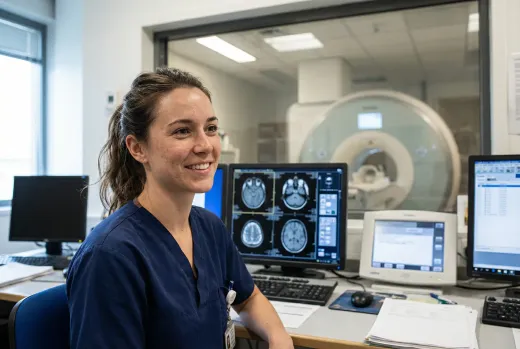
MRI technologist licensing in Washington
Washington does not require a specific state license for MRI technologists. MRI uses magnetic fields, not ionizing radiation, so it falls outside most state radiologic technology licensing requirements. Employers require national certification through ARRT or ARMRIT.
Both ARRT and ARMRIT certifications are accepted by most Washington employers. The MRI staffing shortage has made facilities across the state increasingly flexible about certification type, with outpatient imaging centers and community hospitals leading the way in accepting ARMRIT-certified technologists.
Key Takeaway
Washington does not require a state license for MRI technologists. Employers require national certification (ARRT or ARMRIT), and both are widely accepted across the state.
MRI tech programs in Washington
Tesla MR Institute (hybrid, statewide)
Tesla MR Institute’s program is designed for people entering MRI directly, including career changers and healthcare workers without radiology backgrounds.
Key details:
- Duration: 12-18 months
- Prerequisite: None. No prior radiology credentials required.
- Format: Online didactic coursework combined with in-person clinical rotations at local Washington sites
- Clinical sites in Washington: 16+ facilities across the state
- Certification: Prepares for ARMRIT certification
- Cost: Starting at $11,500 (full program, payment plans available)
- Strength: Accessible to career changers, flexible schedule, affordable
Traditional pathway (ARRT)
If you already hold ARRT certification in radiography or another primary modality, you can add MRI as a post-primary specialty through structured clinical experience and the ARRT MRI exam. Contact local radiologic technology programs or your employer for post-primary training opportunities in Washington.
Tip
For a detailed comparison of ARRT vs ARMRIT pathways, read our ARRT vs ARMRIT comparison guide.
MRI technologist salary in Washington
MRI technologists in Washington earn an average of approximately $90K per year, with salaries ranging from $75K-$108K depending on metro area, experience, and facility type. The state has no income tax, which increases take-home pay.
The national median for MRI technologists is $88,180 according to May 2024 BLS data.
Entry-level MRI technologists in Washington typically start at the lower end of this range. With 3-5 years of experience and specialty skills (cardiac MRI, breast MRI, pediatric), salaries move toward the upper range. Travel MRI techs working Washington assignments can earn premium weekly rates.
For a deeper dive into MRI tech compensation, see our MRI technologist salary guide and salary by state breakdown.
Clinical training sites in Washington
Tesla MR Institute has 5+ clinical training sites across Washington, with concentrations in Vancouver, Seattle, Renton, Olympia.
Most Washington students are placed within 30-45 minutes of their home. The larger metro areas have the most available sites and the quickest placement timelines.
Employer Tip
If you are a facility manager in Washington interested in hosting MRI training students, Tesla MR Institute partners with hospitals and imaging centers across the state. See our clinical site partnership page for details.
How to become an MRI tech in Washington
Path 1: Career changers (ARMRIT)
- Confirm eligibility. You need a high school diploma or GED. Healthcare experience is preferred but not required.
- Enroll in an ARMRIT-approved program. Tesla MR Institute’s hybrid program lets you complete didactic coursework online while doing clinical rotations at a Washington facility.
- Complete clinical hours. Log supervised clinical training at one of 16+ Washington sites.
- Pass the ARMRIT exam. After completing your program and clinical requirements, sit for the ARMRIT certification exam.
- Apply for jobs. Your ARMRIT certification is your credential.
Path 2: Existing rad techs (ARRT post-primary)
- Confirm ARRT eligibility. You need current ARRT certification in a primary pathway.
- Complete post-primary MRI requirements. Through employer-sponsored clinical experience or structured education.
- Pass the ARRT MRI exam.
- Update your credentials. Your ARRT(MR) certification goes on your resume.
For a broader look at requirements across all states, see our state-by-state guide.
MRI licensing in Washington
Washington does not require a specific state license for MRI technologists. The state’s Department of Health certifies some medical imaging professionals, but MRI technologists are generally exempt since MRI does not involve ionizing radiation. Employers require ARRT(MR) or ARMRIT certification. Washington’s competitive healthcare market and strong labor protections mean many positions offer above-average compensation and benefits.
Employers throughout Washington accept both ARRT(MR) and ARMRIT certification. Tesla MR Institute’s program prepares you for the ARMRIT exam, which does not require prior X-ray credentials.
MRI salary by metro in Washington
MRI technologists in Washington earn $84K-$114K per year depending on location and experience. Washington is among the highest-paying states for MRI technologists, well above the $88K national median, driven by the state’s high cost of living, competitive labor market, and lack of state income tax.
| Metro Area | Salary Range |
|---|---|
| Seattle-Tacoma-Bellevue | $90K-$114K |
| Spokane-Spokane Valley | $80K-$100K |
| Olympia-Tumwater-Lacey | $82K-$102K |
| Vancouver (Portland metro) | $82K-$104K |
Washington has no state income tax, which means higher take-home pay compared to similar metros in other states.
Where MRI techs work in Washington
Major healthcare employers in Washington include Providence Health Washington, Virginia Mason Franciscan Health, MultiCare Health System, PeaceHealth, Swedish Health Services, UW Medicine (University of Washington). These systems operate hospitals, outpatient imaging centers, and specialty clinics across the state.
Washington state offers some of the highest MRI tech salaries in the nation, compounded by the significant advantage of no state income tax—a combination that makes Seattle-area positions among the most financially rewarding in the country. The presence of UW Medicine and the Fred Hutchinson Cancer Center creates demand for research-oriented MRI professionals. Washington’s tech-driven economy generates a well-insured population with high healthcare utilization. Joint Base Lewis-McChord near Tacoma and Naval Station Everett add federal imaging positions. Vancouver, WA—across the river from Portland, OR—offers the unique advantage of Washington’s no income tax with access to Oregon’s no sales tax.
MRI programs by city in Washington
Looking for MRI training in a specific Washington city? See our detailed guides:
More resources
- How to become an MRI technologist — step-by-step career guide
- MRI technologist salary guide — pay by state, setting, and experience
- MRI technologist requirements — what employers verify
- ARRT vs ARMRIT certification — choose the right credential path