MRI Technologist Training

MRI Tech Programs in Colorado

7 in-person or regional programs plus Tesla MR's hybrid option, compared side by side below. None of the local programs admit you without a prior X-ray credential; Tesla MR does.

Comparing programs nationally? See MRI tech school formats, costs, and certification paths. Checking accreditation? See every accredited MRI tech certification program.

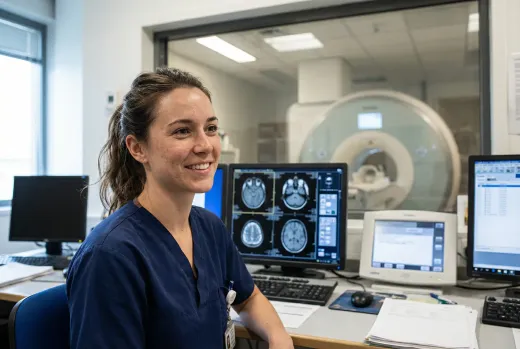
MRI technologist student training at a clinical site
$105K Avg. Salary
0 Affiliated Sites
12-18 mo Program Length
Starting at $11,500 Tuition
Already in imaging?

Already working in an imaging department in Colorado?

X-ray, CT, and nuclear medicine techs, MRI aides, transporters, schedulers, and nurses who work around a scanner do not need a second degree or an X-ray license to move into MRI. The coursework is online, so you keep your job, and clinical hours can happen at a facility you already know.

Train where you work.

If your department has an MRI scanner and will host you, our site team asks them first. Your employer signs a site agreement and names an ARRT or ARMRIT mentor.

How clinicals at your current facility work

Keep your paycheck.

The online phases fit around a hospital schedule. Clinicals are the squeeze, and we show the schedules other hospital employees have used.

MRI school while working full time

Ask your employer to pay.

Some employers cover part of tuition, and we can invoice them directly. Here is what to ask HR before you pay a deposit.

Employer tuition reimbursement
Your options

MRI programs available to Colorado residents

7 in-person or regional programs plus Tesla MR's hybrid option. None of them train you in MRI directly without a prior X-ray credential; the local route is X-ray first, then MRI. Facts come from each school's published pages. Confirm with the school before you apply.

Published cost is what each school states on its own site. Some schools publish tuition only; others include fees, books, or uniforms; public colleges often distinguish in-district from out-of-district rates. Each row says which. For the national list with accreditor and entry requirement for every program, see accredited MRI tech certification programs.

Program Path Credential Length Prior X-ray? Format Published cost
Tesla MR Online coursework, clinicals near you
MRI direct
Certificate (ARMRIT exam eligibility)ARMRIT
12 to 18 months
No
Hybrid: online lectures, in-person clinicals
$11,500 to $13,400 by payment plan
Community College of Denver, Magnetic Resonance Imaging Certificate Denver, CO For registered technologists certified through ARRT, ARDMS, or NMTCB. Application cycles: June 1 to July 31 for fall, November 1 to December 31 for spring. Courses RTE 1084 and RTE 2084 carry additional fees.
MRI after X-ray
Certificate in Magnetic Resonance Imaging (13 credits)ARRT (MR) post-primary
Online didactic courses plus at least 25 weeks of clinical internship (15-week internship in spring or fall, or 10 weeks in summer)
Yes
Online didactic courses with weekday internships throughout the Denver metropolitan area
Not published
Red Rocks Community College, Magnetic Resonance Imaging (MRI) Certificate Arvada, CO Requires an eligible primary-pathway credential in good standing (ARRT Radiography, Radiation Therapy, Nuclear Medicine Technology, or Sonography, or equivalent NMTCB or ARDMS). Starts each fall and spring; applications accepted year-round; satisfies the ARRT 16 hour structured education requirement.
MRI after X-ray
Certificate in Magnetic Resonance Imaging (16 credits)ARRT (MR) post-primary
Two semesters, part-time
Yes
Online didactic combined with in-person clinicals
MRI: $5,100 (in-state tuition $2,880, fees $1,400, books $300, uniform $300, screening $120, BLS $100); academic year not stated
Pueblo Community College, Magnetic Resonance Imaging BAS (bachelor's completion) Pueblo, CO Requires graduation from a regionally accredited radiologic technology program and a passed ARRT primary certification exam in radiography. Fall start; apply to the program by June 1.
MRI after X-ray
BAS in Magnetic Resonance Imaging (120 credits, degree completion program)ARRT (MR) post-primary
Not stated
Yes
Mostly online with face-to-face clinical education for MRI and CT
Not published
UCHealth School of Radiologic Technology, MRI Online Traditional Course Colorado Springs, CO 2026 flyer limits admission to current UCHealth employees who are ARRT registered in Radiography, Nuclear Medicine Technology, Radiation Therapy, or Sonography. 2026 classes ran March 31 to November 24 with applications due before February 26, 2026; certified by the Colorado Division of Private Occupational Schools.
MRI after X-ray
MRI course (18 semester credits)ARRT (MR) post-primary
8 months (two semesters)
Yes
Online classes via Microsoft Teams Tuesday and Thursday, in-person clinicals of 12 to 16 hours per week (minimum 256 clinical hours each semester); Colorado Springs students have an evening MRI lab
$3,000 per semester for a total of $6,000 (2026 MRI course flyer)
Red Rocks Community College, Radiologic Technology AAS Arvada, CO JRCERT accredited since 1996 with a current 8-year award. Program starts in the fall; applications accepted December 15 to January 31; selective admissions.
X-ray first
AAS in Radiologic Technology (79 credits)ARRT (R)
5 semesters, full-time
No
In-person, online and hybrid course delivery with clinical shifts
Radiography: $15,600 (in-state tuition $10,280, fees $4,000, books $800, uniform $300, screening $120, BLS $100); academic year not stated
UCHealth School of Radiologic Technology (Memorial Hospital and Anschutz campuses) Colorado Springs, CO JRCERT accredited (8-year award in 2018). Colorado Springs campus starts mid-June with a March 1 deadline; Denver/Aurora campus starts mid-January with an October 1 deadline. Seven prerequisite courses required; does not participate in Title IV federal aid.
X-ray first
Associate of Applied Science in Radiologic TechnologyARRT (R)
23 months (6 consecutive semesters)
No
In-person, hospital-based; classes and clinicals between 8 a.m. and 4 p.m., Monday through Friday
Tuition $13,500 per year for a total of $27,000; total cost of the program approximately $28,890 (Tuition and Fees 2025 document)
Aims Community College, Radiologic Technology AAS Greeley, CO Page states the program follows ASRT and ARRT standards; JRCERT accreditation is not stated on the page. Start term, deadline and seats not stated on the page.
X-ray first
AAS in Radiologic Technology (74 credits)ARRT (R)
Five semesters
No
In-person; half the week in classroom and labs and half the week in a clinical internship
Estimated program tuition: in-district $10,598, in-state $17,191, WUE $25,243, out-of-state $47,995, plus estimated lab/course fees $436; academic year not stated

Verified against each program's own website between Sep 18, 2026 and Oct 31, 2026. Tuition, length, and admission rules change; the school's page is the authority. Tesla MR is not a degree-granting institution and does not participate in federal financial aid. See accreditation. The schools named here are not affiliated with Tesla MR and do not endorse it; their names belong to their owners. Spot an error? Email info@teslamr.com and we will review it within 10 business days.

The path

How to become an MRI tech in Colorado

Five steps, the same in Colorado as anywhere else. Where you do step four is what changes by city.

  1. Confirm you are eligible

    A high school diploma or GED is the floor. You do not need a prior X-ray, radiography, or healthcare credential for the ARMRIT route. Some of the in-person programs in the table above do require one.

  2. Pick the credential you are aiming for

    Employers in Colorado hire both ARRT (MR) and ARMRIT technologists. ARRT usually means a two-year degree or a prior radiography license. ARMRIT is the certificate route for career changers.

  3. Choose a program format that fits your life

    Full-time campus programs are faster if you can stop working. Hybrid programs put the coursework online and the clinical hours at a facility near you, which is how most working adults finish.

  4. Complete supervised clinical hours

    Every path ends at a scanner. Clinical training is the part that depends on local capacity, so ask any program how placement works before you enroll. Ours is explained below.

  5. Pass the registry exam and get hired

    Colorado is a non-licensure state for imaging technologists. Employers require ARRT (MR) or ARMRIT certification. Once certified, you can apply to the hospital systems and imaging groups listed further down this page.

Where you would train and work

MRI employers in Colorado, and which ones are in our clinical network

We are still building our network in Colorado. An affiliated site is a facility in our clinical network where students can be placed. The others are places MRI techs work in Colorado that we have not affiliated with yet.

Affiliated site Employer, not yet affiliated

We have not mapped Colorado employers yet. Tell us where you live and our site team will do it for your application.

Pulled from Tesla MR's site database on October 31, 2026. Affiliations are added and change over time; the assessment you receive during admissions is the one that applies to you.

Clinical placement

How clinical placement works

Our Clinical Sites team leads placement. You are not expected to find or negotiate your own clinical site. We look for a facility within a reasonable commute of your home and widen the search only if we need to.

Timing depends on facilities having capacity when you reach clinicals. If your area is thin, we tell you during admissions, not after you enroll, and we talk through the options with you.

Growing here · Colorado

We are still building our network in Colorado. If you apply, the site team maps your area first and tells you what to expect before you commit.

  1. We look at your area during admissions

    If you already have a facility in mind, maybe where you work, we reach out and see whether you can train there. If not, our site team maps the hospitals and imaging centers near your home and starts the conversation.

  2. You get a straight answer before you enroll

    Clinicals are still months away at this point, so a site's answer is usually "we expect so, check back closer to the date." We tell you what we heard and what it means for your timeline.

  3. You start the coursework while the site work continues

    Most students begin Phase I and Phase II before a specific facility is named. That is normal, and the site team keeps working your area in the background.

  4. Your site is confirmed as clinicals approach

    Once clinicals are weeks away rather than months, facilities can commit to dates. We work to have your placement set before Phase III begins. Which facility and which shift depends on who has capacity at that time.

MRI technologist licensing in Colorado

Colorado does not issue a state license for MRI technologists. The Colorado Department of Public Health and Environment describes Colorado as a non-licensure state; its operator registrations cover X-ray roles such as limited scope, fluoroscopy and bone densitometry, and do not mention MRI.

Employers set the credential requirement. Most postings ask for ARRT (MR) or ARMRIT, the two national MRI certifications, and both are valid in all 50 states.

đź’ˇ

Key Takeaway

Colorado is a non-licensure state for imaging technologists. Employers require ARRT (MR) or ARMRIT certification.

MRI technologist salary in Colorado

BLS reports a May 2025 median of $105,380 for MRI technologists in Colorado, with about 670 employed statewide (BLS OEWS, state estimates). The national median is $95,480. For comparison, Colorado radiologic technologists, which includes X-ray and CT, have a median of $87,760.

Entry-level pay sits below the median. Shift differentials, specialty work such as cardiac or breast MRI, and 3 to 5 years of experience push experienced technologists above it. See the MRI technologist salary guide and salary by state for the full breakdown.

Where MRI techs work in Colorado

Major healthcare employers in Colorado include UCHealth, CommonSpirit Health (Centura Health), SCL Health (Intermountain), Denver Health, Children’s Hospital Colorado, HCA HealthONE. These systems operate hospitals, outpatient imaging centers, and specialty clinics across the state.

Colorado’s healthcare market benefits from a highly educated workforce and a quality-of-life draw that attracts top talent, but the high cost of living along the Front Range corridor means employers must offer competitive compensation. UCHealth and CommonSpirit Health dominate the market with extensive imaging networks across the state. The presence of military installations like the U.S. Air Force Academy and Fort Carson creates additional demand, and mountain resort communities frequently struggle to recruit imaging staff, often offering premium pay and housing incentives.

MRI programs by city in Colorado

Looking for MRI training in a specific Colorado city? See our detailed guides:


More resources

ARMRIT Accredited Nationally recognized certification
334+ Clinical Sites Partner network in 38 states
Starting at $11,500 Payment plans available

Frequently Asked Questions

It depends on the path. The X-ray-first route is a 2-year radiography degree followed by an MRI certificate, often about another year. Every Colorado MRI program we verified asks for an existing imaging registry first, so the local route starts with X-ray. Tesla MR's hybrid certificate takes most students 12 to 18 months.

BLS does not break CT out separately; it reports radiologic technologists and technicians, which includes X-ray and CT, at a Colorado median of $87,760 versus $105,380 for MRI technologists (May 2025). Nationally the figures are $80,110 and $95,480. MRI is the higher-paid modality in both sets of numbers.

The coursework is real: MRI physics, cross-sectional anatomy, pulse sequences, and safety around a magnet that is always on. Most students who put in steady weekly hours pass. In Colorado the harder part is often the entry requirement, since every MRI program we verified in the state asks for an existing imaging registry first. Every path ends with a national registry exam, ARRT or ARMRIT.

Not through a Colorado campus program that we could verify: each MRI program in the state asks for an existing ARRT, ARDMS, or NMTCB registry, so the local route is X-ray first. Tesla MR's hybrid certificate accepts students with no prior imaging credential and places clinicals at affiliated Colorado sites. Check the prior X-ray column in the table above before you apply anywhere.

Our Clinical Sites team leads placement. You are not expected to secure your own site. If you know a facility, you can propose it, but we review it, confirm capacity, sign the agreement, and approve it. The affiliated Colorado health systems are listed on this page.

MRI tech schools in nearby cities and states

Take the next step

Ready to start your MRI career in Colorado?

Join hundreds of students training at clinical sites across the country. No prerequisites, no application fee, rolling admissions.

MRI Training in Colorado 12-18 months · No prerequisites
Apply Now