MRI Technologist Training

MRI Tech Programs in Utah

Every MRI technologist program a Utah resident can attend, compared side by side, plus which Utah health systems are in Tesla MR's clinical network and exactly how placement works.

Comparing programs nationally? See MRI tech school formats, costs, and certification paths. Checking accreditation? See every accredited MRI tech certification program.

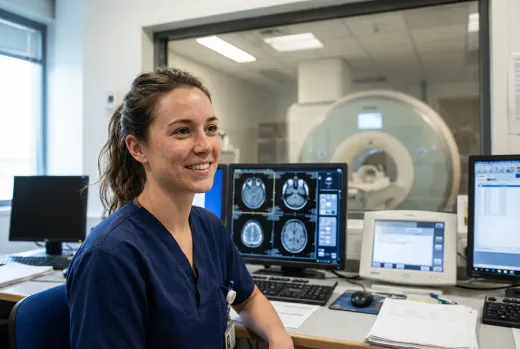
MRI technologist student training at a clinical site
$91K Avg. Salary
7 Affiliated Sites
12-18 mo Program Length
Starting at $11,500 Tuition
The path

How to become an MRI tech in Utah

Five steps, the same in Utah as anywhere else. Where you do step four is what changes by city.

  1. Confirm you are eligible

    A high school diploma or GED is the floor. You do not need a prior X-ray, radiography, or healthcare credential for the ARMRIT route. Some in-person programs below do require one, so check the table.

  2. Pick the credential you are aiming for

    Employers in Utah hire both ARRT (MR) and ARMRIT technologists. ARRT usually means a two-year degree or a prior radiography license. ARMRIT is the certificate route for career changers.

  3. Choose a program format that fits your life

    Full-time campus programs are faster if you can stop working. Hybrid programs put the coursework online and the clinical hours at a facility near you, which is how most working adults finish.

  4. Complete supervised clinical hours

    Every path ends at a scanner. Clinical training is the part that depends on local capacity, so ask any program how placement works before you enroll. Ours is explained below.

  5. Pass the registry exam and get hired

    Utah has no MRI-specific license. MRI-only technologists should confirm with the state licensing division whether the radiologic technologist license applies to them. Once certified, you can apply to the hospital systems and imaging groups listed further down this page.

Your options

MRI programs available to Utah residents

7 in-person or regional programs plus Tesla MR's hybrid option. 2 of them train you in MRI directly without a prior X-ray credential. Facts come from each school's published pages. Confirm with the school before you apply.

Published cost is what each school states on its own site. Some schools publish tuition only; others include fees, books, or uniforms; public colleges often distinguish in-district from out-of-district rates. Each row says which. For the national list with accreditor and entry requirement for every program, see accredited MRI tech certification programs.

Program Path Credential Length Prior X-ray? Format Published cost
Tesla MR Online coursework, clinicals near you
MRI direct
Certificate (ARMRIT exam eligibility)ARMRIT
12 to 18 months
No
Hybrid: online lectures, in-person clinicals
$11,500 to $13,400 by payment plan
University of Utah School of Medicine, MRI Technologist Program Salt Lake City, UT Two pathways: primary (minimum associate degree in any major, 2.8 GPA, prerequisite courses, patient care and MRI observation hours, no prior registry) and post-primary (ARRT R, T or N, or NMTCB). Sessions start January and July; about 16 students per session; July 2027 cohort deadline March 5, 2027.
MRI direct
Certificate in MRI (certificate-only program, 550 clinical and 100 didactic hours)ARRT (MR)
9 months
No
In-person; the page states distance education or virtual attendance is not available
Tuition for the 2027 program is $5,000.00; beginning with the 2028 program tuition will increase to $6,000
Weber State University, BS in Advanced Radiologic Sciences, MRI Primary Pathway emphasis Ogden, UT For applicants who are not ARRT certified. Requires an AS or AAS degree or higher, patient care experience, certification as a Limited Practical Technologist (LPT) before starting, and RADT 4601. Application opens Nov. 1, 2026 for an Aug. 30, 2027 start; Utah residents are assigned clinical sites.
MRI direct
Bachelor of Science in Advanced Radiologic Sciences, MRI emphasis (Primary Pathway)ARRT (MR)
3 straight semesters, beginning each fall semester
No
WSU campus and online, with travel to Ogden for classes once a month; 24 hours per week of clinical education
Not published
Weber State University, BS in Advanced Radiologic Sciences, MRI emphasis Ogden, UT Requires an AAS or AS degree or higher and ARRT certification. Application opens Nov. 1, 2026 for an Aug. 30, 2027 (fall) start. Out-of-state regional students must secure their own clinical site.
MRI after X-ray
Bachelor of Science in Advanced Radiologic Sciences: Magnetic Resonance Imaging (MRI)ARRT (MR) post-primary
3 straight semesters
Yes
Travel once per month to the Ogden campus for classes; 24 hours of clinical education per week in a Weber State-affiliated healthcare facility
Not published
Weber State University, AAS in Radiography Ogden, UT Offered at Ogden, Salt Lake and Provo campuses plus Utah Outreach (rural) locations. Starts fall semester.
X-ray first
Associate of Applied Science (AAS) in RadiographyARRT (R)
Five semesters
No
Hybrid: face-to-face instruction combined with virtual learning on Zoom, plus clinical education
In-state tuition rates apply for Ogden, Salt Lake, Provo and Utah Outreach programs (no dollar figure published on the page); out-of-state outreach programs listed at $3,450 per semester
Salt Lake Community College, Radiologic Technology AAS West Jordan, UT JRCERT accredited per the 2026 program handbook. One day cohort every fall in odd years and two cohorts every fall in even years; seats vary with clinical sites. Does not accept transfer credits from other radiologic technology programs.
X-ray first
Associate of Applied Science in Radiologic TechnologyARRT (R)
Two-year degree
No
Classroom instruction and clinical experiences (Jordan Campus, Health Sciences Center)
Not published
Utah Tech University, Medical Radiography AAS St. George, UT JRCERT accredited (8-year award). Top 12 to 15 scoring applicants admitted plus up to five alternates; application closes 5:00 pm Feb. 1, 2027. Transfer students from other radiography programs are not accepted.
X-ray first
Associate of Applied Science (AAS) in Medical Radiography (87 credits minimum)ARRT (R)
Two-year, full-time program (five semesters)
No
Didactic coursework with clinical experience at cooperating hospitals, clinics and doctors' offices
Not published
Mountainland Technical College (MTECH), Radiography Technology Lehi, UT One start per year in August; 12 to 16 applicants offered admission; application window runs from the 2nd Friday of February to the 2nd Friday of March.
X-ray first
MTECH Program Certificate in Radiography Technology (applicants need an associate degree or higher in any field, or completed UVU AAS in Healthcare Services requirements)ARRT (R)
15 months
No
Classroom, laboratory and clinical instruction (over 900 clinical hours)
Total cost $6,905 (academic year not stated on the page)

Verified against each program's own website between Sep 18, 2026 and Sep 21, 2026. Tuition, length, and admission rules change; the school's page is the authority. Tesla MR is not a degree-granting institution and does not participate in federal financial aid. See accreditation. The schools named here are not affiliated with Tesla MR and do not endorse it; their names belong to their owners. Spot an error? Email info@teslamr.com and we will review it within 10 business days.

Where you would train and work

MRI employers in Utah, and which ones are in our clinical network

Tesla MR has 7 affiliated clinical sites in Utah. An affiliated site is a facility in our clinical network where students can be placed. The others are places MRI techs work in Utah that we have not affiliated with yet.

Affiliated site Employer, not yet affiliated

Rayus Radiology

Affiliated site
  • Layton Layton
  • Pleasant Grove Pleasant Grove
  • Riverton Riverton
  • Salt Lake City Salt Lake City
  • South Ogden South Ogden
  • Springville Springville
  • +1 more locations

CommonSpirit

Employer, not yet affiliated
  • Holy Cross Hospital Salt Lake City

Envision Imaging

Employer, not yet affiliated
  • Bountiful Bountiful
  • Draper Draper

Granger Medical

Employer, not yet affiliated
  • West Jordan West Jordan

Moab Valley Healthcare

Employer, not yet affiliated
  • Moab Regional Hospital Moab

Moran Eye Center

Employer, not yet affiliated
  • Moran Eye Center South Jordan

University of Utah Health

Employer, not yet affiliated
  • Main Hospital Salt Lake City

Pulled from Tesla MR's site database on September 21, 2026. Affiliations are added and change over time; the assessment you receive during admissions is the one that applies to you.

Clinical placement

How clinical placement works

Our Clinical Sites team leads placement. You are not expected to find or negotiate your own clinical site. We look for a facility within a reasonable commute of your home and widen the search only if we need to.

Timing depends on facilities having capacity when you reach clinicals. If your area is thin, we tell you during admissions, not after you enroll, and we talk through the options with you.

Growing here · Utah

We have 7 affiliated sites in Utah and are actively adding more. If you apply, the site team looks at your specific location first and tells you what to expect.

  1. We look at your area during admissions

    If you already have a facility in mind, maybe where you work, we reach out and see whether you can train there. If not, our site team maps the hospitals and imaging centers near your home and starts the conversation.

  2. You get a straight answer before you enroll

    Clinicals are still months away at this point, so a site's answer is usually "we expect so, check back closer to the date." We tell you what we heard and what it means for your timeline.

  3. You start the coursework while the site work continues

    Most students begin Phase I and Phase II before a specific facility is named. That is normal, and the site team keeps working your area in the background.

  4. Your site is confirmed as clinicals approach

    Once clinicals are weeks away rather than months, facilities can commit to dates. We work to have your placement set before Phase III begins. Which facility and which shift depends on who has capacity at that time.

MRI technologist licensing in Utah

Utah’s Division of Professional Licensing (DOPL) issues three licenses under Utah Code 58-54: Radiologic Technologist, Radiologist Assistant and Radiology Practical Technician; there is no MRI-specific license, and neither the statute nor the DOPL page names MRI. The statute defines the practice of radiologic technology as using radiation beyond normal background levels for diagnostic or therapeutic purposes and requires ARRT (or NMTCB) certification for the Radiologic Technologist license, so MRI-only technologists should confirm with DOPL whether that license applies to them.

Employers set the credential requirement. Most postings ask for ARRT (MR) or ARMRIT, the two national MRI certifications, and both are valid in all 50 states.

💡

Key Takeaway

Utah has no MRI-specific license. MRI-only technologists should confirm with the state licensing division whether the radiologic technologist license applies to them.

MRI technologist salary in Utah

BLS reports a May 2025 median of $91,150 for MRI technologists in Utah, with about 300 employed statewide (BLS OEWS, state estimates). The national median is $95,480. For comparison, Utah radiologic technologists, which includes X-ray and CT, have a median of $81,000.

Entry-level pay sits below the median. Shift differentials, specialty work such as cardiac or breast MRI, and 3 to 5 years of experience push experienced technologists above it. See the MRI technologist salary guide and salary by state for the full breakdown.

Where MRI techs work in Utah

Major healthcare employers in Utah include Intermountain Health, University of Utah Health, MountainStar Healthcare (HCA), Steward Health Care Utah, Revere Health. These systems operate hospitals, outpatient imaging centers, and specialty clinics across the state.

Utah’s MRI market is dominated by Intermountain Health, one of the nation’s most respected integrated health systems and a pioneer in value-based care, which operates a vast network of hospitals and clinics along the Wasatch Front. The state’s rapidly growing population, Utah consistently ranks among the fastest-growing states, is driving significant healthcare expansion, particularly in the St. George area and suburban Salt Lake communities. University of Utah Health adds academic and research imaging opportunities. Utah’s young population demographic and outdoor recreation lifestyle make it an attractive market for younger MRI professionals.


More resources

ARMRIT Accredited Nationally recognized certification
334+ Clinical Sites Partner network in 38 states
Starting at $11,500 Payment plans available

Frequently Asked Questions

It depends on the path. The X-ray-first route is a 2-year radiography degree followed by an MRI certificate, often about another year. 2 of the Utah programs in the table above take students with no imaging credential; their lengths are listed in the Length column. Tesla MR's hybrid certificate takes most students 12 to 18 months.

BLS does not break CT out separately; it reports radiologic technologists and technicians, which includes X-ray and CT, at a Utah median of $81,000 versus $91,150 for MRI technologists (May 2025). Nationally the figures are $80,110 and $95,480. MRI is the higher-paid modality in both sets of numbers.

The coursework is real: MRI physics, cross-sectional anatomy, pulse sequences, and safety around a magnet that is always on. Most students who put in steady weekly hours pass. In Utah the harder part is often getting a seat, since campus MRI cohorts are small and most admit once a year. Every path ends with a national registry exam, ARRT or ARMRIT.

Yes. University of Utah School of Medicine, MRI Technologist Program and Tesla MR's hybrid certificate both accept students with no prior imaging credential. The post-primary certificates in the table require an existing ARRT, ARDMS, or NMTCB registry, so check the prior X-ray column before you apply anywhere.

Our Clinical Sites team leads placement. You are not expected to secure your own site. If you know a facility, you can propose it, but we review it, confirm capacity, sign the agreement, and approve it. The affiliated Utah health systems are listed on this page.

MRI tech schools in nearby cities and states

Take the next step

Ready to start your MRI career in Utah?

Join hundreds of students training at clinical sites across the country. No prerequisites, no application fee, rolling admissions.

MRI Training in Utah 12-18 months · No prerequisites
Apply Now