MRI Technologist Training

MRI Tech Programs in Minnesota

Tesla MR's hybrid MRI program takes 12 to 18 months and needs no prior imaging credential: coursework is online, and our site team arranges your clinical training. Every other program a Minnesota resident can attend is compared below.

Comparing programs nationally? See MRI tech school formats, costs, and certification paths. Checking accreditation? See every accredited MRI tech certification program.

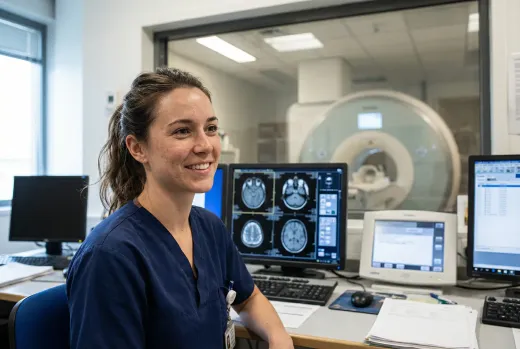
MRI technologist student training at a clinical site
$101K Avg. Salary
22 Affiliated Sites
12-18 mo Program Length
Starting at $11,500 Tuition
Already in imaging?

Already working in an imaging department in Minnesota?

X-ray, CT, and nuclear medicine techs, MRI aides, transporters, schedulers, and nurses who work around a scanner do not need a second degree or an X-ray license to move into MRI. The coursework is online, so you keep your job, and clinical hours can happen at a facility you already know.

Train where you work.

If your department has an MRI scanner and will host you, our site team asks them first. Your employer signs a site agreement and names an ARRT or ARMRIT mentor.

How clinicals at your current facility work

Keep your paycheck.

The online phases fit around a hospital schedule. Clinicals are the squeeze, and we show the schedules other hospital employees have used.

MRI school while working full time

Ask your employer to pay.

Some employers cover part of tuition, and we can invoice them directly. Here is what to ask HR before you pay a deposit.

Employer tuition reimbursement

Program at a glance

  • 12-18 month program
  • No prerequisites: a high school diploma or GED
  • 100% online coursework
  • Our site team handles clinical placement
  • Eligible to sit the ARMRIT exam on completion

Start your MRI career in Minnesota

No application fee. Rolling admissions year-round.

View Program Details Or talk to an advisor
Your options

MRI programs available to Minnesota residents

7 in-person or regional programs plus Tesla MR's hybrid option. 3 of them train you in MRI directly without a prior X-ray credential. Facts come from each school's published pages. Confirm with the school before you apply.

Published cost is what each school states on its own site. Some schools publish tuition only; others include fees, books, or uniforms; public colleges often distinguish in-district from out-of-district rates. Each row says which. For the national list with accreditor and entry requirement for every program, see accredited MRI tech certification programs.

Program Path Credential Length Prior X-ray? Format Published cost
Tesla MR Online coursework, clinicals near you
MRI direct
Certificate (ARMRIT exam eligibility)ARMRIT
12 to 18 months
No
Hybrid: online lectures, in-person clinicals
$11,500 to $13,400 by payment plan
Mayo Clinic School of Health Sciences (Magnetic Resonance Imaging Program, certificate option) Rochester, MN JRCERT accredited (three year award); up to 16 students per class; apply Dec. 15 to Jan. 15; begins late May or early June; minimum 2.85 GPA and 3 hours of MRI job shadowing.
MRI direct
Certificate of completion in MRI (35 credits); applicant must already hold an associate or bachelor's degree plus prerequisitesARRT (MR)
1 year program (11.5 months)
No
In-person; 70% clinical setting, 5% labs, 25% classroom; 900 clinical hours
Tuition $15,400 (35 credits, $440/credit) plus $100 program fee for the 2026-2027 academic year; page lists a Mayo Clinic Scholarship of -$8,900 for estimated direct expenses of $6,600
Rochester Community and Technical College (Magnetic Resonance Imaging AAS, affiliated with Mayo Clinic School of Health Sciences) Rochester, MN Special admittance program; maximum of 10 students admitted each year; minimum cumulative GPA 2.75 with C or higher in prerequisites.
MRI direct
AAS in Magnetic Resonance Imaging (63 credits: 28 general education credits at RCTC plus 35 MRI core credits taught through Mayo Clinic School of Health Sciences)ARRT (MR)
28 credits at RCTC, then a one-year MRI program at Mayo Clinic School of Health Sciences
No
In-person; MRI core and 900 clinical hours delivered through Mayo Clinic School of Health Sciences
Not published
University of Minnesota Rochester (BS in Health Sciences, MRI track with Mayo Clinic School of Health Sciences) Rochester, MN Capstone is the Mayo Clinic MRI program; UMR page refers applicants to the Mayo Clinic program site for application process and costs.
MRI direct
Bachelor of Science in Health Sciences plus a certificate from Mayo Clinic School of Health SciencesARRT (MR)
One-year capstone within the bachelor's degree
No
In-person; 900 clinical hours at Mayo Clinic
Not published
Century College (Radiologic Technology AAS) White Bear Lake, MN JRCERT accredited; fall start only; Fall 2027 application opens September 21, 2026 with a December 1, 2026 deadline; minimum 14 MnTC credits and 2.50 MnTC GPA to apply.
X-ray first
AAS in Radiologic TechnologyARRT (R)
Six consecutive semesters, full-time only
No
A mix of daytime and online courses, some evening and weekend clinical rotations
Not published
Dunwoody College of Technology (Radiologic Technology AAS) Minneapolis, MN JRCERT accredited (8 year award); minimum 2.5 GPA; next application review February 1, 2027 for the Fall 2027 start.
X-ray first
AAS in Radiologic TechnologyARRT (R)
2 years
No
Daytime classes only and on campus only
Not published
Lake Superior College (Radiologic Technology AAS) Duluth, MN Requires a general college application and a program-specific application; proof of current registration as a Certified Nursing Assistant, Certified Medical Assistant, or equivalent is required.
X-ray first
AAS in Radiologic Technology (78 credits)Not stated
Not stated (78 credits)
No
On-Campus
Page lists Lake Superior College at $5,931 based on average 2025-26 tuition and fees (college-wide annual figure, not program-specific)
Minnesota State Community and Technical College (Radiologic Technology AAS) Detroit Lakes, MN JRCERT accredited (eight year award); offered at the Detroit Lakes Campus.
X-ray first
AAS in Radiologic Technology (79 credits)ARRT (R)
Not stated (79 credits)
No
Multiple delivery formats with didactic and clinical education, as stated
Not published

Verified against each program's own website between Sep 18, 2026 and Oct 9, 2026. Tuition, length, and admission rules change; the school's page is the authority. Tesla MR is not a degree-granting institution and does not participate in federal financial aid. See accreditation. The schools named here are not affiliated with Tesla MR and do not endorse it; their names belong to their owners. Spot an error? Email info@teslamr.com and we will review it within 10 business days.

The path

How to become an MRI tech in Minnesota

Five steps, the same in Minnesota as anywhere else. Where you do step four is what changes by city.

  1. Confirm you are eligible

    A high school diploma or GED is the floor. You do not need a prior X-ray, radiography, or healthcare credential for the ARMRIT route. Some of the in-person programs in the table above do require one.

  2. Pick the credential you are aiming for

    Employers in Minnesota hire both ARRT (MR) and ARMRIT technologists. ARRT usually means a two-year degree or a prior radiography license. ARMRIT is the certificate route for career changers.

  3. Choose a program format that fits your life

    Full-time campus programs are faster if you can stop working. Hybrid programs put the coursework online and the clinical hours at a facility near you, which is how most working adults finish.

  4. Complete supervised clinical hours

    Every path ends at a scanner. Clinical training is the part that depends on local capacity, so ask any program how placement works before you enroll. Ours is explained below.

  5. Pass the registry exam and get hired

    Minnesota regulates X-ray operators, and its statute does not mention MRI. Employers require ARRT (MR) or ARMRIT certification. Once certified, you can apply to the hospital systems and imaging groups listed further down this page.

Where you would train and work

MRI employers in Minnesota, and which ones are in our clinical network

Tesla MR has 22 affiliated clinical sites in Minnesota. An affiliated site is a facility in our clinical network where students can be placed. The others are places MRI techs work in Minnesota that we have not affiliated with yet.

Affiliated site Employer, not yet affiliated

Rayus Radiology

Affiliated site
  • Alexandria (Alomere Health) Alexandria, MN
  • Blaine Blaine, MN
  • Burnsville Burnsville, MN
  • Coon Rapids Coon Rapids, MN
  • Duluth (Aspirus St. Luke's) Duluth, MN
  • Eagan Eagan, MN
  • +14 more locations

Central Minnesota Diagnostics Inc

Affiliated site
  • Headquarters Milaca, MN

ICare Diagnostic Imaging

Affiliated site
  • ICare Diagnostic Imaging Brooklyn Center, MN

Abbott Northwestern Hospital

Employer, not yet affiliated
  • Abbott Northwestern Hospital Minneapolis, MN

Allina Health

Employer, not yet affiliated
  • United Hospital Saint Paul, MN

CentraCare

Employer, not yet affiliated
  • St. Cloud Hospital St. Cloud, MN

Essentia Health

Employer, not yet affiliated
  • Ada Ada, MN
  • Deer River Deer River, MN
  • Duluth Clinic 1st Street (Building A) Duluth, MN
  • Fosston Fosston, MN
  • Holy Trinity Hospital Graceville, MN
  • International Falls Clinic International Falls, MN
  • +7 more locations

Generose Building

Employer, not yet affiliated
  • Generose Building Rochester, MN

Plus 9 more imaging groups in the area.

Pulled from Tesla MR's site database on October 9, 2026. Affiliations are added and change over time; the assessment you receive during admissions is the one that applies to you.

Clinical placement

How clinical placement works

Our Clinical Sites team leads placement. You are not expected to find or negotiate your own clinical site. We look for a facility within a reasonable commute of your home and widen the search only if we need to.

Timing depends on facilities having capacity when you reach clinicals. If your area is thin, we tell you during admissions, not after you enroll, and we talk through the options with you.

Established network · Minnesota

We have 22 affiliated sites in Minnesota. Most students here are placed within that network, and the site team adds facilities as students need them.

  1. We look at your area during admissions

    If you already have a facility in mind, maybe where you work, we reach out and see whether you can train there. If not, our site team maps the hospitals and imaging centers near your home and starts the conversation.

  2. You get a straight answer before you enroll

    Clinicals are still months away at this point, so a site's answer is usually "we expect so, check back closer to the date." We tell you what we heard and what it means for your timeline.

  3. You start the coursework while the site work continues

    Most students begin Phase I and Phase II before a specific facility is named. That is normal, and the site team keeps working your area in the background.

  4. Your site is confirmed as clinicals approach

    Once clinicals are weeks away rather than months, facilities can commit to dates. We work to have your placement set before Phase III begins. Which facility and which shift depends on who has capacity at that time.

MRI technologist licensing in Minnesota

Minnesota Statutes section 144.121, subdivision 5, sets examination requirements only for individuals operating x-ray systems (ionizing radiation) on living humans, such as passing the ARRT radiography exam or the state limited scope x-ray operator exam. The statute does not mention magnetic resonance imaging, and no separate state license for MRI technologists appears in it.

Employers set the credential requirement. Most postings ask for ARRT (MR) or ARMRIT, the two national MRI certifications, and both are valid in all 50 states.

💡

Key Takeaway

Minnesota regulates X-ray operators, and its statute does not mention MRI. Employers require ARRT (MR) or ARMRIT certification.

MRI technologist salary in Minnesota

BLS reports a May 2025 median of $100,900 for MRI technologists in Minnesota, with about 710 employed statewide (BLS OEWS, state estimates). The national median is $95,480. For comparison, Minnesota radiologic technologists, which includes X-ray and CT, have a median of $83,400.

Entry-level pay sits below the median. Shift differentials, specialty work such as cardiac or breast MRI, and 3 to 5 years of experience push experienced technologists above it. See the MRI technologist salary guide and salary by state for the full breakdown.

Where MRI techs work in Minnesota

Major healthcare employers in Minnesota include Mayo Clinic, Allina Health, Fairview Health Services (M Health Fairview), Sanford Health, HealthPartners, CentraCare. These systems operate hospitals, outpatient imaging centers, and specialty clinics across the state.

Minnesota is home to the Mayo Clinic in Rochester, one of the most prestigious medical institutions in the world, which attracts top imaging talent globally and drives excellence across the state’s entire healthcare workforce. The Minneapolis-St. Paul metro area is one of the most competitive healthcare labor markets in the Midwest, with Allina Health, Fairview, and HealthPartners competing aggressively for MRI technologists. Minnesota’s strong economy, high quality of life, and excellent schools make it an attractive long-term destination, though the climate is a factor for some candidates.

MRI programs by city in Minnesota

Looking for MRI training in a specific Minnesota city? See our detailed guide:


More resources

ARMRIT Accredited Nationally recognized certification
334+ Clinical Sites Partner network in 38 states
Starting at $11,500 Payment plans available

Frequently Asked Questions

It depends on the path. The X-ray-first route is a 2-year radiography degree followed by an MRI certificate, often about another year. 3 of the Minnesota programs in the table above take students with no imaging credential; their lengths are listed in the Length column. Tesla MR's hybrid certificate takes most students 12 to 18 months.

BLS does not break CT out separately; it reports radiologic technologists and technicians, which includes X-ray and CT, at a Minnesota median of $83,400 versus $100,900 for MRI technologists (May 2025). Nationally the figures are $80,110 and $95,480. MRI is the higher-paid modality in both sets of numbers.

The coursework is real: MRI physics, cross-sectional anatomy, pulse sequences, and safety around a magnet that is always on. Most students who put in steady weekly hours pass. In Minnesota the harder part is often getting a seat, since campus MRI cohorts are small and most admit once a year. Every path ends with a national registry exam, ARRT or ARMRIT.

Yes. Mayo Clinic School of Health Sciences (Magnetic Resonance Imaging Program, certificate option) and Tesla MR's hybrid certificate both accept students with no prior imaging credential. Check the prior X-ray column in the table above before you apply anywhere.

Our Clinical Sites team leads placement. You are not expected to secure your own site. If you know a facility, you can propose it, but we review it, confirm capacity, sign the agreement, and approve it. The affiliated Minnesota health systems are listed on this page.

MRI tech schools in nearby cities and states

Take the next step

Ready to start your MRI career in Minnesota?

Join hundreds of students training at clinical sites across the country. No prerequisites, no application fee, rolling admissions.

MRI Training in Minnesota 12-18 months · No prerequisites
Apply Now