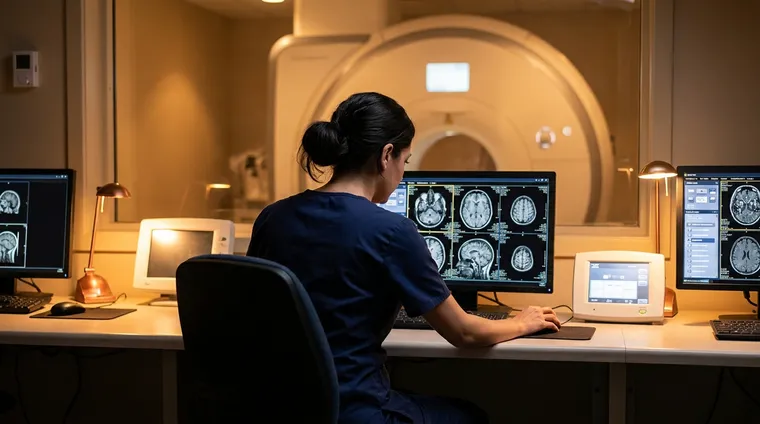
You already have a head start
Any hospital employee — from EVS to dietary to registration to transport — can become an MRI technologist in 12–18 months without prior imaging credentials. You already understand hospital workflows, HIPAA compliance, and patient interaction, which gives you a meaningful advantage over applicants from outside healthcare. MRI technologists earn a median of $95,480/year.
Here is the short version: you can become a certified MRI technologist in 12 to 18 months, you do not need X-ray credentials or a college degree, and the median salary is $95,480 per year (BLS, May 2025). That is likely double or more what most hospital support roles pay.
64% of Tesla MR Institute applicants already work in healthcare. This is the most common starting point for MRI training, not the exception.
Exploring multiple career paths? See all healthcare career change paths at Healthcare Career Change to MRI Tech.
Which hospital roles transition well to MRI
Almost any hospital position gives you transferable skills. Here is what each role brings to the table:
Patient transporters move patients between departments all day. You understand patient handling, wheelchair and stretcher transfers, and how to communicate with patients who are anxious, in pain, or confused. MRI techs do all of this during every scan.
Registration desk staff and unit clerks manage scheduling, insurance verification, and patient flow. MRI departments rely on the same administrative systems. Your familiarity with RIS, EMR, and patient data entry translates directly.
Surgical techs work in sterile, high-stakes environments with complex equipment. The attention to detail, procedural discipline, and ability to anticipate what comes next in a workflow are directly applicable to MRI scanning.
Phlebotomists perform patient assessments, manage needle access, and handle specimens under clinical protocols. In MRI, contrast injection is a core part of many exams, and your venipuncture comfort is an advantage.
CNAs and medical assistants provide direct patient care, take vitals, and manage clinical documentation. Every one of these skills is used in MRI patient preparation and monitoring.
Environmental services workers understand hospital compliance, infection control protocols, and facility operations. While the clinical skills are new, your comfort in the hospital environment and understanding of safety culture transfer.
Key Takeaway
You do not need a specific hospital role to qualify for MRI training. The ARMRIT pathway requires only a high school diploma or GED. What your hospital experience gives you is a practical advantage: you already know how to work in a clinical environment, handle patients, and operate within healthcare systems.
The ARMRIT path: no X-ray credentials needed
The biggest barrier people assume exists is the X-ray requirement. Traditionally, becoming an MRI tech meant getting an associate degree in radiologic technology first, working as an X-ray tech, then adding MRI as a post-primary credential. That is a 3 to 4 year path minimum.
The ARMRIT pathway eliminates that entirely. ARMRIT (American Registry of Magnetic Resonance Imaging Technologists) is a standalone MRI certification that requires:
- High school diploma or GED
- Completion of an ARMRIT-approved training program
- 1,000+ supervised clinical hours performing MRI exams
- Passing the ARMRIT certification exam
No college degree. No prerequisite courses. No prior imaging experience. There are 41,340 MRI technologists in the US, and the field has persistent staffing shortages. Employers accept ARMRIT credentials across the country.
Why hospital workers have a built-in advantage
People entering MRI from outside healthcare face a steep adjustment period during clinical rotations. They have never been in a hospital. They do not know how to interact with patients professionally. They are learning clinical culture and MRI skills simultaneously.
You skip that entire adjustment. On your first day of clinical, you already know:
- How to navigate a hospital building
- How to communicate with patients across age groups and acuity levels
- What HIPAA requires and what violating it looks like
- How shift changes, handoffs, and documentation work
- The rhythm of a hospital day, from morning admissions through evening discharges
This means more of your mental bandwidth goes toward learning MRI-specific skills instead of adapting to the clinical environment. It is a measurable advantage that shows up in faster clinical progression.
The financial case for hospital workers
The salary jump
| Current role (typical) | Annual salary | MRI tech (median) | Difference |
|---|---|---|---|
| Patient transporter | $28,000-$34,000 | $95,480 | +$54,000-$60,000 |
| Unit clerk | $32,000-$38,000 | $95,480 | +$50,000-$56,000 |
| Phlebotomist | $37,000-$42,000 | $95,480 | +$46,000-$51,000 |
| CNA | $33,000-$40,000 | $95,480 | +$48,000-$55,000 |
| Surgical tech | $52,000-$62,000 | $95,480 | +$26,000-$36,000 |
Your employer may help pay for it
About 15% of Tesla MR applicants receive some form of employer tuition assistance. Many hospitals offer reimbursement programs for employees pursuing healthcare credentials. Tesla MR Institute’s tuition starts at $11,500, which falls within most hospital tuition reimbursement caps (typically $5,000 to $10,000 per year).
Steps to explore employer funding:
- Check your HR portal for tuition reimbursement or professional development policies
- Ask your manager about department-specific training budgets
- Contact your hospital’s education or workforce development office
- Inquire about employer-sponsored MRI training partnerships (Tesla MR works with employers on apprenticeship and sponsored training programs)
Even without reimbursement, Tesla MR’s tuition starting at $11,500 is a fraction of what associate degree programs charge. The return on that investment, based on the salary increase alone, is typically realized within the first two months of MRI employment.
Tesla MR Institute program details
| Program detail | What you get |
|---|---|
| Duration | 12-18 months |
| Format | Hybrid: online coursework + in-person clinical |
| Tuition | Starting at $11,500 |
| Clinical sites | 334+ partner sites across 38 states |
| Prerequisites | High school diploma or GED only |
| Schedule | Designed for working adults |
The online coursework covers MRI physics, cross-sectional anatomy, MRI safety, patient care, and imaging protocols. You work through it on your own schedule. The clinical component requires in-person hours at an MRI imaging site, where you learn to operate scanners under the supervision of certified technologists.
Clinical rotations at your own hospital
If your hospital has an MRI department, there is a real possibility of completing clinical rotations where you already work. This simplifies scheduling, eliminates a commute to a separate clinical site, and lets you train in an environment you already know. Tesla MR coordinates clinical placements and can work with your employer to establish your facility as a clinical site if it is not already in the network.
How to make the transition step by step
Step 1: Confirm the path works in your market
Look at MRI tech job postings in your area. Check whether they accept ARMRIT certification. In most markets, they do. This takes 30 minutes of browsing job boards and gives you confidence the credential will get you hired.
Step 2: Explore employer funding
Before spending your own money, check what your hospital offers. Tuition reimbursement, professional development grants, and workforce pipeline programs can reduce or eliminate your out-of-pocket cost.
Step 3: Enroll and start online coursework
Tesla MR enrolls students on a rolling basis. There is no semester schedule to wait for. You can start online coursework within weeks of enrollment and work through it around your current shifts.
Step 4: Begin clinical hours
Once you have progressed through foundational coursework, you start supervised clinical hours at an MRI site. At 20 hours per week, the 1,000+ hour requirement takes approximately 12 months. Some students complete it faster by scheduling more hours. If you can arrange clinical time at your own hospital, the scheduling logistics become significantly easier.
Step 5: Pass the ARMRIT exam and advance
After completing your program and clinical hours, you take the ARMRIT certification exam. With persistent MRI staffing shortages nationwide, newly certified techs are in high demand. Many receive job offers before they finish their program, often from the same hospital where they completed clinical rotations.
Common questions from hospital workers
“I only have a high school diploma. Can I still do this?” Yes. 37% of Tesla MR applicants have only a high school diploma. The ARMRIT pathway does not require a college degree. If you have a HS diploma or GED, you meet the educational prerequisite.
“I do not have any patient care experience.” That is fine for enrollment. If you work in environmental services, food services, or an administrative role, you still qualify. Your hospital familiarity helps even if your current role is not patient-facing.
“Can I keep my current job while training?” Most students do. The online coursework is self-paced. Clinical hours require in-person shifts, which you will need to schedule around your work. Some students switch to part-time during the clinical phase.
“What if my hospital does not have an MRI department?” Tesla MR has 334+ clinical partner sites across 38 states. You will be placed at a site based on your location, regardless of whether your current employer has MRI capability.
Make the Move With Tesla MR Institute
Tesla MR Institute is built for hospital workers who want to advance into MRI without leaving their jobs. Here is what the program includes:
- Tuition: Starting at $11,500 — less than most hospitals spend on a single month of agency MRI staffing
- Duration: 12-18 months from enrollment to certification eligibility
- Prerequisites: High school diploma or GED. No X-ray certification required.
- Clinical training: 329+ clinical sites across 38 states — your hospital may already be a partner site
- Format: Online coursework plus in-person clinical rotations, designed for working adults
You already know your hospital. You already work with patients. In 12-18 months, you could be the MRI tech instead of watching those positions sit unfilled from down the hall.
Similar Career Transitions
Other healthcare workers making the same move to MRI:
- CNA to MRI tech — CNAs bring patient care and hospital workflow experience
- Patient care tech to MRI tech — PCTs have the most seamless transition path into MRI
- EKG tech to MRI tech — EKG techs bring cardiac monitoring skills valuable in MRI
- Dental assistant to MRI tech — dental assistants bring imaging awareness and clinical skills
Related reading
Frequently Asked Questions
Yes. The ARMRIT certification pathway requires only a high school diploma or GED, completion of an approved training program, 1,000+ supervised clinical hours, and passing the ARMRIT exam. No college degree or prior imaging credentials are needed. 37% of Tesla MR applicants have only a high school diploma.
Most hospital workers complete MRI training in 12 to 18 months through a hybrid program. Because you already understand hospital operations and clinical culture, you may progress through the material faster than someone entering healthcare for the first time.
In many cases, yes. If your hospital has an MRI department and is willing to serve as a clinical site, you may be able to complete your supervised clinical hours there. Tesla MR Institute has 334+ clinical partner sites across 38 states, and adding new sites through existing employer relationships is common.
Many hospitals offer tuition reimbursement for employees pursuing healthcare credentials. About 15% of Tesla MR applicants receive some form of employer funding. Check with your HR department about tuition assistance, professional development budgets, or scholarship programs. Tesla MR tuition starts at $11,500, which is well within most employer reimbursement caps.
Any hospital role qualifies you to apply. Tesla MR has trained students who previously worked as patient transporters, registration desk staff, unit clerks, surgical techs, phlebotomists, CNAs, medical assistants, and environmental services workers. The ARMRIT pathway has no prerequisite healthcare experience requirements beyond a high school diploma.
MRI technologists earn a national median of $95,480 per year according to the Bureau of Labor Statistics (May 2025). Most entry-level hospital support roles pay $28,000 to $45,000. That represents a potential salary increase of $43,000 to $60,000 annually.
No. Tesla MR Institute's hybrid program is designed for working adults. Didactic coursework is online and self-paced. Clinical hours require in-person attendance, but most students schedule them around their existing work shifts. Some students reduce to part-time hours during the clinical phase.
ARMRIT stands for the American Registry of Magnetic Resonance Imaging Technologists. It is a standalone MRI certification that does not require prior X-ray or radiologic technology credentials. This is the pathway that allows hospital workers without imaging backgrounds to enter MRI directly.