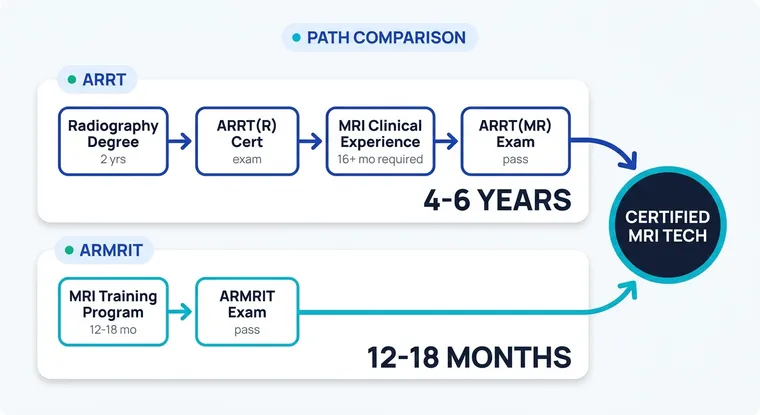
ARRT MRI certification requires an existing radiography credential (typically a 2-year associate degree) before you can add MRI as a post-primary specialty. ARMRIT certification is a standalone MRI credential that requires no prior healthcare degrees or radiology experience — just an approved training program and clinical hours. Both are nationally recognized, and both qualify you to work as an MRI technologist.
If you are trying to figure out which one fits your situation, here is the full breakdown: cost, time, exams, state acceptance, job prospects, and the honest trade-offs of each.
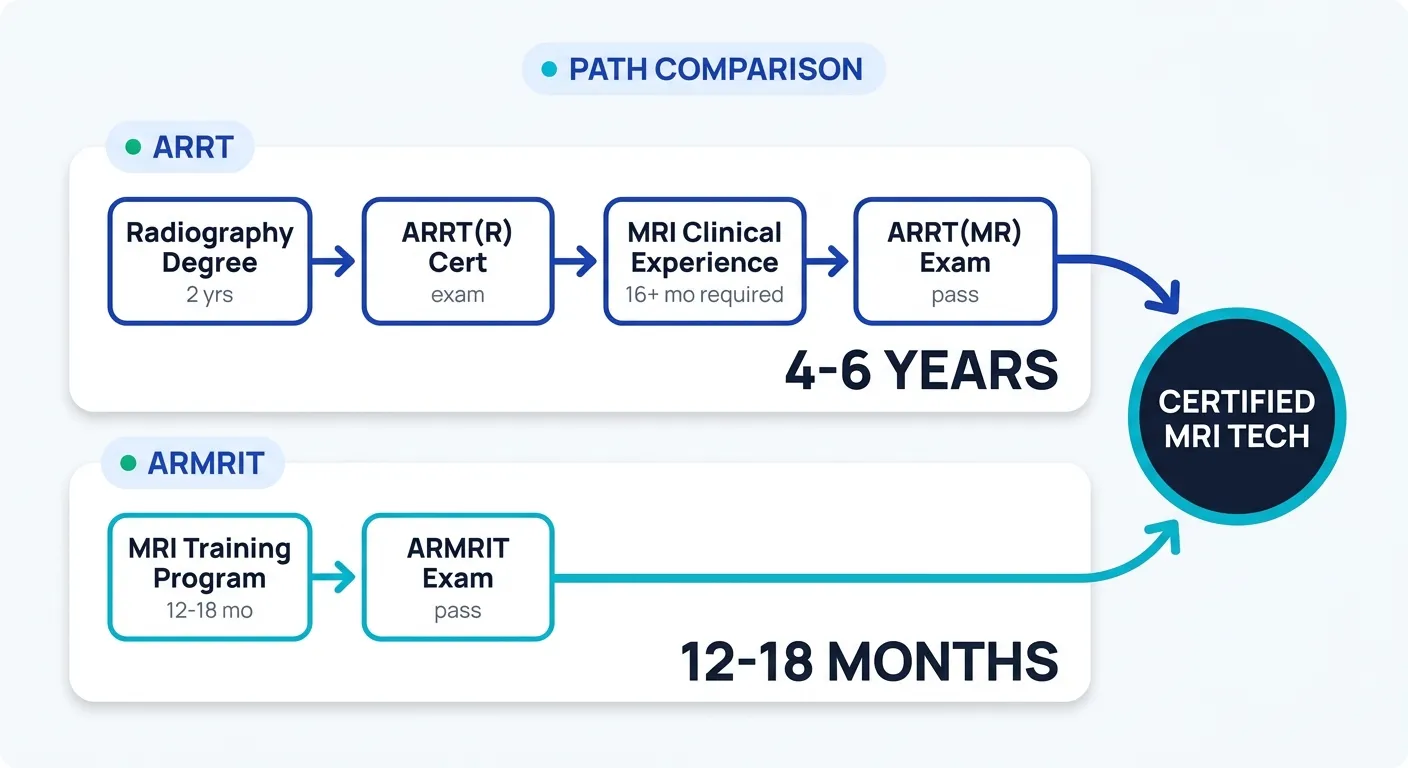
ARRT vs ARMRIT at a Glance
| Category | ARRT RT(MR) | ARMRIT |
|---|---|---|
| Prerequisite | Associate’s degree from JRCERT-accredited radiology program | High school diploma or GED |
| Prior certification needed | Yes (RT(R) or equivalent) | No |
| MRI training | Post-primary pathway after radiology degree | Standalone MRI program (12-18 months) |
| Clinical hours | Varies by pathway | 1,000+ hours in MRI |
| Exam | 200 questions, 3 hours | MRI-focused exam |
| Exam fee | $225 | $250 |
| Total time to credential | 4-6 years | 12-18 months |
| Total cost | $20,000-$55,000+ | $8,500-$15,000 |
| Renewal cycle | Every 2 years, 24 CE credits | Every 2 years, 24 CE credits |
| Multi-modality | Yes (can add CT, mammo, etc.) | MRI only |
| State acceptance | All 50 states | 40+ states |
That table covers the basics, but the numbers alone do not tell the whole story. Let’s dig into what actually matters for your decision.
How Each Certification Path Works
The biggest difference between ARRT and ARMRIT is not the exam or the credential itself. It is what you have to do before you are eligible to sit for that exam.
The ARRT Pathway (4-6 Years)
ARRT MRI certification is a post-primary credential. That means MRI is an add-on to a primary radiologic technology certification. Here is the sequence:
- Complete a JRCERT-accredited radiology program (2-year associate’s degree). These programs are competitive. Wait lists of 1-2 years are common at community colleges, and most accept only 15-25 students per year.
- Pass the ARRT radiography exam to earn your RT(R) credential.
- Complete MRI-specific requirements through structured education, clinical experience, or an ARRT-recognized MRI program.
- Pass the ARRT MRI exam to add RT(MR) to your credentials.
Best case: 4 years. With wait lists and part-time scheduling, 5-6 years is more realistic. During years 1-2, you are studying general radiology (X-ray positioning, radiation physics, radiographic procedures) that does not apply to MRI.
The ARMRIT Pathway (12-18 Months)
ARMRIT treats MRI as a standalone specialty, not an add-on:
- Enroll in an MRI training program that meets ARMRIT’s educational standards. Programs like Tesla MR Institute cover MRI physics, anatomy, safety, and clinical procedures.
- Complete 1,000+ hours of clinical MRI training at an approved clinical site.
- Pass the ARMRIT exam.
Best case: 12 months. Most candidates finish in 15-18 months, including clinical hours.
The difference is not about rigor. Both paths require you to learn MRI physics, safety protocols, patient care, and scanning procedures. The difference is that ARRT bundles two years of general radiology into the prerequisite, while ARMRIT lets you focus exclusively on MRI from day one.
Key Takeaway
ARRT requires a 2-year radiology degree before MRI training begins. ARMRIT goes straight to MRI. The time difference is 3-4 years, and the cost difference is $10,000-40,000. Both exams test the same core MRI knowledge.
ARRT vs ARMRIT: Cost Breakdown
Money matters. Here is what each path actually costs when you add everything up.
ARRT Total Cost
| Expense | Range |
|---|---|
| Associate’s degree tuition (2 years) | $15,000-$40,000 |
| Books, supplies, clinical fees | $2,000-$5,000 |
| ARRT radiography exam | $225 |
| MRI coursework or training | $3,000-$10,000 |
| ARRT MRI exam | $225 |
| Total | $20,000-$55,000+ |
That lower end ($20,000) assumes in-state community college tuition with no prerequisites to make up. The upper end reflects private programs or candidates who need prerequisite science courses.
ARMRIT Total Cost
| Expense | Range |
|---|---|
| MRI training program tuition | $8,000-$14,000 |
| Study materials | $200-$500 |
| ARMRIT exam fee | $250 |
| Total | $8,500-$15,000 |
The ARMRIT pathway costs 60-75% less. For career changers, working adults, or anyone paying out of pocket, that difference is significant. Tesla MR Institute also offers scholarship opportunities to help with tuition.
Tip
If cost is a major factor, check whether your employer will sponsor your training. Many imaging centers and hospitals cover tuition for employees who commit to working at the facility after certification. See our guide on employer-sponsored MRI training for details.
State-by-State Acceptance: Where Each Certification Works
This is the question that should come first in your research: does your state accept the certification you are considering?
States That Accept Both ARRT and ARMRIT
Over 40 states accept both certifications for MRI practice. This includes every major job market:
- California — accepts ARMRIT-certified techs for MRI positions
- Texas — no state MRI licensure requirement; facilities set their own credentialing standards
- Florida — recognizes ARMRIT certification
- New York — MRI is not a separately licensed modality; facility credentialing applies
- Illinois, Ohio, Pennsylvania, Michigan, Georgia — accept ARMRIT
States With Restrictive Requirements
A smaller number of states have licensing structures that default to ARRT. These typically bundle MRI under a general “licensed radiologic technologist” designation rather than treating MRI as its own modality. New Jersey and Oregon are among the more restrictive states.
Even in restrictive states, the landscape is shifting. Legislative efforts in several states are working to recognize MRI-specific credentials as the technologist shortage makes alternative pathways more practical.
Before you enroll in any program: Check your state’s Department of Health or radiologic technology licensing board website. Confirm which credentials are accepted for MRI practice in the state where you plan to work. Requirements change, and what was true two years ago may not be true today.
The Exam: ARRT MRI vs ARMRIT
Both exams are real tests that require serious preparation. Here is how they compare.
ARRT MRI Exam
- 200 questions, 3-hour time limit
- Covers MRI procedures, patient care, safety/screening, image production, and MRI physics
- Requires ARRT primary certification (RT(R)) as a prerequisite
- Pass rate for first-time takers: approximately 75%
- Computer-based testing at Pearson VUE centers
ARMRIT Exam
- MRI-focused exam covering physics, safety, anatomy, procedures, image quality, and contrast
- Does not require prior ARRT certification
- Pass rate for first-time takers: approximately 70-80%
- Tests practical MRI knowledge rather than general radiology
Both exams cover the same core material: MRI physics, patient safety and screening, scanning procedures, image quality, and anatomy. The ARRT exam assumes foundational radiologic technology knowledge. The ARMRIT exam focuses entirely on MRI-specific content.
Neither exam is a rubber stamp. Plan to study. If you are going the ARMRIT route, our free ARMRIT practice test and study guide has sample questions and a study plan.
ARRT vs ARMRIT: Job Prospects and Salary
Here is where honesty matters. There are real differences in how employers view each credential, and you should understand them before choosing.
Where ARRT Has an Advantage
- Multi-modality positions. If a job posting says “MRI/CT Tech” or “Multi-Modality Technologist,” they want someone who can float between scanners. That requires ARRT credentials in multiple modalities. ARMRIT is MRI-only.
- Restrictive states. In states that require a general radiology license, ARRT is the default path.
- Legacy hospital systems. Some large hospital HR departments have not updated their credentialing policies and still list “ARRT required” even when state law accepts ARMRIT. This is changing, but it has not changed everywhere.
Where ARMRIT Holds Its Own
- Dedicated MRI positions. If the role is purely MRI (and most MRI jobs are), ARMRIT certification qualifies you.
- Outpatient and freestanding imaging centers. These facilities hire for MRI specifically and are generally more open to ARMRIT credentials.
- The 40+ states that accept it. In these states, ARMRIT and ARRT carry equivalent legal weight for MRI practice.
- Growing acceptance. The MRI technologist shortage is real. The Bureau of Labor Statistics reports 41,340 MRI technologist positions nationally, and many go unfilled for months. Facilities are broadening their requirements.
Salary Comparison
Here is the good news: the credential on your badge does not determine your paycheck. The BLS reports a national median salary of $95,480 per year for MRI technologists (May 2025 data), and that figure does not differentiate by credential type.
What does affect salary:
- Location. California ($120,560 median), Alaska ($114,360), and Washington ($119,770) pay the most. See our highest paying MRI tech jobs guide for the full state breakdown.
- Experience. Entry-level techs start around $60,000-70,000. Experienced techs with 5+ years earn $90,000-110,000+.
- Facility type. Hospitals and specialty imaging centers generally pay more than small outpatient clinics.
- Shift differentials. Evenings, nights, and weekends pay 10-20% more at most facilities.
Want to become MRI-certified in 12-18 months? Tesla MR Institute’s ARMRIT pathway gets you there at a fraction of the traditional cost. Explore the program.
Which Certification Should You Choose?
Your decision comes down to three factors: where you are starting from, where you want to work, and how quickly you need to get there.
Choose ARRT if:
- You already hold an RT(R) or are currently enrolled in a radiology program (you are partway there)
- You want to work as a multi-modality tech (MRI + CT + X-ray)
- Your target state specifically requires ARRT credentials for MRI
- You are 18-20 years old with time to invest in a full associate’s degree before specializing
- You want the broadest possible job flexibility across all imaging modalities
Choose ARMRIT if:
- You are a career changer and do not want to spend 4-6 years in school
- You want to work specifically in MRI (not multi-modality)
- Your state accepts ARMRIT (over 40 states do)
- You are a working adult who needs a program you can complete while keeping your current job
- Cost matters and you want to keep total investment under $15,000
- You are an MRI tech aide or MRI assistant ready to move up
- You want to be working as a certified MRI tech within 12-18 months, not 4-6 years
The Honest Trade-Off
ARRT gives you broader credential portability and multi-modality options. ARMRIT gets you into MRI faster and cheaper, but limits you to MRI-only roles and is not accepted in every state.
For someone whose goal is specifically to become an MRI technologist and work in MRI, ARMRIT is the more direct route. For someone who wants to keep all imaging modality doors open and has the time and budget for a longer education, ARRT is the safer bet.
Neither choice is wrong. The wrong choice is the one that does not match your actual circumstances.
Is ARMRIT Legitimate? Addressing Common Concerns
If you have been researching ARMRIT online, you have probably seen skepticism on forums and Reddit. Let’s address the common concerns directly, because they deserve honest answers.
“ARMRIT is not as well-known as ARRT.” True. ARRT has been around since 1922 and credentials over 340,000 technologists across all imaging modalities. ARMRIT is smaller and MRI-specific. Less recognition does not mean less legitimate, but it does mean you may need to explain your credential to some employers.
“Some employers only list ARRT on job postings.” Also true. Some HR departments have not updated their templates. In practice, many of those facilities will accept ARMRIT-certified applicants, especially when they have open positions they cannot fill. If a posting says “ARRT required” and you hold ARMRIT, it is worth calling the department directly.
“ARMRIT schools are accredited by ARMRIT, not a regional accreditor.” This is a fair point. Programs that prepare students for ARMRIT certification are typically accredited through their own professional standards rather than regional accreditation bodies. This means credits may not transfer to a traditional college. If you think you might want to pursue a radiology degree later, factor this into your decision.
“You cannot convert ARMRIT to ARRT.” Correct. ARRT has its own educational prerequisites (JRCERT-accredited program, associate’s degree). Holding ARMRIT does not waive those. If you later decide you want ARRT credentials, you would need to go back and complete those requirements separately.
These are real limitations, not dealbreakers. Thousands of ARMRIT-certified technologists work full-time in MRI across the country. The American College of Radiology has endorsed ARMRIT. But you should go in with open eyes about what the credential does and does not give you.
Tip
Research your specific job market before choosing. Search job postings on Indeed and LinkedIn in the city where you want to work. Count how many say “ARRT required” vs. “ARRT or ARMRIT” vs. “MRI certification required.” That will tell you more than any general advice.
For Employers: ARRT vs ARMRIT in Your Hiring Policy
If you are a radiology director or hiring manager, the ARRT vs ARMRIT question has direct operational implications.
The MRI staffing shortage has left thousands of positions unfilled nationwide. Facilities that accept only ARRT credentials are voluntarily limiting their candidate pool to technologists who completed a 4-6 year education pipeline that is not producing enough graduates to meet demand.
Adding “ARRT or ARMRIT” to your job postings costs nothing and immediately expands the pool of qualified candidates. Both credentials require demonstrated knowledge of MRI physics, safety, anatomy, and procedures. The difference is in prerequisite education (general radiology vs. MRI-focused), not in MRI clinical competency.
Employer Cost Comparison
| ARRT Pathway | ARMRIT Pathway | |
|---|---|---|
| Training investment | $20,000-$55,000+ | $8,500-$15,000 |
| Time to certified tech | 4-6 years | 12-18 months |
| Can train at your facility | Varies | Yes, as a clinical training site |
If you are considering sponsoring employees through MRI training, the ARMRIT pathway through a program like Tesla MR Institute produces a certified technologist in 12-18 months for under $15,000. Trainees can complete their clinical hours at your facility, contributing to operations during training. Learn more in our employer MRI training guide.
How Tesla MR Institute’s ARMRIT Program Works
Tesla MR Institute offers an MRI training program built around the ARMRIT certification pathway:
- Duration: 12-18 months of MRI-focused curriculum
- Coursework: MRI physics, cross-sectional anatomy, safety protocols, patient care, and scanning procedures
- Clinical training: 1,000+ hours at 334+ partner clinical sites across 38 states
- Active students: Approximately 290 students currently enrolled
- Exam prep: Integrated ARMRIT exam preparation, including our free practice test and study guide
- Flexibility: Designed for working adults who need to keep their current job during training
The program is not a shortcut. It is a focused path to the same destination: a certified MRI technologist operating MRI scanners safely and competently.
The Bottom Line on ARRT vs ARMRIT
Both certifications produce qualified MRI technologists. Both require real study and clinical training. Both earn comparable salaries.
The choice comes down to your starting point and your goals. ARRT makes sense if you want multi-modality flexibility or your state requires it. ARMRIT makes sense if MRI is your target, you want to get there faster, and you work in one of the 40+ states that accept it.
Do the research for your specific situation: check your state’s requirements, search job postings in your target market, and do the math on total cost and timeline. The right certification is the one that gets you where you want to go.
Ready to start your MRI career? Explore Tesla MR Institute’s certification program or check out our complete ARMRIT certification guide for a deeper look at the ARMRIT credential.
Related reading
Frequently Asked Questions
ARRT requires you to complete a JRCERT-accredited radiologic technology program (typically a 2-year associate's degree) before adding MRI certification. ARMRIT lets you train specifically for MRI without prior radiology credentials. ARRT takes 4-6 years total, ARMRIT takes 12-18 months.
ARMRIT is accepted for MRI practice in over 40 states, including California, Texas, Florida, New York, and Illinois. A few states have licensing structures that specifically require ARRT credentials. Check your state's radiologic technology licensing board for current rules before enrolling in any program.
Neither exam is easy. Both test MRI physics, safety, anatomy, and clinical procedures. Pass rates for first-time test takers hover around 70-80% for both. The ARMRIT exam focuses exclusively on MRI, while the ARRT MRI exam assumes knowledge from a broader radiologic technology education. Different, not easier.
Not directly. ARRT requires graduation from a JRCERT-accredited program and an associate's degree. You would need to complete those educational requirements separately. However, many ARMRIT-certified techs work successfully for their entire career without ever pursuing ARRT credentials.
Yes. Most large hospital systems accept ARMRIT certification for dedicated MRI positions, and acceptance has grown as the MRI staffing shortage forces facilities to broaden their requirements. Outpatient imaging centers, orthopedic practices, and freestanding MRI facilities tend to be the most receptive. The exceptions are some academic medical centers and a handful of states with licensing structures that specifically require ARRT credentials. Always check the specific job posting — large systems like HCA, Sentara, Inova, and most regional hospitals routinely hire ARMRIT-certified techs.
Both ARRT and ARMRIT-certified MRI technologists earn similar salaries for equivalent roles. The BLS reports a national median of $95,480 per year for MRI technologists regardless of credential type. Salary depends more on location, experience, and facility type than on which registry issued your certification.
The ARRT pathway costs $20,000-55,000 including a 2-year associate's degree, books, and exam fees. The ARMRIT pathway costs $8,500-15,000 total including tuition and exam fees. The ARMRIT pathway is 60-75% cheaper because it skips the prerequisite radiology degree.
Yes. ARMRIT has been credentialing MRI technologists since the early 1990s and is endorsed by the American College of Radiology. ARMRIT-certified techs work in hospitals, imaging centers, and clinics across the country. The organization maintains professional standards, requires continuing education, and provides credential verification.
Both require 24 continuing education credits every two years in MRI-related topics. The renewal process and requirements are nearly identical between the two organizations.
Tesla MR Institute's program prepares students for ARMRIT certification. The program takes 12-18 months, includes 1,000+ clinical hours at 334+ sites across 38 states, and costs significantly less than the traditional ARRT pathway.