If you manage a healthcare facility with MRI capabilities, you already know the staffing problem. MRI technologist positions sit open for months. Recruiters charge steep fees. The techs you do hire sometimes leave within a year for a better offer down the street. MRI tech training for employers offers a different path: instead of competing for a shrinking pool of experienced techs, you train the people you already have.
This guide walks through everything HR departments, workforce development teams, and practice managers need to know about sponsoring MRI technologist training for your staff. We will cover candidate selection, program structure, costs, accreditation, and how to make the transition work without disrupting your operations.
Why Employers Are Investing in MRI Tech Training
The numbers paint a clear picture. There are more than 5,000 open MRI technologist positions across the United States right now. The Bureau of Labor Statistics projects 8% job growth for MRI techs through 2032. Median salary sits above $85,000. That combination of high demand, growing need, and competitive pay means recruiting is expensive and unreliable.
Here is what many facility managers are discovering: training your own MRI techs costs less than hiring them.
See the Numbers for Yourself
Train vs. Recruit ROI Calculator
Compare the true cost of external recruiting vs. training your own MRI techs.
A typical external recruiting cycle for an experienced MRI technologist includes agency fees (often 15-25% of first-year salary), sign-on bonuses ($5,000-$15,000 is common), possible relocation expenses, and weeks or months of lost revenue from an unstaffed scanner. Add it up and you are looking at $30,000 to $50,000 per hire. And there is no guarantee that tech stays past the first year.
Employer-sponsored MRI training, by contrast, costs less than $15,000 per student through programs like Tesla MR Institute. You get a trained technologist who already knows your facility, your team, and your workflows. And because you invested in their career, they are far more likely to stick around.
Some facilities are going further. They are building training pipelines, enrolling one or two employees per year so they always have new techs coming through the program. It turns the reactive MRI staffing shortage into a predictable workforce plan.
Key Takeaway
Training your own MRI techs costs less than $15,000 compared to $30,000-$50,000 for external recruiting. Plus, internally trained techs have significantly higher retention rates because you invested in their career growth.
Who Makes a Good Candidate from Your Existing Staff
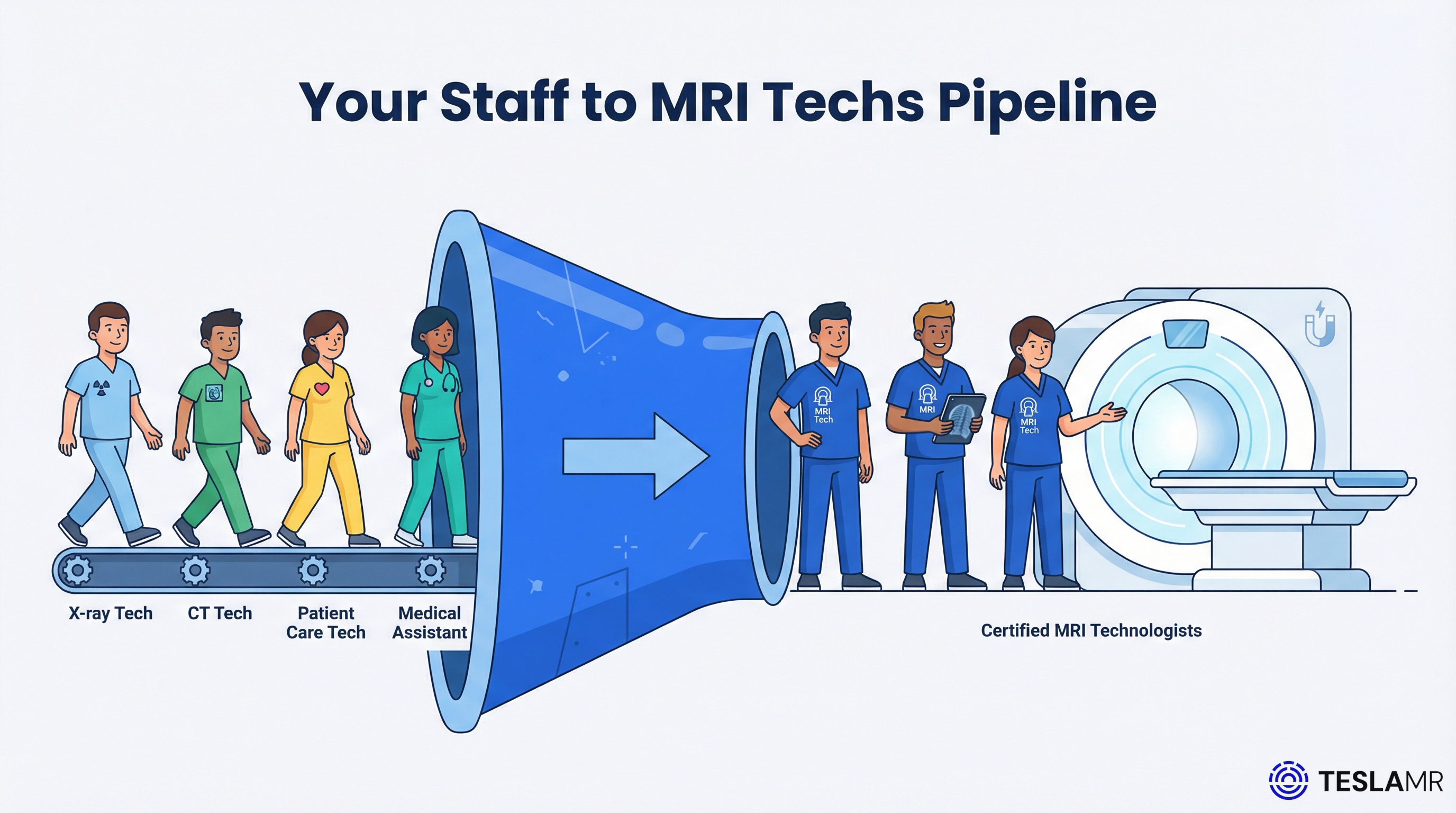
Not every employee is a fit for MRI training, but you might be surprised by who qualifies. The traditional path to MRI required an X-ray certification first, which limited the candidate pool significantly. Programs like Tesla MR Institute have dropped that prerequisite, which means you can consider a much wider range of your current staff.

Good candidates often come from these roles:
Medical assistants and patient care techs. They already understand clinical environments, patient interaction, and basic medical terminology. The transition to MRI is a natural step up.
Front desk and scheduling staff. This might sound surprising, but employees who have spent years in your facility understand your operations deeply. If they have the aptitude and motivation, the clinical knowledge can be taught.
CT and X-ray techs. The most obvious candidates. They already hold imaging certifications and understand the technical side of diagnostic imaging. Adding MRI to their skill set makes them more valuable and more versatile.
Lab techs and phlebotomists. Another group with clinical experience and comfort working with patients. They know sterile technique, patient safety protocols, and how to stay calm under pressure.
The key qualities to look for are not just clinical background. You want people who are detail-oriented, comfortable with technology, good at communicating with anxious patients, and willing to commit to 12-18 months of study alongside their current job. Motivation matters more than background.
One honest note: not everyone will finish. MRI training is demanding. Have a candid conversation with candidates about the time commitment before enrolling them. It is better to select two highly motivated employees than five who are lukewarm about it.
Employer Tip
Look beyond traditional clinical roles when selecting candidates. Medical assistants, front desk staff, and lab techs often make excellent MRI trainees because they already understand your facility and have the motivation to advance their careers.
Program Structure: How Online Learning and Clinical Hours Work Together
One of the biggest concerns employers have about MRI tech training is disruption. You need your staff on the floor, not sitting in a classroom across town. That is where modern program design makes a real difference.
Tesla MR Institute, for example, runs a three-phase program that keeps the first seven months almost entirely online.
Phase 1 (2 months, online, 5+ hours per week). This is foundational coursework. MRI physics, anatomy, safety protocols, patient care principles. Your employee handles this on their own time, evenings or weekends, whatever works with their schedule. No travel, no classroom, no disruption to their shifts.
Phase 2 (5 months, online + simulator, 10+ hours per week). The workload increases. Students continue online coursework and begin working with MRI simulators. The time commitment roughly doubles but remains flexible. Most of this can still happen outside work hours, though some employees may need a slightly reduced schedule during this phase.
Phase 3 (11 months, in-person clinicals, 20+ hours per week). This is where real hands-on training happens. Students complete 1,000 clinical hours working with actual patients on actual MRI scanners. And here is the part employers love: if your facility qualifies as a clinical site, your employee does their clinical training right in your building, on your equipment, with your patients.
That last point deserves emphasis. Your trainee is not disappearing to some distant hospital for a year. They are learning on your scanner, building skills they will use in exactly the same environment after certification. It is the closest thing to on-the-job training that a formal MRI program can offer.
MRI Tech Training for Employers: Time Commitment and Scheduling
Let’s be specific about what this looks like week by week, because “12-18 months” can mean a lot of different things.
During Phases 1 and 2 (the first seven months), your employee needs 5-10 hours per week for coursework. Most students handle this entirely outside their normal shifts. Early mornings, evenings, weekends. If your employee currently works full-time, they can likely continue doing so without any schedule changes during this period.
Phase 3 is where you will need to plan more carefully. Twenty or more hours per week of clinical time is significant. Here are a few approaches facilities use:
Shift restructuring. Move the employee to a reduced schedule (say, three days per week in their current role) and dedicate two days to clinical training. This works well when you have enough coverage to absorb the change.
Clinical hours as work hours. If the employee is completing clinicals at your facility, some employers count those hours as paid work time. The employee is physically present and contributing to patient throughput, even as a trainee. They are working under supervision, but they are still doing real, productive work.
Weekend and evening clinical blocks. Some facilities run MRI scanners on extended hours. Scheduling clinical time during off-peak shifts can minimize the impact on your regular staffing.
Gradual ramp-up. The 20-hour weekly minimum does not have to start at full intensity on day one of Phase 3. Work with the program to build a schedule that starts lighter and increases as the employee gains competence.
The honest reality: Phase 3 will require some operational adjustment. But it is 11 months, not forever. And at the end, you have a fully trained MRI tech who costs you a fraction of what external recruiting would have.
Ready to explore how employer-sponsored MRI training could work for your facility? Connect with Tesla MR Institute to discuss your staffing needs and timeline.
Cost and ROI: The Real Numbers Behind Corporate MRI Training
Let’s talk money, because that is ultimately what gets budget approval.
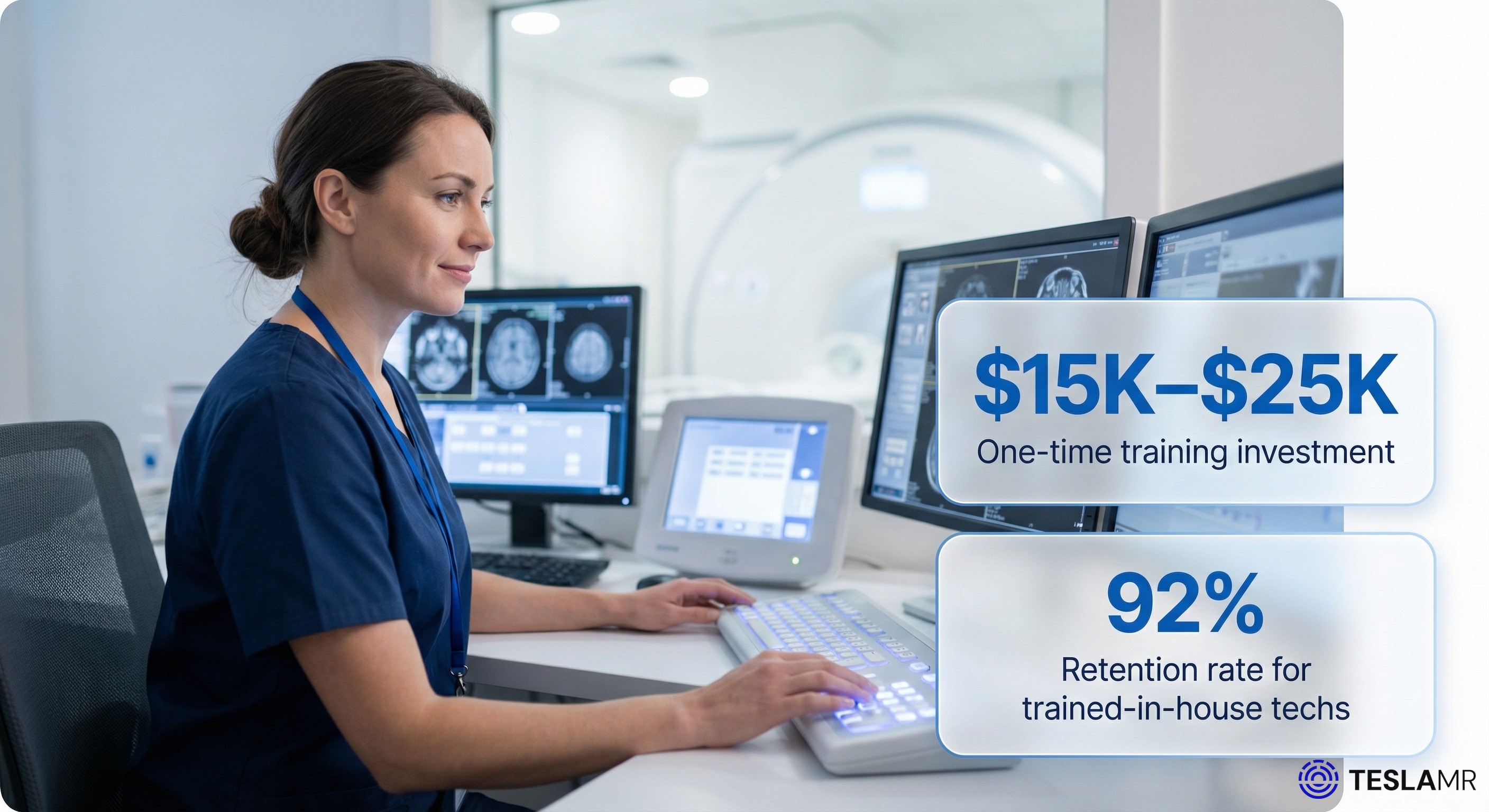
Direct program costs. Tesla MR Institute charges less than $15,000 for the full program. That covers all three phases, online coursework, simulator access, and clinical coordination. Some employers pay the full tuition upfront. Others set up tuition reimbursement agreements where the employee pays and gets reimbursed upon completion or certification.
Recruiting cost comparison. Hiring an experienced MRI technologist externally typically costs:
- Recruiting agency fee: $12,750-$21,250 (15-25% of an $85,000 salary)
- Sign-on bonus: $5,000-$15,000
- Relocation assistance: $3,000-$10,000
- Lost revenue during vacancy: varies widely, but a single unstaffed MRI scanner can mean $5,000-$15,000 per week in lost imaging revenue
Total external hire cost: $25,750-$61,250. And that assumes you find someone within a reasonable timeframe.
Retention math. This is where the ROI really shows up. External hires in healthcare have notoriously high turnover. Many MRI techs who take sign-on bonuses leave as soon as the commitment period ends. Internal promotions and trained-from-within employees stay longer. Industry data consistently shows that employees who receive employer-sponsored training and career advancement have significantly higher retention rates than external hires.
If you train an employee for $15,000 and they stay five years, your cost per year of employment is $3,000. If you recruit externally for $40,000 and that tech leaves after 18 months, your cost per year is $26,667. The difference is dramatic.
Tax benefits. Employer education expenses may qualify for tax deductions under Section 127 of the Internal Revenue Code, which allows employers to provide up to $5,250 per year in tax-free educational assistance to employees. Consult your tax advisor for specifics, but this can further reduce the effective cost.
Key Takeaway
The ROI math is clear: train an employee for $15,000 and they stay 5 years = $3,000/year. Recruit externally for $40,000 and they leave after 18 months = $26,667/year. Internal training delivers better retention and costs far less.
What ARMRIT Accreditation Means and Why It Matters
If you are evaluating MRI technologist training programs for hospitals, accreditation should be near the top of your checklist. Not all MRI training programs are created equal, and the credential your employee earns matters for compliance, insurance, and patient safety.
ARMRIT stands for the American Registry of Magnetic Resonance Imaging Technologists. It is the recognized credentialing body specifically for MRI technologists. When a program is ARMRIT accredited, it means the curriculum, clinical requirements, and assessment standards meet national benchmarks.
Why should employers care? A few reasons:
Insurance and liability. Many malpractice insurers and facility policies require MRI operators to hold recognized credentials. An ARMRIT certification satisfies that requirement.
Regulatory compliance. While MRI technologist licensing varies by state, having ARMRIT-credentialed techs simplifies compliance regardless of your state’s specific rules. It is a recognized standard that regulators understand.
Quality assurance. ARMRIT-accredited programs require 1,000 clinical hours. That is not a small number. It means your employee has extensive hands-on experience before they are working independently. Compare that to some shorter certificate programs that may leave graduates technically certified but practically underprepared.
Hiring credibility. If you ever need to demonstrate to patients, partners, or accrediting bodies that your MRI staff meet professional standards, ARMRIT certification is straightforward proof.
Tesla MR Institute is ARMRIT accredited. When evaluating any MRI training program, ask directly about accreditation status. If a program cannot clearly state its accreditation, that is a red flag.
Employer Tip
Always verify ARMRIT accreditation when evaluating MRI training programs. It’s not just about education quality—it affects insurance compliance, regulatory requirements, and your facility’s credibility with patients and partners.
What Your Facility Needs to Be a Clinical Training Site
One of the strongest selling points of employer-sponsored MRI training is the ability to host clinical hours on site. Your employee trains on your equipment, with your patients, under the supervision of your existing staff. But your facility does need to meet certain requirements.
A functioning MRI scanner. This seems obvious, but the scanner needs to be in regular clinical use. A decommissioned or rarely-used unit would not provide adequate training volume.
A qualified clinical preceptor. You need at least one experienced, credentialed MRI technologist on staff who is willing to supervise the trainee. This person does not need special teaching credentials, but they do need to be patient, thorough, and willing to dedicate time to instruction. The preceptor continues doing their regular work while supervising the trainee, so the added burden is manageable, but it is real. Choose someone who actually wants to mentor.
Adequate patient volume. The trainee needs to complete 1,000 clinical hours with real patients. If your facility runs a low volume of MRI exams, it may be difficult to accumulate enough varied experience. High-volume sites are ideal. A facility running 15 or more exams per day provides plenty of learning opportunities.
Administrative cooperation. Someone at your facility needs to handle paperwork: clinical hour logs, competency checklists, communication with the training program. This is not a huge time commitment, but it needs to happen consistently.
Safety compliance. Your MRI suite must meet standard safety requirements. Proper screening protocols, ferromagnetic detection, emergency procedures, zone designations. Any accredited MRI facility should already have these in place.
Tesla MR Institute has 260+ partner clinical sites across the country. If your facility is not currently set up as a clinical site, the process to become an MRI clinical training site is straightforward. The program works with you to verify requirements and get the paperwork completed. Most facilities are approved within a few weeks.
Managing the Transition from Trainee to Certified Tech
The 18-month training period is not a light switch. Your employee does not walk in one day as a medical assistant and walk out the next as an MRI tech. The transition is gradual, and managing it well makes a big difference.
During Phase 1 and 2 (months 1-7). Your employee’s day-to-day role does not change much. They are studying on their own time. You might notice them reading MRI physics textbooks on lunch breaks. The main thing you need to do during this period is be supportive. Check in occasionally. Ask how the coursework is going. Make sure they know the investment is valued.
During Phase 3 (months 8-18). This is where the real operational planning matters. Your employee is now spending 20+ hours per week doing clinical training. If they are training at your facility, you will see them in the MRI suite regularly, working alongside your existing tech. A few things to manage:
Backfill planning. If you are pulling the employee from their current role for 20 hours a week, you need coverage. Hire a part-time temp, redistribute duties, or plan for reduced capacity in their original role. Do not try to have them do both jobs at full capacity. That is a recipe for burnout and failure.
Preceptor support. Your supervising MRI tech is taking on extra responsibility. Acknowledge that. Whether it is a small stipend, schedule flexibility, or simply recognition, make sure the preceptor feels supported too.
Progressive responsibility. As the trainee gains competence, they can take on more independent work (still supervised). By the end of Phase 3, they should be functioning close to the level of a new graduate tech. This is actually a staffing benefit. You are gradually gaining scanner capacity as the trainee becomes more proficient.
Post-certification. Once your employee passes their ARMRIT certification exam, they are ready to work as an MRI technologist. But “ready” does not mean “expert.” Plan for a ramp-up period. Pair them with your experienced tech for the first few weeks of independent work. Build their confidence with straightforward exams before throwing them into complex cases.
Retention agreements. Many employers who sponsor training include a retention clause: the employee agrees to stay for a set period (typically 2-3 years) after certification, or repay a portion of the tuition. This is standard practice in healthcare education sponsorship and protects your investment. Be reasonable with the terms. A two-year commitment is fair. A five-year commitment might discourage good candidates from enrolling.
Building a Long-Term MRI Workforce Pipeline
Once you have successfully trained one MRI tech through an employer-sponsored program, consider making it a recurring part of your workforce strategy. The facilities getting the most value from MRI tech training for employers are not treating it as a one-time fix. They are building pipelines.
Here is what that looks like in practice:
Annual enrollment cycles. Enroll one or two employees per year. Stagger start dates so you always have someone at a different phase of training. When one employee finishes, another is midway through, and a third is just starting.
Career ladder visibility. When your staff can see a clear path from medical assistant to MRI technologist, you attract better candidates for entry-level roles and reduce turnover across the board. People stay at organizations where they can grow.
Preceptor development. Your first internally-trained MRI tech becomes the preceptor for the next trainee. This creates a self-sustaining cycle and gives your techs a sense of professional purpose beyond their daily scanning duties.
Cross-training opportunities. An MRI tech who started as a CT tech can cover both modalities during staffing crunches. These multi-skilled employees are incredibly valuable and almost impossible to recruit externally. See our radiology tech to MRI tech crossover guide for what the transition looks like from the tech’s perspective, or explore our MRI apprenticeship and cross-training guide for the full employer playbook on building a structured training pipeline.
The facilities that struggle with MRI staffing five years from now will be the ones still relying entirely on external recruiting. The ones that invest in training pipelines today will have stable, skilled, loyal teams.
Frequently Asked Questions
How much does employer-sponsored MRI tech training cost?
Programs like Tesla MR Institute cost less than $15,000 per student. Compare that to $30,000-$50,000 in recruiting costs for a single experienced MRI tech, and the math favors training your own people.
How long does it take for an employee to become a certified MRI technologist?
Most programs run 12 to 18 months. At Tesla MR, students move through three phases: two months of online coursework, five months of online learning plus simulator work, and eleven months of in-person clinical training.
Do employees need an X-ray certification before starting MRI training?
Not necessarily. Tesla MR Institute does not require X-ray certification as a prerequisite, which opens the door for a wider range of your existing staff to enroll.
Can employees keep working while completing MRI training?
Yes. The program is designed for working adults. The first two phases are online and require 5 to 10 hours per week. Clinical hours in Phase 3 require about 20 hours per week, which may need schedule adjustments but does not require employees to quit their jobs.
What is ARMRIT accreditation and why should employers care?
ARMRIT (American Registry of Magnetic Resonance Imaging Technologists) is the recognized credentialing body for MRI technologists. Training through an ARMRIT-accredited program means your staff meet national standards, which matters for compliance, insurance, and patient safety.
Can our facility serve as the clinical training site?
Yes, and that is one of the biggest advantages. If your facility has a functioning MRI scanner and a qualified MRI technologist willing to serve as a clinical preceptor, your employee can complete their 1,000 clinical hours on site. Tesla MR has 329+ clinical sites nationwide, and your facility can become one of them.
What is the ROI of training an MRI tech internally versus hiring externally?
Training internally typically costs less than $15,000 per employee. External recruiting can run $30,000 to $50,000 when you factor in agency fees, sign-on bonuses, relocation, and lost productivity. Internal trainees also stay longer, with retention rates significantly higher than external hires.
How many MRI tech positions are currently unfilled?
There are more than 5,000 open MRI technologist positions nationwide, and the Bureau of Labor Statistics projects 8% job growth through 2032. The shortage is real and growing, which is exactly why more employers are turning to training programs rather than waiting for the right candidate to appear.
Partner with Tesla MR Institute
Ready to build your own MRI technologist pipeline? Tesla MR Institute works directly with healthcare facilities to solve staffing challenges through strategic training partnerships.
Why Choose Tesla MR for Corporate Training:
- ARMRIT-accredited program with national credibility
- Under $15,000 total cost per trained technologist
- 329+ clinical sites across 38+ states
- Designed for working adults with flexible scheduling
- Your facility can be the clinical site for hands-on training
The conversation starts with understanding your specific needs: How many techs do you need? What’s your timeline? Which current employees might be good candidates? From there, we build a training plan that works with your operations, not against them.
Schedule a consultation to discuss employer-sponsored MRI training for your facility →
Related reading
Frequently Asked Questions
Programs like Tesla MR Institute cost less than $15,000 per student. Compare that to $30,000-$50,000 in recruiting costs for a single experienced MRI tech, and the math favors training your own people.
Most programs run 12 to 18 months. At Tesla MR, students move through three phases: two months of online coursework, five months of online learning plus simulator work, and eleven months of in-person clinical training.
Not necessarily. Tesla MR Institute does not require X-ray certification as a prerequisite, which opens the door for a wider range of your existing staff to enroll.
Yes. The program is designed for working adults. The first two phases are online and require 5 to 10 hours per week. Clinical hours in Phase 3 require about 20 hours per week, which may need schedule adjustments but does not require employees to quit their jobs.
ARMRIT (American Registry of Magnetic Resonance Imaging Technologists) is the recognized credentialing body for MRI technologists. Hiring or training through an ARMRIT-accredited program means your staff meet national standards, which matters for compliance, insurance, and patient safety.
Yes, and that is one of the biggest advantages. If your facility has a functioning MRI scanner and a qualified MRI technologist willing to serve as a clinical preceptor, your employee can complete their 1,000 clinical hours on site. Tesla MR has 329+ clinical sites nationwide, and your facility can become one of them.
Training internally typically costs less than $15,000 per employee. External recruiting for an experienced MRI tech can run $30,000 to $50,000 when you factor in agency fees, sign-on bonuses, relocation, and lost productivity during the vacancy. Internal trainees also stay longer, with retention rates significantly higher than external hires.
The ASRT's 2025 survey found a 17.4% MRI technologist vacancy rate, translating to roughly 7,200 unfilled positions nationwide. The Bureau of Labor Statistics projects 6% job growth through 2032. The shortage is real and getting worse, which is why more employers are turning to training programs.