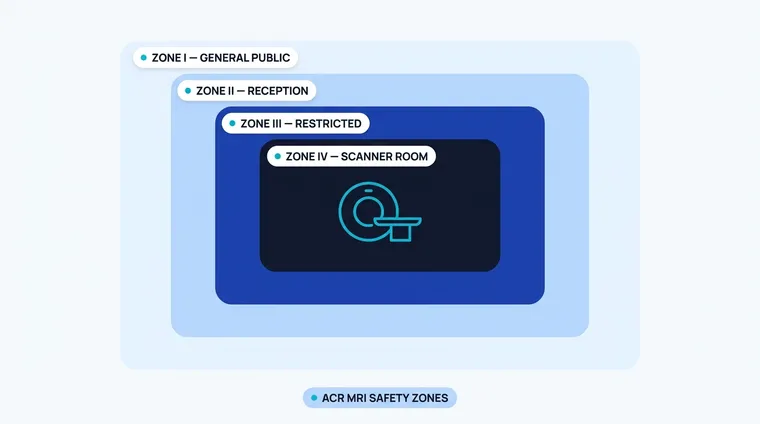
MRI safety training is required for every person who enters the restricted zones of an MRI suite, from the technologist operating the scanner to the custodian mopping the floor at 2 AM. MRI scanners produce magnetic fields 30,000 to 60,000 times stronger than the Earth’s magnetic field, and the FDA still receives roughly 300 MRI-related adverse event reports every year. Most of those incidents trace back to one thing: gaps in staff training and screening procedures.
This guide covers the American College of Radiology (ACR) safety framework, the difference between Level 1 and Level 2 MRI safety training, how to earn MRI safety certification through the ABMRS, and how to build a training program that keeps your facility compliant and your people safe.
Why MRI Safety Training Matters
MRI-related incidents are not abstract risks. They happen regularly, and the consequences range from minor injuries to fatalities.
Between 2000 and 2024, the FDA documented multiple deaths related to MRI safety failures, including projectile incidents where ferromagnetic objects were brought into the scanner room. Burns from monitoring equipment, hearing damage from acoustic noise, and implant-related injuries appear consistently in adverse event databases.
A single MRI safety incident can cost a facility:
- Patient injury lawsuits ranging from $500,000 to several million dollars
- Equipment damage of $50,000 to $500,000+ if a projectile strikes the scanner
- Operational downtime while the scanner is repaired or replaced (average 2-6 weeks)
- Accreditation sanctions including loss of ACR or Joint Commission certification
- Increased malpractice insurance premiums for the facility and individual providers
Beyond liability, there is the basic obligation to protect patients and staff. Every person in your facility who could potentially enter the MRI environment needs to understand why a seemingly harmless wheelchair or oxygen tank becomes a deadly projectile near a 1.5T or 3T magnet.
Key Takeaway
If someone enters Zone III for any reason, they need documented MRI safety training. No exceptions for “I’ll only be in there for a minute.” A ferromagnetic oxygen tank does not care how long you planned to stay.
ACR MRI Safety Framework Overview
The American College of Radiology publishes the ACR Guidance Document on MR Safe Practices, the primary reference for MRI safety in the United States. First published in 2002 and updated periodically (most recently in 2020), this document establishes the standards that accreditation bodies and regulators reference.
The ACR framework rests on five core principles:
- Physical access control through a four-zone model
- Personnel classification into Level 1 and Level 2 categories
- Designated MRI Safety Officer oversight
- Screening protocols for every individual entering restricted zones
- Emergency preparedness including quench procedures
Both ACR MRI accreditation and Joint Commission hospital surveys evaluate compliance with these principles. If your facility holds or is pursuing either accreditation, your safety training program must align with these requirements.
The 4 MRI Safety Zones Explained
The ACR four-zone model is the foundation of physical MRI safety. Each zone represents a different level of magnetic field exposure and requires a corresponding level of access control.
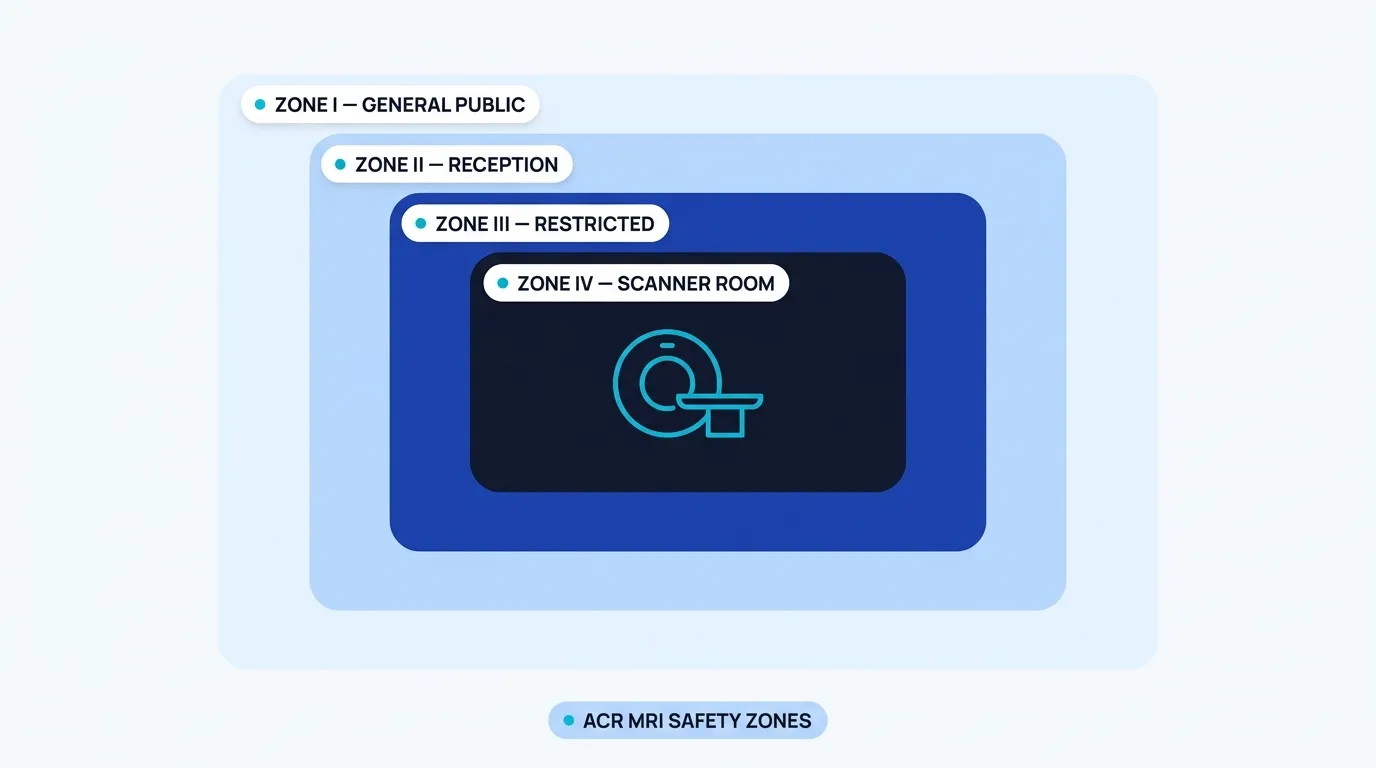
| Zone | Area | Magnetic Field | Who Can Enter | Access Control |
|---|---|---|---|---|
| Zone I | General public areas (lobby, parking, public corridors) | None (ambient) | Anyone | No restrictions |
| Zone II | MRI reception, waiting room, patient changing area | None to weak fringe field | Patients, visitors under staff supervision | Staff oversight; initial screening begins here |
| Zone III | MRI control room, equipment room, corridors adjacent to scanner | Significant fringe field (5 gauss line typically here) | Screened individuals + Level 1 or Level 2 personnel only | Locked door, badge access, or equivalent physical barrier; signage required |
| Zone IV | The MRI scanner room itself | Full static field (1.5T, 3T, 7T) | Screened patients + Level 2 personnel only | Direct access only via Zone III; ferromagnetic detection at entry |
The 5-gauss boundary (where field strength drops to 5 gauss / 0.5 mT) typically defines the physical edge of Zone III, since that’s the FDA-defined threshold below which pacemakers and implanted cardiac devices are generally considered safe.
Zone I: General Public Access
Zone I is any area freely accessible to the general public: hospital lobbies, parking areas, and general corridors. No MRI-specific safety measures are required in Zone I.
Zone II: Supervised Public Access
Zone II is the transition area between the public environment and the MRI-controlled areas. This is typically the MRI reception desk, waiting room, and patient changing areas. Patients and visitors move through Zone II under staff supervision.
Initial patient screening begins in Zone II. This is where patients complete MRI safety questionnaires and are asked about implants, metallic foreign bodies, and other contraindications.
Zone III: Restricted Access
Zone III is where the magnetic field from the MRI scanner may pose a risk to individuals with certain implants or ferromagnetic objects. Access to Zone III is strictly controlled and limited to screened individuals accompanied by Level 2 MRI Personnel, or to individuals who themselves hold Level 1 or Level 2 status.
Zone III typically includes the MRI control room, equipment room, and corridors immediately adjacent to the scanner room. The physical boundary of Zone III should be clearly marked with restricted access signage, and access should be controlled by locked doors, badge access, or equivalent barriers.
Key Zone III requirements:
- All individuals screened before entry
- Ferromagnetic detection systems recommended at the entrance
- Access physically restricted (locked door, badge access)
- Clear signage indicating restricted nature
- No unauthorized personnel without screening, even in emergencies
Zone IV: The MRI Scanner Room
Zone IV is the magnet room itself. This is the area of greatest risk, where the static magnetic field, gradient fields, and radiofrequency fields are all present during scanning. Only screened, trained individuals should enter Zone IV. Patients enter only after completing the full screening process and being escorted by Level 2 MRI Personnel.
Zone IV risks include projectile incidents, thermal burns from conductive loops, acoustic noise exceeding 100 dB, implant interactions, and quench hazards (rapid release of cryogenic gases).
Level 1 MRI Safety Training: What It Covers and Who Needs It
Level 1 MRI safety training is designed for personnel who need access to Zone III but do not operate the MRI scanner or work independently in restricted areas. This is the baseline training level for anyone whose job occasionally brings them near the MRI environment.
Who Needs Level 1 Training
- Nurses who assist with MRI procedures (sedation, contrast administration)
- Anesthesiologists and anesthesia staff providing sedation during MRI scans
- Transport staff who bring patients to and from the MRI suite
- Cleaning and environmental services staff
- Facilities maintenance workers
- Security personnel who may respond to calls in the MRI area
- Research assistants in facilities with research MRI scanners
What Level 1 Training Covers
A Level 1 MRI safety training program typically runs 2 to 4 hours and includes:
- Magnetic field basics: What the magnetic field is, why it is always on (even when the scanner appears “off”), and what happens when ferromagnetic objects enter the field
- Zone model overview: Understanding all four zones and which ones they have access to
- Personal screening: How to check themselves for ferromagnetic items before entering Zone III (jewelry, hair pins, pens, badges, tools, pocket contents)
- Projectile hazard recognition: Identifying common ferromagnetic items that become dangerous near the scanner
- Patient safety awareness: Understanding that patients with certain implants or devices cannot enter Zone III or IV
- Emergency procedures: What to do during a fire alarm, cardiac arrest, or quench event in the MRI area
- Supervision requirements: Understanding that Level 1 Personnel cannot enter Zone III without general Level 2 supervision
Tip
Level 1 training can often be delivered online for the didactic portion, but should include a walkthrough of the specific MRI suite where the person will work. Generic online training alone does not satisfy the site-specific component.
Level 1 Key Limitation
Level 1 Personnel cannot work independently in Zone III. They must be under the general supervision of Level 2 Personnel. “General supervision” means a Level 2 person is available and aware of the Level 1 person’s presence, not necessarily standing next to them.
Level 2 MRI Safety Training: Advanced Requirements
Level 2 MRI safety training is the advanced tier for personnel who operate MRI equipment, screen patients, or work independently in Zone III and Zone IV. This is the standard expected of every working MRI technologist.
Who Needs Level 2 Training
- MRI technologists (whether ARRT(MR) or ARMRIT certified)
- MRI physicists
- Radiologists who work in or supervise MRI operations
- MRI Safety Officers (MRSO)
- Research staff who independently operate MRI scanners
- Any personnel who authorize or supervise others’ access to Zone III or IV
What Level 2 Training Covers
Level 2 training is more extensive, typically 8 to 16 hours initially, and covers:
- MRI physics relevant to safety: Static magnetic fields, gradient fields, radiofrequency fields, and how each creates specific hazards (projectile risk, peripheral nerve stimulation, tissue heating)
- Advanced screening protocols: How to conduct thorough patient screening, verify implant compatibility using databases like MRISafety.com, and make go/no-go decisions for patients with devices
- Implant and device safety: Understanding MR Safe, MR Conditional, and MR Unsafe classifications. Knowing where to look up conditions of use for MR Conditional devices
- Contrast agent safety: Recognizing adverse reactions to gadolinium-based contrast agents, understanding nephrogenic systemic fibrosis risk, and knowing contraindications
- Thermal injury prevention: Proper positioning to avoid conductive loops, monitoring lead placement, and bore temperature management
- Acoustic protection: Providing appropriate hearing protection, understanding SAR limits, and managing noise exposure for patients and staff
- Emergency procedures in detail: Quench protocols (including when to initiate a controlled quench vs. emergency quench), cardiac arrest response inside the MRI room, fire response, and projectile incident management
- Ferromagnetic detection: Operating handheld wands and walk-through detection systems
- Regulatory and documentation requirements: ACR standards, Joint Commission expectations, state regulations, and record-keeping
Level 2 Training Must Be Hands-On
Unlike Level 1, Level 2 training cannot be delivered entirely online. The hands-on components are not optional:
- Practicing patient screening procedures with real questionnaires
- Demonstrating emergency equipment use (quench button, emergency stop, fire extinguisher locations)
- Walking through the specific scanner’s safety features and emergency protocols
- Practicing proper patient positioning to prevent burns
- Operating ferromagnetic detection equipment
Programs like Tesla MR Institute’s MRI technologist training build Level 2 safety training into the curriculum so students arrive at clinical sites already trained. This saves clinical sites significant onboarding time, which matters when you are dealing with the ongoing MRI staffing shortage.
MRI Safety Certification: ABMRS Credentials
Beyond Level 1 and Level 2 personnel classification, formal MRI safety certification validates advanced expertise and is increasingly expected by accreditation surveyors. The American Board of Magnetic Resonance Safety (ABMRS) offers three recognized credentials.
MRSO: MRI Safety Officer Certification
The MRSO certification is designed for the person responsible for managing a facility’s MRI safety program. Most facilities with ACR accreditation are expected to have a designated MRI Safety Officer, and the ABMRS credential demonstrates that person actually knows what they are doing.
MRSO requirements:
- Level 2 MRI Personnel status
- Knowledge of ACR guidelines, Joint Commission standards, and FDA reporting
- Pass the ABMRS MRSO examination
- Exam cost: approximately $400-$500
- Renewal: every 5 years with continuing education credits
The MRSO exam covers MRI physics as it relates to safety, zone management, screening procedures, incident investigation, emergency protocols, and regulatory compliance. Most candidates prepare using courses from MTMI, Applied Radiology, or self-study with the ACR guidance document.
MRSE: MRI Safety Expert Certification
The MRSE is aimed at MRI physicists and engineers who provide expert-level safety oversight. This credential goes deeper into the physics, particularly gradient field effects, RF heating calculations, and implant testing methodologies. Most facilities do not need an MRSE on staff, but larger hospital systems and research institutions benefit from having one available.
MRMD: MRI Safety for Radiologists
The MRMD credential is for radiologists who oversee MRI departments. It validates that the interpreting physician understands safety risks, screening responsibilities, and their role in the safety chain.
Is MRI Safety Certification Worth It?
For the designated MRSO at any facility: yes, absolutely. The certification costs $400-$500, preparatory courses run $200-$800, and many employers cover these expenses. The return on investment is straightforward:
- Accreditation surveyors respond more favorably to credentialed MRSOs
- Credentialed MRSOs earn 5-10% more than non-credentialed peers in similar roles
- A properly trained MRSO reduces incident risk, which reduces liability exposure
- If your facility has ever had a near-miss, you already know this is worth the investment
Who Needs What Training: Quick Reference
| Role | Required Level | Zone Access | Training Hours | Online OK? |
|---|---|---|---|---|
| MRI Technologist | Level 2 | III and IV | 8-16 initial | Partial (hands-on required) |
| Radiologist (MRI) | Level 2 | III and IV | 8-16 initial | Partial |
| MRI Safety Officer | Level 2 + MRSO | III and IV | 16+ initial | Partial |
| MRI Physicist | Level 2 | III and IV | 8-16 initial | Partial |
| Nurse (MRI procedures) | Level 1 or 2 | III (supervised) | 2-4 or 8-16 | Yes for Level 1 |
| Anesthesiologist | Level 1 | III (supervised) | 2-4 | Yes (plus site walkthrough) |
| Transport Staff | Level 1 | III (supervised) | 2-4 | Yes (plus site walkthrough) |
| Cleaning Staff | Level 1 | III (supervised) | 2-4 | Yes (plus site walkthrough) |
| Maintenance | Level 1 | III (supervised) | 2-4 | Yes (plus site walkthrough) |
| Security | Level 1 | III (supervised) | 2-4 | Yes (plus site walkthrough) |
| Front Desk | Awareness only | II only | 0.5-1 | Yes |
MRI Safety Officer Responsibilities in Practice
Every MRI facility should designate at least one MRI Safety Officer. The ACR requires this role for accredited facilities, and it is not something you can assign in name only.
Day-to-Day MRSO Duties
- Policy development and maintenance: Creating and updating the facility’s MRI safety manual, reviewing it at least annually
- Training coordination: Ensuring all personnel complete appropriate safety training before Zone III access and that renewal records are current
- Incident review: Investigating safety events and near misses, documenting findings, and implementing corrective actions
- Screening protocol enforcement: Periodically auditing patient and personnel screening for consistency and thoroughness
- Ferromagnetic detection management: Overseeing the operation, calibration, and maintenance of detection systems
- Equipment review: Evaluating any new equipment proposed for use in Zone III or IV for MR safety compatibility
- Accreditation preparation: Maintaining documentation and serving as the primary contact for safety-related survey questions
- Emergency drills: Coordinating at least annual quench drills, cardiac arrest response simulations, and fire drills specific to the MRI suite
Employer Tip
Many facilities designate an MRSO on paper but do not give that person dedicated time for the role. If your MRSO is a full-time MRI technologist expected to handle safety oversight “in their spare time,” you have a compliance gap. Budget at minimum 4-8 hours per week for MRSO duties at a single-scanner site.
Ferromagnetic Screening: Your Last Line of Defense
Ferromagnetic screening is the single most effective intervention for preventing projectile incidents. The ACR recommends screening at the Zone III entrance, with additional screening at the Zone IV entrance. If you implement only one improvement from this guide, make it a better screening protocol.
Patient Screening Process
- Written questionnaire covering implants, devices, surgical history, metallic foreign bodies, and occupational exposure to metal. The questionnaire should be completed by the patient or guardian before the patient reaches Zone III, ideally in Zone II (the waiting area).
- Verbal review of the questionnaire by Level 2 Personnel with follow-up questions. Do not skip this step. Patients frequently misunderstand written questions, forget about old surgical hardware, or do not realize that certain items (dental implants, tattoos with metallic ink) are relevant.
- Implant verification using manufacturer documentation and MRI safety databases like MRISafety.com. For MR Conditional devices, verify the specific conditions of use (field strength limits, SAR limits, gradient slew rate limits) and confirm your scanner meets those conditions.
- Ferromagnetic detection scan using a handheld wand or walk-through detector at the Zone III or Zone IV entrance.
- Change of clothing into MRI-safe garments when indicated. Hospital gowns eliminate the risk of metallic fasteners, underwires, and forgotten pocket contents.
The Items That Keep Getting Through
Despite screening, certain items appear in incident reports with frustrating regularity:
- Oxygen tanks and cylinders: The most dangerous projectile risk. A standard steel oxygen tank accelerates toward the scanner bore with enough force to kill.
- IV poles: Not all are MR Safe. Aluminum poles exist, but steel ones are still common in many hospitals.
- Wheelchairs and stretchers: Standard hospital wheelchairs are ferromagnetic. MR Safe versions are specifically labeled and usually a different color.
- Cleaning equipment: Mop handles, vacuum cleaners, floor polishers, and cleaning supply carts often contain ferromagnetic components.
- Personal items: Bobby pins, hair clips, safety pins, belt buckles, steel-toed shoes, pocket knives, and coins.
- Medical instruments: Hemostats, scissors, stethoscopes, and laryngoscope handles that staff carry habitually.
Personnel Screening
Staff entering Zone III need daily self-screening: no pens, badges with clips, tools, scissors, hair pins, or any other ferromagnetic objects. Many facilities post a visual checklist at the Zone III entrance as a reminder. Special attention goes to emergency responders who may carry ferromagnetic equipment like stethoscopes, radios, or weapons. If a code is called in the MRI suite, the first instinct of responding personnel is to rush in. Training must override that instinct with the protocol: screen first, then enter.
Detection Systems
Studies in the Journal of Magnetic Resonance Imaging show that ferromagnetic detection systems catch items missed by questionnaire-based screening alone. Two options:
- Handheld wands: Less expensive ($2,000-$5,000), require a trained operator, good for low-volume sites
- Walk-through portals: More expensive ($15,000-$30,000), automated, higher throughput, better for busy multi-scanner sites
These systems supplement the screening questionnaire. They do not replace it. A walk-through portal will catch the forgotten pen in a lab coat pocket, but it will not tell you whether a patient’s cardiac pacemaker is MR Conditional.
Training Frequency and Renewal
Initial Training
All personnel must complete MRI safety training before being granted access to Zone III or Zone IV. No grace period, no “shadow for a week and pick it up.” Complete the training, pass the assessment, then get access.
Annual Refresher
The ACR recommends annual safety training refreshers. Most accreditation programs and state regulations require them. Annual refresher content should cover:
- Policy updates from the past year
- Review of any incidents or near misses (anonymized as needed)
- Updated screening protocols or new equipment
- Emergency procedure walk-through
- Any new ACR guidance or regulatory changes
Triggered Retraining
Additional training after:
- Any safety incident or near miss at the facility
- Installation of a new MRI scanner
- Significant policy changes
- Introduction of new procedures (new contrast agent protocol, new implant screening workflow)
Documentation Requirements
Every training session must be documented with: date and time, content covered, instructor name and qualifications, attendee names and signatures, and assessment results. Keep records for at least six years. Accreditation surveyors will ask for them.
Common Compliance Gaps That Get Facilities in Trouble
After reviewing safety programs across many facilities, certain gaps appear over and over:
1. Forgetting Non-Clinical Staff
Facilities train their MRI techs and radiologists but forget about cleaning staff, security, maintenance workers, and transport personnel. If they enter Zone III, they need training.
2. No Ferromagnetic Detection
Relying solely on questionnaires and visual checks. Ferromagnetic detection adds a layer that catches what human memory misses, and is increasingly expected for accreditation.
3. Outdated Screening Forms
MRI screening questionnaires should be reviewed and updated at least annually. New implant types and devices enter the market regularly. A screening form from 2019 is not catching devices approved in 2024.
4. Paper-Only MRSO
Naming an MRSO without giving them time or authority to do the work. Surveyors ask the MRSO specific questions about their activities, and “I handle it when I can” will not pass.
5. No Emergency Drills
Written emergency procedures that have never been practiced. The first time your team runs a quench drill should not be during an actual quench.
6. Contractor and Vendor Blind Spots
Third-party service engineers, construction workers, and equipment vendors who enter Zone III must be screened and supervised. This is frequently overlooked during scanner maintenance or facility renovation.
7. No Near-Miss Tracking
If your facility only tracks actual incidents, you are missing the leading indicators. Near misses are the data that prevents the next real event.
Tip
Start a simple near-miss log. Even a shared spreadsheet where staff can anonymously report “I caught a wheelchair headed toward Zone III” or “Patient’s screening form missed a hip implant” will surface patterns before they become incidents.
How to Build an MRI Safety Training Program
Step 1: Assess Your Current State
Identify every role that accesses Zone III or IV. Review existing training records. Audit screening procedures. Evaluate whether your MRSO designation is functional, not just on paper.
Step 2: Define Training Tiers
- Level 2: 8-16 hours initial. MRI physics, all four zones, screening procedures, emergency protocols, contrast safety, equipment-specific procedures
- Level 1: 2-4 hours. Zone awareness, hazard recognition, personal ferromagnetic screening, emergency evacuation
- Zone II Awareness: 30-60 minutes. Basic concepts, role in initial patient screening
Step 3: Source or Develop Content
Options include in-house development by your MRSO and MRI physicist, vendor-provided training from your scanner manufacturer, third-party courses from the ABMRS or ASRT, or a blended approach. Whatever you choose, customize to your facility’s specific equipment, layout, and procedures. Generic training alone is insufficient.
Step 4: Add Competency Assessment
Training without assessment is incomplete:
- Written or online quizzes for didactic content
- Practical demonstrations (screening procedure, emergency equipment location)
- Observation during initial supervised period
- Annual competency checks at renewal
Step 5: Track Everything
Use a learning management system or structured spreadsheet: who was trained, what level, when completed, when renewal is due, and assessment scores. Make it easy for your MRSO to pull a compliance report before an accreditation survey. At minimum, your tracking system should answer these questions instantly:
- Who is overdue for annual refresher training?
- Which new hires have not yet completed initial training?
- Who holds Level 1 vs Level 2 status?
- When was the last emergency drill conducted?
- What incidents or near misses occurred since the last training cycle?
Some facilities use their existing LMS (Healthstream, Relias, etc.) for online components and supplement with a simple spreadsheet for hands-on competency sign-offs. Whatever system you use, it needs to survive staff turnover. If your MRSO leaves and the new one cannot find the training records, you have a problem.
How Tesla MR Prepares Students for MRI Safety
One of the persistent challenges for clinical sites is receiving students or new hires who lack adequate MRI safety training. Time spent teaching safety basics is time your existing staff is not scanning patients.
Tesla MR Institute addresses this directly. Every student in the MRI technologist training program completes a full safety curriculum before they begin clinical rotations:
- ACR four-zone model and access control principles
- Level 2 Personnel training covering MRI physics, hazards, and emergency procedures
- Patient and personnel screening procedures and practice
- Ferromagnetic awareness and detection principles
- Contrast agent safety including adverse reaction recognition
- Emergency protocols including quench and cardiac arrest response
- Implant screening using current databases and manufacturer documentation
When a Tesla MR student arrives at your clinical training site, they have already completed the didactic safety training that many facilities spend weeks delivering to new hires. Your site’s orientation focuses on equipment-specific procedures and local protocols, not starting from zero.
For facilities dealing with the MRI staffing shortage, partnering with a training program that handles safety education upfront reduces the onboarding burden. We currently work with over 1,800 clinical sites across all 50 states, including major networks like RadNet (127 sites), HCA Healthcare (78 sites), and Rayus (36 sites).
Frequently Asked Questions
Answers to the most common MRI safety training questions are included in the FAQ schema above. For additional questions about MRI safety requirements at your facility, contact Tesla MR or consult the ACR Guidance Document on MR Safe Practices.
Real-World MRI Safety Incidents: Lessons Learned
Understanding why safety protocols exist is easier when you see what happens without them. These cases, drawn from FDA MAUDE reports and published literature, illustrate common failure modes:
The Floor Buffer Incident (2021): A maintenance worker brought a commercial floor buffer into the MRI scanner room at a mid-Atlantic hospital after hours. The buffer contained a large electric motor with ferromagnetic components. It was pulled from the worker’s hands and struck the scanner bore at high speed. No patients were present, but the scanner sustained over $200,000 in damage and was offline for three weeks. The worker had never received MRI safety training. The facility’s MRSO had requested training for maintenance staff months earlier but was told it was “not a priority.”
The Oxygen Tank Projectile (multiple incidents): Oxygen cylinders are the single most documented projectile in MRI incident reports. In one widely cited case, a 6-year-old patient was fatally injured when a ferromagnetic oxygen tank was brought into the scanner room. The tank was attracted to the magnet and struck the child. This tragedy led to significant updates to ACR guidelines and is the reason screening protocols emphasize oxygen equipment specifically.
The Unscreened Visitor: A family member accompanied a patient into the Zone IV scanner room while wearing a steel-reinforced back brace. The brace was pulled toward the magnet, injuring the visitor. The escort had not been screened because staff assumed family members “just sit in the corner.”
Every one of these incidents was preventable with the training protocols described in this guide.
Additional Resources
- ARMRIT Certification Guide — certification pathway for MRI technologists
- ARRT vs ARMRIT Comparison — which credential is right for your team
- MRI Apprenticeship and Employer Training — build your MRI workforce in-house
- MRI Technologist Career Path — from aide to certified technologist
- Highest Paying MRI Tech Jobs — salary data by setting, state, and certification
Frequently Asked Questions
MRI safety training teaches personnel how to work safely in and around MRI environments. It covers the risks of strong magnetic fields, proper screening procedures, the four ACR safety zones, and emergency protocols. Training is classified into Level 1 (basic awareness for supervised access) and Level 2 (full training for independent access) under the ACR framework.
Level 1 MRI Personnel have completed basic MRI safety education and can work in Zone III only under the supervision of Level 2 Personnel. Level 2 MRI Personnel have extensive training in MRI physics, safety protocols, and emergency procedures, and can work independently in Zone III and Zone IV. MRI technologists, physicists, and radiologists who interpret MRI studies should be Level 2.
Anyone who enters Zone III or Zone IV of the MRI suite needs MRI safety training. This includes MRI technologists, radiologists, nurses who assist with MRI procedures, anesthesiologists, cleaning staff, maintenance workers, and security personnel. The specific level of training depends on their role and frequency of access.
The MRI Safety Officer (MRSO) oversees the facility's MRI safety program. Responsibilities include maintaining safety policies, conducting incident reviews, ensuring screening protocols are followed, managing ferromagnetic detection, coordinating safety training for all personnel, and serving as the point of contact for safety questions. The MRSO should hold Level 2 MRI Personnel status and ideally carry ABMRS MRSO certification.
The ACR recommends annual MRI safety training for all personnel who access Zone III and Zone IV. Many accreditation bodies and state regulations require annual refresher courses. New employees should complete safety training before they are granted unescorted access to restricted MRI zones.
Zone I is the general public area outside the MRI suite. Zone II is the interface between public space and the MRI environment (reception/waiting area). Zone III is the restricted area near the scanner room where the magnetic field is significant and access is controlled. Zone IV is the MRI scanner room itself, where the magnetic field is strongest.
The American Board of Magnetic Resonance Safety (ABMRS) offers three credentials: MRSO (MRI Safety Officer) for safety program managers, MRSE (MRI Safety Expert) for physicists and engineers, and MRMD for radiologists overseeing MRI operations. These certifications validate expertise in MRI safety and are increasingly expected by accreditation surveyors.
Non-compliance can result in accreditation loss from the ACR or The Joint Commission, increased liability exposure, higher insurance premiums, potential fines from state regulators, and patient or staff injuries. The FDA receives approximately 300 MRI-related adverse event reports per year, many traced to training gaps.
Level 1 MRI safety training can often be delivered online. Level 2 training typically requires hands-on components including equipment-specific emergency procedures and practical screening exercises. Most facilities use a blended approach: online didactic content followed by in-person practical training at the specific MRI site.
ABMRS certification exams cost between $350 and $500 depending on the credential. Preparatory courses from providers like MTMI or Applied Radiology range from $200 to $800. Many employers cover these costs as part of professional development. The investment pays for itself through reduced incident risk and smoother accreditation surveys.
No. The ACR recommends annual MRI safety training for all Level 1 and Level 2 personnel who access Zone III or Zone IV, and most accreditation bodies (ACR, The Joint Commission) require documented annual refreshers. Initial training before unescorted access is mandatory; annual recertification keeps personnel current on protocol changes, new implant guidance, and updated emergency procedures. ABMRS certifications (MRSO, MRSE, MRMD) require continuing education credits every cycle as well.