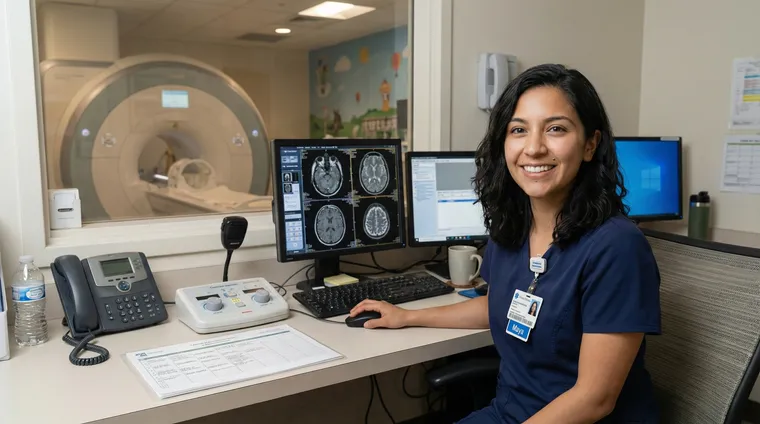
The highest paying MRI tech jobs pay well above the national median of $95,480. MRI technologists working in outpatient care centers earn an average of $121,740 per year according to Bureau of Labor Statistics data, and travel MRI positions can push total compensation past $150,000 annually. If you want to maximize your earning potential as an MRI technologist, the combination of where you work, what you specialize in, and which credentials you hold makes all the difference.
This guide breaks down the specific settings, states, metros, and career moves that separate $65,000 MRI techs from $120,000+ earners.
The Highest Paying MRI Tech Settings
Not all MRI jobs pay the same. The work setting has one of the largest impacts on your paycheck, often more than experience level or geographic location.
According to BLS May 2025 data, here is what MRI technologists earn by setting:
| Setting | Mean Annual Wage | Typical Pros | Typical Cons |
|---|---|---|---|
| Outpatient care centers | $121,740 | Higher pay, scheduled volume, predictable hours, fewer emergencies | Less protocol variety, limited trauma/acute experience |
| Specialty hospitals (non-psych) | $101,140 | Niche imaging (orthopedic, oncology), focused workflows | Smaller teams, narrower scope |
| Federal executive branch (VA, military) | $97,080 | Excellent benefits, pension, job security | Slower pay growth, government bureaucracy |
| Offices of physicians | $93,270 | Smaller settings, lighter call load | Limited specialty exposure |
| General medical & surgical hospitals | $89,420 | Full protocol variety, trauma/stroke/cardiac, clinical depth | Call shifts, weekends, emergencies, lower base pay |
| Travel MRI (contract) | $100,000–$180,000 annualized | $2,000–$3,500/wk rates, tax-free stipends, location flexibility | No benefits, rapid onboarding, housing logistics, variable assignment quality |
That spread between outpatient care centers and general hospitals is over $32,000 per year for what is often very similar day-to-day work. Outpatient centers typically run a higher volume of scheduled scans with fewer emergencies, and they pass some of that efficiency into compensation.
Key Takeaway
Outpatient care centers pay MRI technologists an average of $32,000 more per year than general hospitals. If maximizing salary is your priority, this is the single biggest lever you can pull without relocating or adding credentials.
The tradeoff? Outpatient centers tend to run more routine protocols. If you want exposure to trauma, stroke, or complex inpatient cases, hospitals offer that variety but at a lower base salary.
Highest Paying States for MRI Technologists
Geography matters. The top five states by mean annual wage for MRI techs (BLS May 2025) are:
- California - $120,560/yr (3,570 employed MRI techs)
- Washington - $119,770/yr (jumped from #3 in 2024)
- Oregon - $117,610/yr (new top-5 entrant)
- District of Columbia - $116,600/yr (new top-5 entrant)
- Alaska - $114,360/yr
Hawaii ($114,230) and Massachusetts ($111,980) — both previously top-5 — slipped to #6 and #7 in the May 2025 release as Pacific Northwest pay climbed faster.
Compare that to the lower end of the spectrum, where MRI techs in states like West Virginia, Mississippi, and Arkansas earn closer to $65,000 to $72,000 annually.
Before you book a one-way flight to Anchorage, a reality check: these high-paying states also carry higher costs of living. A $110,000 salary in Alaska or Hawaii does not stretch as far as $85,000 in Texas or Tennessee. Run the numbers on housing, state income tax (Alaska has none, California is steep), and local cost of goods before making a move purely for salary.
Tip
Use the BLS cost-of-living comparison tools to calculate real purchasing power. A $90,000 salary in Dallas, Texas (no state income tax) often leaves more in your pocket than $110,000 in San Francisco after taxes and rent.
That said, California employs the most MRI technologists in the country (3,570 positions), so the high wages there are not limited to a handful of positions. New York (3,240) and Texas round out the top three for total employment.
Highest Paying Metros for MRI Tech Jobs
If you want to drill down further, metro areas show even wider salary variation:
- Los Angeles-Long Beach-Anaheim, CA: $110,050/yr
- New York-Newark-Jersey City, NY-NJ-PA: $102,630/yr
- Washington-Arlington-Alexandria, DC-VA-MD: $99,910/yr
- San Francisco-Oakland-Berkeley, CA: $112,340/yr
- Seattle-Tacoma-Bellevue, WA: $108,200/yr
- Boston-Cambridge-Nashua, MA-NH: $106,880/yr
The Bay Area and LA metro consistently rank at the top, driven by large hospital systems, imaging center chains, and the overall high-wage healthcare market in California.
How Certification Affects MRI Tech Salary
Two primary certification paths exist for MRI technologists: ARRT (MR) certification and ARMRIT certification. Both are recognized by employers, but they affect salary in different ways.
ARRT vs ARMRIT Salary Differences
The honest answer: the credential on your badge matters less than your clinical skills for most employers. A direct ARRT vs ARMRIT comparison shows salary differences of $1,000 to $3,000 annually for the same role at the same facility. The bigger factor is what each credential enables.
ARRT (MR) requires a two-year radiologic technology degree first, then MRI specialization. This path takes four or more years total but opens doors to multi-modality roles (CT, X-ray, MRI) which can command higher pay.
ARMRIT certification offers a direct path to MRI-specific credentialing. Through programs like TeslaMR’s MRI certification program, you can earn your credential and enter the field faster. While starting salaries may be slightly lower, experienced ARMRIT-certified techs earn comparable wages to their ARRT counterparts within three to five years.
Key Takeaway
Your certification gets you in the door. Your clinical performance, specialty skills, and work setting determine what you earn after that. An ARMRIT-certified tech at an outpatient center in California can out-earn an ARRT tech at a rural hospital by $40,000 or more.
Dual Certification Premium
Some employers offer $2,000 to $5,000 annual premiums for techs holding multiple modality credentials. If you are already ARMRIT-certified and add CT or mammography, you become more flexible for scheduling and harder to replace. That translates directly to higher pay and stronger negotiating position.
Travel MRI Tech Jobs: The Highest Earners
Travel MRI positions consistently rank among the highest paying MRI tech jobs available. Staffing agencies like AMN Healthcare advertise annual earning potential up to $250,000, though realistic figures for most travel techs fall between $100,000 and $180,000 annualized.
Weekly pay ranges typically look like this:
- Low end: $1,800 to $2,200/week (rural assignments, low-demand areas)
- Mid range: $2,500 to $3,000/week (most metro assignments)
- High end: $3,000 to $3,500/week (crisis staffing, hard-to-fill locations)
These rates include tax-free housing stipends and per diem allowances, which inflate the headline numbers. Your actual taxable income will be lower than the gross pay suggests.
The honest downsides of travel work:
- No employer benefits. You cover your own health insurance, retirement, and PTO.
- Rapid onboarding. You are expected to be productive on unfamiliar equipment within days.
- Variable assignment quality. Some facilities are great; others have outdated equipment or difficult staffing situations.
- Lifestyle strain. Constant relocation is not for everyone, and it is especially hard with a family.
Travel MRI works best as a strategic career phase, not a permanent plan. Many techs do two to three years of travel work in their late twenties or early thirties, bank savings, then transition to a permanent position with a salary floor that is $10,000 to $15,000 higher than where they started.
How to Increase Your MRI Tech Salary
If relocating or traveling is not realistic, here are the most effective ways to boost your pay where you are:
1. Specialize in High-Demand MRI Areas
Cardiac MRI technologists and neuro MRI specialists consistently earn $5,000 to $15,000 more than general MRI techs. Academic medical centers running research protocols pay particularly well for techs who can handle complex sequences and maintain consistency across studies.
2. Add Shift Differentials
Evening shifts typically add $2 to $4 per hour. Night shifts add $3 to $5 per hour. Weekend differentials can add another $2 to $3. A tech working three evening shifts per week adds roughly $3,000 to $6,000 annually without changing jobs.
3. Move to Outpatient Settings
As the BLS data shows, outpatient care centers pay $32,000 more than hospitals on average. If you have two or more years of hospital experience, outpatient centers actively recruit experienced techs who can work independently.
4. Negotiate with Data
Come to salary conversations with specific numbers: your patient throughput, repeat scan rates, any protocols you have optimized, and local salary benchmarks from BLS and job postings. Hiring managers respond to concrete evidence of value, not general requests for more money.
5. Build Toward Leadership
Lead tech and supervisor roles add $10,000 to $20,000. MRI department managers at large facilities earn $90,000 to $120,000. These roles require both technical expertise and management skills, but the career path from tech to manager is well-established.
Tip
The fastest salary increase for early-career techs is reducing repeat scans. If you can demonstrate a lower repeat rate than department average, you have a concrete talking point for your next review. Facilities track this metric closely because every repeat costs time, money, and patient satisfaction.
The MRI Tech Salary Trajectory
Understanding the full earnings arc helps you set realistic expectations:
- Year 0-1 (Entry Level): $55,000 to $70,000. You are building competence and getting comfortable with protocols. Read more in our entry-level MRI technologist salary guide.
- Year 2-5 (Mid-Career): $70,000 to $90,000. This is where specialization and setting choices start making a real difference.
- Year 5-10 (Experienced): $85,000 to $110,000. Experienced techs in high-paying settings or with specialty skills reach six figures.
- Year 10+ (Senior/Lead): $95,000 to $130,000+. Lead techs, supervisors, and techs at premium facilities reach the top of the pay scale.
The national median of $95,480 reflects the middle of this curve. But the gap between the 10th percentile ($61,000) and the 90th percentile ($119,000+) shows how much your choices about setting, location, and specialization matter.
Getting Started on the Path to Higher MRI Tech Pay
The MRI technologist field is growing at 5% through 2032 according to BLS projections, and the ongoing imaging staffing shortage gives qualified techs real leverage. Whether you are just starting your training or looking to level up from your current position, the fundamentals are the same: get credentialed, build clinical competence, and make deliberate choices about where and how you work.
TeslaMR’s ARMRIT certification program places students at over 260 partner clinical sites across the country, with access to a broader network of 877 total facilities. Our graduates enter the workforce ready to perform, which is what separates MRI techs who earn entry-level wages from those who quickly climb to the top of the pay scale. Explore scholarship options to reduce your training costs and start your career with less debt weighing down your first paychecks.
Frequently Asked Questions
The top 10% of MRI technologists earn over $127,000 annually according to the Bureau of Labor Statistics. MRI techs working in outpatient care centers average $121,740 per year, and travel MRI positions can pay $2,000 to $3,500 per week, or $100,000 to $180,000 annualized.
California pays the most, with an annual mean wage of $120,560 for MRI technologists according to BLS May 2025 data. Washington ($119,770) and Oregon ($117,610) rank second and third — both newly above Hawaii and Massachusetts after the May 2025 release.
Salary differences between ARMRIT and ARRT credentials are typically small, usually $1,000 to $3,000 annually for the same role. What matters more is clinical competence, specialty skills, and the setting you work in. Some employers offer pay bumps for dual-credentialed techs.
Travel MRI positions pay significantly more, often $2,000 to $3,500 per week. But the tradeoffs are real: no employer-provided benefits, constant relocation, rapid onboarding at unfamiliar facilities, and variable assignment quality. They work best for experienced techs who can perform independently from day one.
Specialize in high-demand areas like cardiac or neuro MRI, add a second modality credential (CT, mammography), take evening or weekend shifts for differentials of $2 to $5 per hour, or move to an outpatient care center. Building a reputation as a tech who reduces repeat scans and keeps schedules moving also earns raises faster.
On average, yes. BLS data shows outpatient care centers pay MRI technologists a mean of $121,740 per year, compared to $89,420 in general medical and surgical hospitals. The tradeoff is typically less variety in scan types and fewer opportunities for acute or trauma imaging experience.
Cardiac MRI and interventional MRI tend to command the highest premiums, with experienced cardiac MRI techs earning $95,000 to $115,000 in major metros. Neuro MRI is also well-compensated, particularly at academic medical centers running research protocols.
Yes. The BLS projects 5% growth for MRI technologists through 2032, which translates to roughly 2,000 new positions nationally. Combined with retirements and the ongoing imaging staffing shortage, qualified MRI techs have strong negotiating power.
Yes, but not in a single staff role — $200K total compensation requires stacking. The realistic path: a travel MRI contract at $2,800–$3,500/week (~$145K–$180K base if you work 50 weeks), plus consistent overtime or per-diem hours at a second facility, plus tax-free housing/meal stipends. Cardiac MRI or interventional MRI specialists in major California or Bay Area metros can clear $200K in a single W-2 role, but those positions are limited. The fastest practical path to $200K: 3+ years of staff experience, then transition to travel + per-diem with a cardiac specialty.