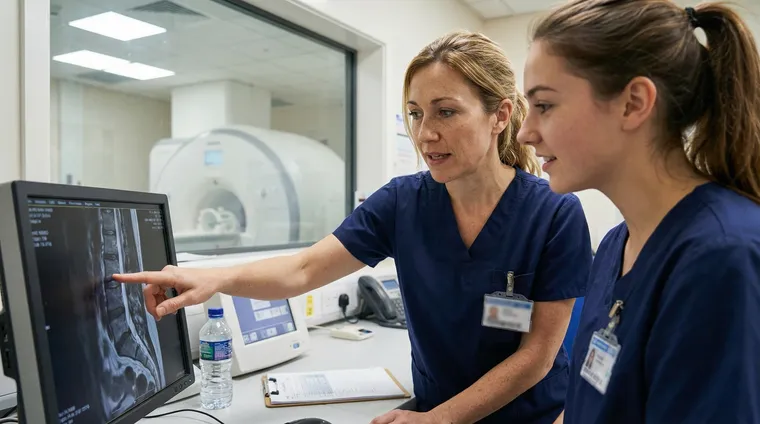
The Short Answer: How to Become an MRI Technologist
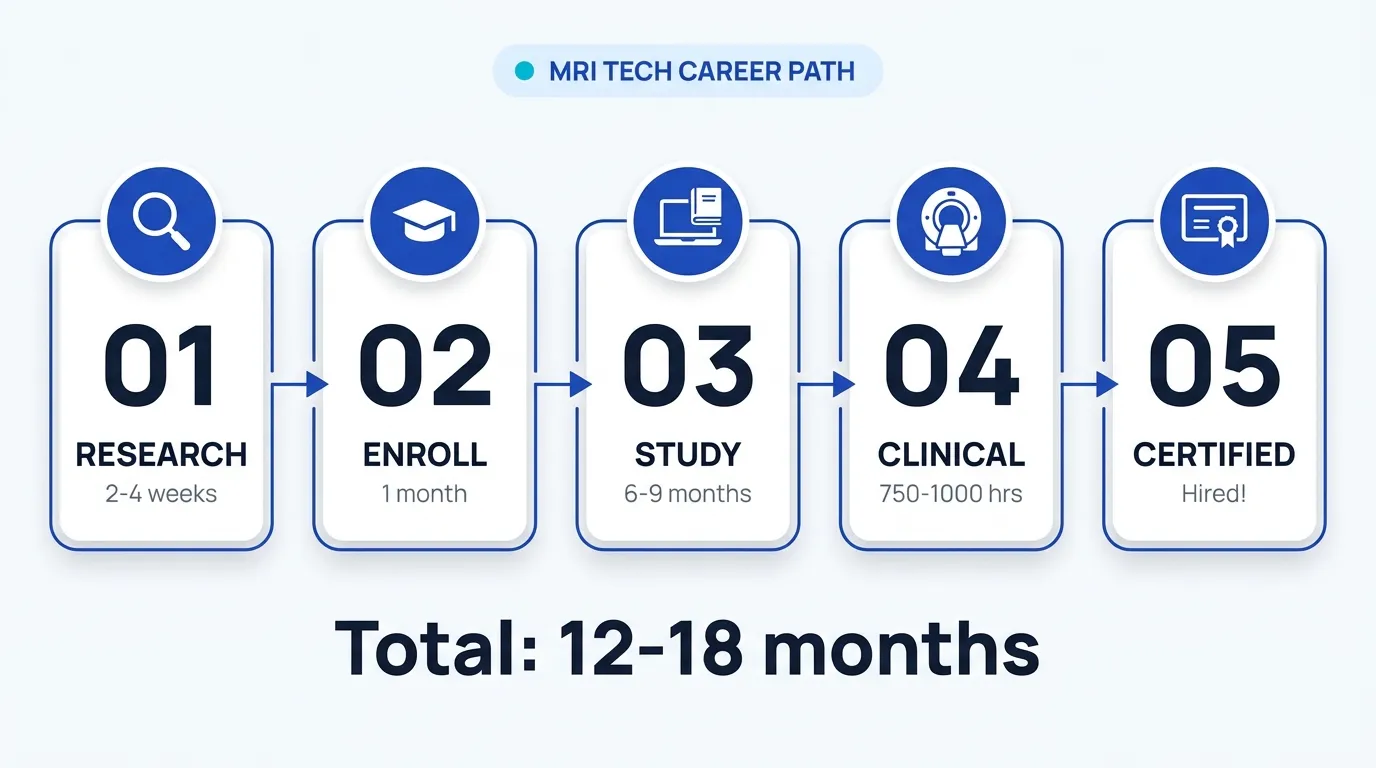
How long is MRI tech school? Most MRI technologist programs take 12–18 months to complete. Career changers with no healthcare background typically finish in 12–18 months through programs like Tesla MR Institute. Existing radiologic technologists adding MRI certification can complete post-primary training in 6–12 months. Community college associate degree programs take 2–4 years.
If you want to become an MRI technologist, you need three things: education (learning MRI physics, safety, anatomy, and protocols), clinical training (hands-on experience with real patients and scanners), and a credential employers recognize (typically ARRT or ARMRIT certification).
The fastest path depends on where you’re starting:
- New to healthcare (no clinical background at all): Enroll in an MRI-specific training program, complete 1,000+ clinical hours, pass the ARMRIT exam. Timeline: 12–18 months.
- Already in healthcare but not a registered technologist (medical assistants, MRI tech aides, MRI assistants, patient care techs, nurses, etc.): Same ARMRIT pathway as above, but your clinical comfort and patient care experience give you a real advantage. You already know how to work with patients, handle a fast-paced clinical environment, and follow protocols. Timeline: 12-18 months, though you may progress faster in clinicals.
- Already ARRT-certified (in X-ray, CT, etc.): Use the ARRT post-primary MRI pathway. You’ll still need clinical hours and exam prep, but you may be able to move faster on didactic requirements.
The rest of this guide breaks down exactly what each step involves, what it costs, and what actually matters when you’re trying to get hired.
If you’ve done your research and you’re ready to move, Tesla MR Institute’s program takes 12-18 months with no prior radiology experience needed. Skip ahead to program details or keep reading for the full breakdown.
Step 1: Understand What MRI Technologists Actually Do
Before you invest your time and money, make sure you understand the requirements of the job and what it actually involves day to day.
The Daily Reality
An MRI technologist’s day typically includes:
Safety screening (the non-negotiable foundation)
- Reviewing patient history for implants, metal fragments, and devices
- Asking the right questions to catch risks patients don’t know to mention
- Escalating safety concerns to the radiologist when information is unclear
Patient positioning and communication
- Accurately positioning patients (often 30+ per day in outpatient settings)
- Managing patient anxiety through 30-60 minute scans
- Educating patients on what to expect during their exam
Protocol execution
- Running the correct sequences for each exam type
- Adjusting parameters to optimize image quality
- Managing contrast administration per site protocols
Collaboration
- Communicating with radiologists about findings and concerns
- Working with nurses, ordering providers, and scheduling staff
- Keeping the schedule moving without cutting corners on safety
Administrative tasks
- Documenting patient history and exam details
- Cleaning the exam room and equipment between patients
- Performing quality assurance (QA) checks on the scanner
What Makes the Job Challenging
- Safety awareness: MRI magnets are always on. Patient safety must be the primary focus at all times.
- Patient management and education: Managing anxiety and claustrophobic patients while maintaining a busy schedule.
- Physical demands: You’re on your feet, often working long shifts, lifting, transferring and positioning patients, and handling coils and equipment.
Related: What does an MRI technologist do? | Day in the life of an MRI technologist
Step 2: Choose the Right MRI Technologist Training Path
There isn’t one “official” route to becoming an MRI technologist. The right path depends on your starting point.
Path A: Career Changer or Healthcare Worker Without a Medical Imaging Credential
If you don’t currently hold a medical imaging credential, this is your path. That includes people coming from outside healthcare entirely (retail, office work, military, trades) as well as those already working in healthcare but not as registered technologists (medical assistants, tech assistants, patient care techs, nurses, and similar roles).
What it looks like:
- Enroll in an ARMRIT-approved MRI training program
- Complete didactic education (safety, anatomy, protocols, physics)
- Complete clinical training (typically 750–1,000+ hours at a real imaging site)
- Pass the ARMRIT registry exam
- Apply for MRI technologist jobs
Timeline: 12–18 months for most programs
Who it fits best:
- Career changers with no healthcare background (no college degree needed, just a high school diploma or GED)
- Healthcare workers who aren’t registered technologists (medical assistants, tech assistants, patient care techs, nurses looking to specialize)
- People who want a focused MRI-specific education without spending 2-4 years in a degree program
- Students whose local employers accept ARMRIT credentials (check job postings in your area)
- Working adults who need flexible scheduling to train while keeping their job
Career Changer to MRI Tech in 13 Months
“After being an MRI tech assistant for 2 years, I knew that I wanted to become an MRI technologist. I didn’t want to go the traditional route—I wanted to do MRI right away because that was where my passion was. I was able to complete the program in 13 months. I recommend not waiting too long to take your exam while the material is still fresh.” — Tesla MR Graduate, Pennsylvania (86% salary increase)
Example program structure (Tesla MR):
- Phase I: 1 month of foundational topics (online, ~5 hours/week)
- Phase II: 5 months of advanced education (online, ~10 hours/week)
- Simulator: 800+ scans on MRI simulator software (earns 250 clinical hours)
- Clinical site: 6 months at a real imaging facility (~20 hours/week, 750 hours)
- Total clinical hours: 1,000
Path B: Already ARRT-Certified (Post-Primary MRI)
If you already hold ARRT credentials in another modality. X-ray, CT, nuclear medicine. you may be able to add MRI as a post-primary credential.
What it looks like:
- Meet ARRT’s education requirements for MRI
- Complete structured clinical experience
- Pass the ARRT post-primary MRI exam
- Add MRI to your existing credential
Timeline: Varies widely depending on how you complete requirements. some finish in 6–12 months with a structured program, others take longer piecing it together.
Who it fits best:
- Technologists who already have ARRT credentials
- People whose employers specifically require ARRT MR
- Students who want to stack MRI onto an existing radiologic technology foundation
Related: ARRT vs ARMRIT MRI certification
Step 3: Meet MRI Program Requirements
For the employer’s perspective on what these requirements mean during hiring, see our MRI technologist requirements guide. Understanding what employers verify helps you prioritize the right things during training.
Educational baseline:
- High school diploma or GED (minimum). No college degree is needed for ARMRIT-pathway programs. Many successful MRI technologists entered the field without any college education.
- Some programs prefer college coursework, but many accept career changers without it
Health and compliance:
- Background check and drug screening
- Immunizations: typically COVID, MMR, varicella, tetanus, TB/PPD, Hepatitis B, flu shot
- Health physical or clearance form
- CPR/BLS certification (often required before clinical)
Practical requirements:
- Reliable transportation to clinical sites
- Ability to meet physical demands: standing for long shifts, helping position patients
- Schedule availability: clinical hours are real shifts, not “whenever you’re free”
Step 4: Choose an MRI Training Program
Your starting point from Step 2 narrows the field. If you’re a career changer or healthcare worker without imaging credentials, you’re looking at ARMRIT-pathway programs. If you’re already ARRT-certified, you need a program that supports the post-primary MRI route. Start there, then evaluate programs on the things that actually matter.
Questions to Ask Before You Enroll
-
“Where do students complete clinical training?” Look for specific site types, geographic coverage, and named partnerships. Vague answers like “we help students find sites” are a red flag.
-
“Who handles clinical placement?” The program should have established partnerships and match you with a site. If students are responsible for finding their own clinical sites, keep looking.
-
“What happens if a clinical site falls through?” Good programs have backup options and support students through transitions.
-
“How many clinical hours do students complete per week?” You want specifics. Most programs run 16-24 hours/week during the clinical phase.
-
“What’s your clinical site network like?” Look for real numbers. Tesla MR, for example, has 334+ partner clinical sites across 38 states, giving students a much better shot at finding a local placement without relocating.
-
“Is there a simulator component?” Simulator training before clinical lets you practice in a risk-free environment. Programs without it put you into clinical less prepared.
-
“Is exam prep built into the curriculum?” You’ll need to pass a registry exam. Good programs don’t leave that to you.
Key Takeaway
Curious what MRI techs actually earn? Our salary guide has 2026 data broken down by state, setting, experience level, and shift type. Spoiler: the median is $95,480/year, and it goes up from there.
Step 5: Understand MRI Training Costs
Tuition is only part of the picture. Here’s what to budget for.
Tuition Ranges
| Program Type | Typical Range |
|---|---|
| Community college associate degree | $8,000–$15,000 |
| Private MRI-specific programs | $11,000–$20,000 |
| University-based programs | $15,000–$30,000+ |
Example (Tesla MR pricing):
- Upfront payment: $11,500 (15% discount)
- Quarterly payments: $12,500 (7% discount)
- Monthly payments: $13,400 (24 × $475 after $2,000 deposit)
Costs Beyond Tuition
| Cost Category | Typical Range |
|---|---|
| Clinical commute (gas, parking) | $100–$300/month during clinical |
| Background check | $50–$150 |
| Drug screening | $30–$75 |
| Immunizations/titers | $100–$300 |
| Health physical | $50–$150 |
| CPR/BLS certification | $50–$100 |
| Scrubs | $50–$100 |
| Registry exam fee | $200–$300 |
Total hidden costs: Plan for an additional $1,000–$2,000 beyond tuition.
The Time Cost
If you reduce work hours during training, factor in the lost income. Dropping from 40 to 30 hours/week at $20/hour costs $800/month, or $9,600 over 12 months. A program that keeps you moving efficiently through clinical can save thousands in opportunity cost.
Related: How much does MRI tech school cost?
Step 6: Complete Clinical Training
Clinical training is where you build real competence. You’ll work at an imaging site (hospital MRI department, outpatient center, or specialty clinic) alongside credentialed MRI technologists, progressing from observation to running exams independently over the course of 750-1,000+ hours.
Tips for Success in Clinical
Consistency beats intensity. Students who complete 16-20 hours per week, every week, outperform those who try to cram 40-hour weeks and burn out.
The students who succeed:
- Treat clinical hours like a non-negotiable job
- Build relationships with their clinical mentors
- Ask for feedback constantly and apply it
- Have a backup plan for when life gets complicated
Related: MRI clinical rotations: what to expect
Tesla MR Institute has 334+ clinical training sites across 38 states. Most students are placed within 30 minutes of home.
Step 7: Prepare for and Pass the Registry Exam
Once you’ve completed your education and clinical requirements, you’ll sit for a credentialing exam. either ARRT or ARMRIT, depending on your pathway.
What the Exams Cover
Both exams test similar core competencies:
| Topic Area | Approximate Weight |
|---|---|
| Patient care and safety | 25–30% |
| Image production | 25–30% |
| Procedures (protocols by body region) | 30–35% |
| Physics and equipment | 10–15% |
Exam Details
ARMRIT Exam:
- 200 questions
- 3-hour time limit
- Computer-based testing at PSI centers
- Passing score: approximately 75%
ARRT Post-Primary MRI Exam:
- 200 questions
- 3.5-hour time limit
- Computer-based testing at Pearson VUE centers
- Scaled scoring (passing score varies)
How to Prepare
Start early: Begin exam prep 2–3 months before your test date, not the week before.
Use structured resources:
- Official content outlines from ARRT or ARMRIT
- Practice exams that mirror the real format
- Program-provided review courses (if available)
Connect concepts to clinical: The questions make more sense when you can picture real scenarios. “What would you do if a patient had this implant?” is easier when you’ve seen it in clinical.
Focus on safety: MRI safety questions are heavily weighted. Know the zones, know the screening process, know when to stop a scan.
Related: MRI registry exam
Step 8: Get Hired as an MRI Technologist
Passing your exam is a milestone, but it’s not the finish line. You still need to convert your credential into a job.
The Job Market Reality
Good news: demand is strong. According to industry data, over 85% of healthcare organizations report difficulty filling MRI technologist positions. The Bureau of Labor Statistics projects about 15,000+ MRI technologist job openings annually through the next decade. Programs like Tesla MR are placing students at their clinical sites, with 284+ students currently training across 38+ states.
Bad news: entry-level competition can still be stiff in some markets, and not all jobs are equal.
What Employers Actually Want
Beyond the credential, hiring managers look for:
-
Safety judgment: Can you explain how you’d handle a screening scenario? What would you do with an unclear implant history?
-
Patient coaching ability: How do you keep anxious patients calm and still? Can you give specific examples?
-
Protocol consistency: Do you know the common exams? Can you troubleshoot when image quality isn’t right?
-
Reliability: Will you show up on time, work your shifts, and communicate when problems arise?
-
Learnability: Are you coachable? Do you take feedback well? Can you adapt to site-specific protocols quickly?
How to Stand Out in Interviews
Be specific, not vague:
- Bad: “I’m a hard worker and I learn fast.”
- Good: “During clinical, I did 15–20 brain MRIs per week. I got comfortable adjusting parameters for motion and learned to coach claustrophobic patients through the full exam.”
Prepare for scenario questions:
- “Walk me through your safety screening process”
- “What would you do if a patient said they might have metal fragments?”
- “How do you handle a patient who can’t stay still?”
Ask smart questions:
- “What’s the typical daily patient volume?”
- “What protocols are most common here?”
- “How do you support new techs in their first 90 days?”
Related: MRI technologist interview questions
MRI Technologist Salary: What You Can Expect
Let’s talk money. According to the Bureau of Labor Statistics, the median annual wage for MRI technologists was $95,480 as of May 2023.
Salary Ranges by Experience
| Experience Level | Typical Range |
|---|---|
| Entry-level (0–2 years) | $55,000–$70,000 |
| Mid-career (3–7 years) | $70,000–$90,000 |
| Experienced (8+ years) | $85,000–$105,000+ |
Real Salary Transformations
Recent program graduates have seen significant salary increases:
- “I went from less than $30,000 to $60,000-$70,000—a 160% increase.” — Tesla MR Graduate, South Carolina
- “From $30,000-$40,000 to more than $80,000.” — Tesla MR Graduate, Texas (157% increase)
- “Tesla has changed my life in a very positive way!” — Tesla MR Graduate, Pennsylvania (86% increase)
For the full picture on MRI tech compensation, including shift differentials, negotiation tactics, and the hidden money most techs miss, see our complete MRI technologist salary guide.
What Drives Pay Differences
Location: High cost-of-living areas (California, New York, Massachusetts) pay more, but adjust for living expenses.
Setting: Hospitals often pay more than outpatient centers, but may require more night/weekend coverage.
Shift differentials: Evening, night, and weekend shifts often add $2–$5/hour or more.
Specialization: Cardiac MRI, neuro MRI, and interventional experience can command premiums.
Credential stacking: Adding CT, mammography, or other modalities increases your value.
Related: MRI technologist salary guide
Common Mistakes (and How to Avoid Them)
Mistake 1: Choosing a Program Without a Clinical Plan
If the clinical path is fuzzy before you enroll, it will be chaotic after. Programs that say “we’ll help you find a site” often mean “you’ll figure it out alone.”
Fix: Ask the specific clinical questions above. Get answers in writing.
Mistake 2: Underestimating Clinical Logistics
Clinical hours are real shifts at real facilities. They’re not flexible study time you can fit around your existing life.
Fix: Map out your clinical commute, schedule, and backup childcare/work coverage before you start. Build buffer for the unexpected.
Mistake 3: Treating Safety Like Memorization
MRI safety isn’t a list of rules to memorize for a quiz. It’s judgment you build through practice and repetition. Students who treat it as trivia struggle in clinical and interviews.
Fix: Connect every safety concept to a scenario. “What would I actually do if this patient had this implant?” Practice explaining your reasoning out loud.
Mistake 4: Waiting to Think About Jobs
Some students focus entirely on training and don’t think about employment until they pass their exam. Then they scramble.
Fix: Start building your job search foundation by month 3–4 of training:
- Research employers in your area
- Track job posting requirements
- Practice interview answers
- Build relationships at your clinical site (they might hire you)
Mistake 5: Not Building a Support System
Career change is hard. MRI training while working and managing life responsibilities is harder. Students who try to white-knuckle it alone often burn out.
Fix: Tell your family/friends what you’re doing. Line up childcare help. Negotiate work schedule adjustments early. Find other students or a mentor who understands the path.
Timeline: What to Expect Month by Month
Here’s a realistic timeline for a career changer entering an MRI program:
Months 1–2: Foundation Phase
- Complete program onboarding and prerequisites
- Start foundational coursework (safety, patient care, basic anatomy)
- Complete compliance requirements (background check, immunizations)
- Begin researching clinical site options
Months 2–6: Education Ramp-Up
- Work through didactic modules (protocols, physics, pathology)
- Start simulator training if available
- Pass quizzes and complete live lecture requirements
- Finalize clinical site placement
Months 6–12: Clinical Immersion
- Begin on-site clinical hours
- Build competencies progressively
- Log hours and document completed protocols
- Start exam prep alongside clinical
Months 12–18: Completion and Credentialing
- Finish remaining clinical hours
- Complete competency sign-offs
- Take registry exam
- Begin job search in earnest
- Receive job offers
Is Becoming an MRI Technologist Right for You?
This career fits well if you:
✅ Like patient interaction but don’t want nursing-level medical responsibility ✅ Want technical skill-building with real-world application ✅ Can handle pressure and make judgment calls ✅ Are physically capable of standing for long shifts and positioning patients ✅ Want job stability in a high-demand field ✅ Can commit to 12–18 months of focused training
This career might not fit if you:
❌ Dislike patient-facing work or coaching anxious people ❌ Want a desk job with minimal physical activity ❌ Can’t maintain a consistent weekly schedule for clinical training ❌ Are uncomfortable with high-stakes safety decisions ❌ Need maximum schedule flexibility (MRI often requires shift work)
Your Next Steps
If you’re ready to move forward:
-
Research local job postings . What credentials do employers in your area want? This determines your path.
-
Evaluate programs . Use the clinical questions above to vet any program you’re considering.
-
Calculate total cost . Include tuition, compliance, clinical travel, and time opportunity cost.
-
Build your support system . Line up the schedule, childcare, and work adjustments you’ll need.
-
Start . The job market isn’t getting less competitive. The best time to begin was yesterday; the second best time is now.
Related Reading
Core guides:
Clinical and training:
- MRI clinical rotations: what to expect
- How long does it take to become an MRI technologist?
- How much does MRI tech school cost?
Career changers:
Career path:
Salary comparisons:
Interview prep:
Definitions:
Frequently Asked Questions
Most training pathways take 12–18 months to complete. The timeline depends on your starting point (career changer vs. already-credentialed tech) and how consistently you can complete clinical hours. Students who maintain steady weekly clinical schedules finish faster than those with gaps.
No. Many programs accept people with zero healthcare background, as well as those already working in healthcare but without a registered technologist credential -- medical assistants, tech assistants, patient care techs, and others. What matters is your ability to handle patient-facing work, follow safety protocols, and commit to clinical training. Programs like Tesla MR are specifically designed to take people from any starting point to job-ready.
ARRT post-primary MRI certification is typically for technologists who already hold ARRT credentials in another modality (like X-ray or CT). ARMRIT certification is common for career changers entering MRI through dedicated MRI programs. Both are recognized by employers, though acceptance varies by region.
Program costs range from $11,000 to $20,000+ depending on the program type and payment plan. Budget for additional costs: clinical commute ($100–$300/month), background checks ($50–$150), scrubs ($50–$100), and health clearances ($100–$300).
MRI technologists screen patients for safety (implants, metal, devices), position and coach patients to stay still, run scan protocols, troubleshoot image quality, and coordinate with radiologists. The job is about 50% patient interaction and 50% technical execution.
Clinical consistency. Students who can't maintain regular weekly clinical hours. due to scheduling conflicts, commute issues, or life circumstances. often fall behind and struggle to complete. The coursework is manageable; protecting clinical time is what separates those who finish from those who don't.
According to the Bureau of Labor Statistics, the median annual wage for MRI technologists was $95,480 as of May 2023. Salaries vary significantly by region, setting, and experience. ranging from about $61,000 at the lower end to over $100,000 for experienced techs in high-demand markets.
Yes. Over 85% of healthcare organizations report difficulty filling MRI technologist positions. The BLS projects about 15,000+ job openings per year through the next decade, driven by an aging population and increasing use of MRI for diagnosis.
It is challenging but trainable — most well-prepared students pass the ARMRIT or ARRT(MR) registry on the first attempt (about 75% first-time pass rate nationally). The hard parts aren't the academics; they're (1) maintaining 16–24 weekly clinical hours for 6–9 months without gaps, (2) developing patient-safety judgment around magnetic-field hazards, and (3) staying calm with anxious or claustrophobic patients during 30–60 minute scans. Students who can protect their clinical time and absorb feedback finish in 12–18 months. Students who treat it like a part-time hobby don't.