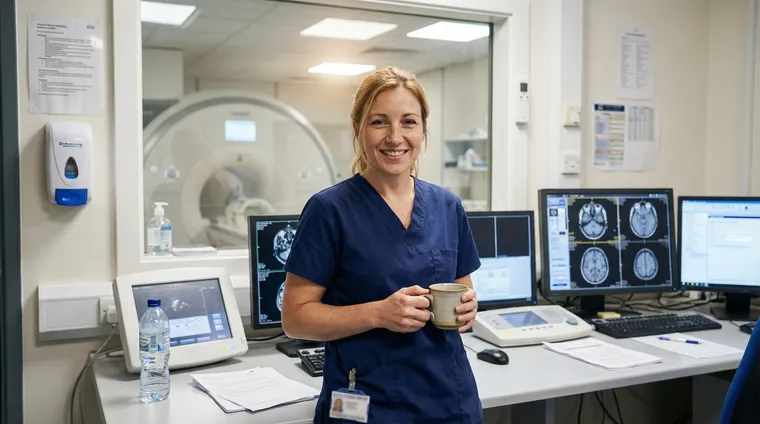
My Path to the Console
I’m Sarah Mitchell. I’ve been an MRI technologist for six years. First at Penn Medicine, now as a senior tech and clinical instructor at Jefferson Health in Philadelphia.
Before MRI, I was a medical assistant wondering if healthcare was really for me. I’d see the imaging orders go out and have no idea what happened after. Then I worked as a radiology aide during my rad tech program and watched an MRI tech calm a claustrophobic patient, run a complex brain scan, and catch an artifact that would’ve ruined the study. All in 45 minutes. I thought: that’s what I want to do.
Six years later, I still feel that way. Not every day is perfect, but I’ve never been bored. Let me walk you through what this job actually involves.
Definition
An MRI technologist operates MRI scanners to produce diagnostic images. The core responsibilities are safety screening, patient positioning and communication, protocol execution, and image quality assessment.
The job is not “pressing buttons.” It’s a combination of safety-critical decision making, patient communication, and technical execution—all happening under schedule pressure. I tell my students: you’re part nurse, part engineer, part detective.
Core Job Duties
1. Safety Screening
What it involves:
- Reviewing patient history for implants, devices, and metal
- Asking detailed follow-up questions when responses are unclear
- Verifying device compatibility for conditional implants
- Escalating safety concerns to the radiologist when needed
Why it matters: MRI uses powerful magnetic fields. Ferromagnetic objects can become projectiles. Some implants can malfunction or heat. Safety screening is the most important thing MRI technologists do.
I’ve personally caught things that could have caused serious harm. a patient who forgot about a spinal cord stimulator, another who didn’t realize her insulin pump wasn’t MRI-safe. You can’t rush this step. Ever.
Time investment: 5–15 minutes per patient
2. Patient Positioning and Setup
What it involves:
- Selecting appropriate RF coils for the exam
- Positioning patients for optimal image acquisition
- Ensuring patient comfort (uncomfortable patients move)
- Securing the area being imaged while maintaining access
- Providing hearing protection and communication devices
Why it matters: Correct positioning determines image quality. Poor setup means repeat scans.
Time investment: 5–10 minutes per patient
3. Patient Communication
What it involves:
- Explaining the procedure in understandable terms
- Setting expectations about noise, duration, and what patient needs to do
- Calming anxious or claustrophobic patients
- Providing ongoing communication during the scan
- Knowing when to pause and when to push through
Why it matters: Patient motion is the primary cause of poor image quality. Effective patient communication prevents motion.
This is the part of the job I love most. Some patients are fine. Others are terrified. of the enclosed space, the noise, or what the scan might reveal. I’ve held hands, played patients’ favorite music, and talked people through panic attacks. When someone tells you “I couldn’t have done this without you,” that’s when you remember why you chose this career.
Time investment: Ongoing throughout exam
4. Protocol Execution
What it involves:
- Running appropriate imaging sequences for each exam type
- Adjusting parameters based on patient factors
- Managing contrast administration when ordered
- Responding to real-time quality issues during acquisition
- Knowing when to deviate from standard protocols
Why it matters: Correct protocols produce diagnostic images. Wrong protocols waste time and may require repeats.
Time investment: 20–60 minutes per exam
5. Image Quality Assessment
What it involves:
- Evaluating images as they’re acquired
- Identifying artifacts and determining causes
- Deciding whether to repeat sequences
- Ensuring adequate coverage and diagnostic quality
- Flagging concerning findings for radiologist attention
Why it matters: Releasing a patient before images are adequate means bringing them back. Catching issues during the exam saves everyone time.
Time investment: Ongoing throughout exam
6. Documentation and Coordination
What it involves:
- Documenting screening and exam information
- Communicating relevant patient information to radiologists
- Coordinating with scheduling about delays or issues
- Maintaining equipment and reporting problems
- Supporting department workflow
Time investment: 5–10 minutes per patient
A Typical Workflow
For each patient, the sequence looks like:
- Review order . What exam? What clinical question?
- Call patient back . Greet, begin building rapport
- Screen . Safety questionnaire, verbal verification, clarification as needed
- Prep . Patient changes, removes metal, uses restroom
- Position . Coil selection, patient positioning, comfort optimization
- Communicate . Explain procedure, set expectations, calm anxiety
- Scan . Execute protocols, monitor quality, communicate with patient
- Contrast (if applicable) . Re-screen, administer, post-contrast sequences
- Verify . Check image quality and coverage
- Release . Help patient off table, provide any instructions
- Document . Complete records
- Reset . Prepare room for next patient
Total time per patient: 30–75 minutes depending on exam complexity
Skills That Matter Most
Technical Skills
- Protocol knowledge across body regions
- Coil selection and positioning
- Parameter adjustment for image optimization
- Artifact recognition and troubleshooting
- Equipment operation and basic maintenance
Patient Skills
- Clear, calm communication
- Anxiety management techniques
- Physical positioning assistance
- Reading patient cues and adapting
- Maintaining professionalism under pressure
Safety Skills
- Thorough screening habits
- Knowledge of conditional device protocols
- Judgment about when to escalate
- Constant vigilance (not treating screening as routine)
Workflow Skills
- Time management and prioritization
- Schedule flexibility
- Team coordination
- Documentation accuracy
- Problem-solving when things go wrong
What the Job Feels Like Day-to-Day
The good:
- Intellectually engaging work
- Direct patient impact
- Variety within structure
- Strong job security
- Team environment
The challenging:
- Schedule pressure
- Anxious or difficult patients
- Physical demands (standing, positioning)
- High-stakes safety responsibility
- Occasional long or irregular shifts
The reality: Most techs find the work satisfying because it combines technical skill with human connection. The challenges are manageable once you build competence.
Why I Still Love This Job
I specialize in cardiac MRI now. stress perfusion, viability imaging, the complex stuff. Last week I scanned a 34-year-old dad who needed cardiac imaging before a valve repair. He was terrified. Not of the MRI. of what we might find.
I spent an extra five minutes with him before the scan. Explained everything. Told him I’d be talking to him the whole time. When we finished, he said, “That wasn’t nearly as bad as I thought.” His surgeon got the images she needed. He’s having his surgery next month.
That’s what this job is. It’s technical, yes. But it’s also deeply human. You’re with people on some of the most uncertain days of their lives, and you get to make that experience a little better while producing images that guide their care.
When I was a medical assistant, I never imagined I’d end up here. Now I can’t imagine doing anything else.
Related Reading
Frequently Asked Questions
Both. Approximately 50% involves patient interaction (screening, communication, positioning) and 50% involves technical work (running protocols, assessing images). Strong techs excel at both.
No. MRI technologists produce the images; radiologists (physicians) interpret them and make diagnoses. However, techs need to recognize when images are adequate and when additional sequences might be needed.
Outpatient centers typically see 12–20 patients per tech per day. Hospital MRI varies (8–15) depending on case complexity. Volume depends on exam types and scheduling.
Clear patient communication, consistent protocol execution, strong safety habits, and the ability to troubleshoot image quality. The best techs reduce motion, minimize repeats, and keep patients calm.
Safety screening. Before any scan, techs must verify patients are safe to enter the MRI environment. One screening error can cause serious harm. Everything else depends on getting safety right.