If you manage an imaging center or radiology department, you already know the problem. There aren’t enough MRI technologists to go around. Positions sit open for months. When you do find someone, the signing bonus and relocation package eat through your budget fast. And then they leave in two years for a better offer down the road. More facilities are starting to train MRI technologists in-house as an alternative, and the economics actually make a lot of sense once you look at the numbers.
This guide walks through how in-house MRI training works, what it costs compared to traditional recruiting, how to identify good candidates on your existing staff, and how to set the whole thing up without disrupting your operations.
Why Hiring MRI Technologists Is So Difficult Right Now
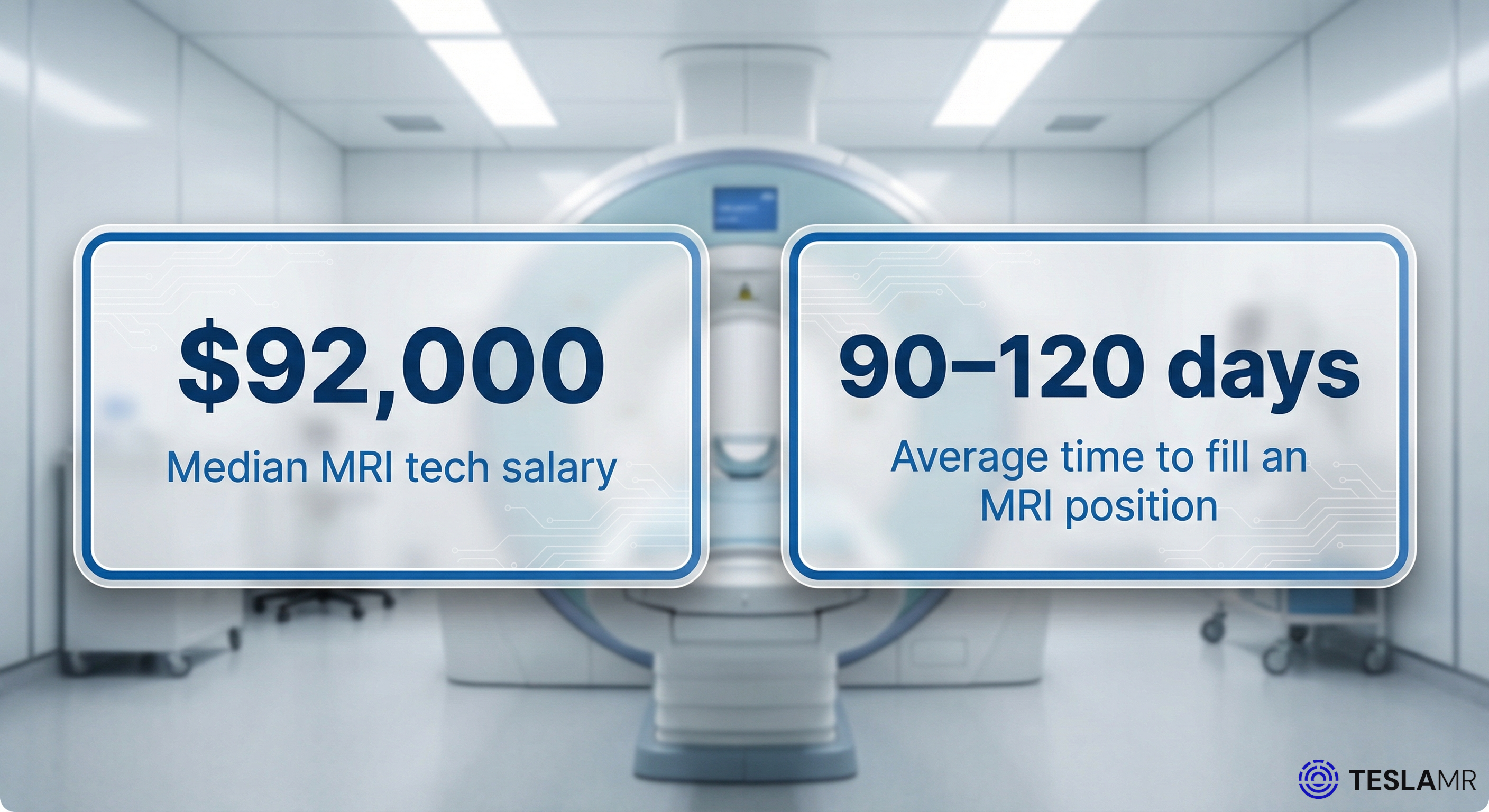
The numbers tell the story pretty clearly. There are over 5,000 open MRI technologist positions across the United States right now. The Bureau of Labor Statistics projects 8% job growth for MRI techs through 2032, which is faster than the average for all occupations. Meanwhile, training programs aren’t producing graduates fast enough to fill the gap.
The median salary for an MRI technologist has climbed past $85,000 annually. In high-cost metro areas, you’re looking at six figures. That’s before you factor in the signing bonuses that have become standard. It’s not unusual to see $10,000 to $20,000 signing bonuses for experienced MRI techs, and even then, candidates have multiple offers to choose from.
Here’s what makes this especially painful for smaller imaging centers and rural hospitals. You’re competing for the same candidates as large health systems that can offer better benefits packages, more schedule flexibility, and clearer advancement paths. When a new grad has offers from a major academic medical center and a freestanding imaging center, the medical center usually wins.
Travel and agency MRI techs can fill the gap temporarily, but the cost is staggering. Rates for travel MRI techs commonly run $2,500 to $4,000 per week. That’s $130,000 to $208,000 annually for one position. And you get no continuity, no institutional knowledge, and a revolving door of techs who need orientation every 13 weeks.
The recruiting cycle has become a treadmill. You spend money to attract candidates, spend more to onboard them, invest in getting them comfortable with your protocols, and then watch them leave when someone else offers a bigger bonus. Something has to change.
The In-House Training Model Explained
The idea behind in-house MRI training is straightforward. Instead of competing in a brutal hiring market for experienced technologists, you take someone already on your team and train them to become an MRI tech. Your facility serves as the clinical training site. Your MRI department provides the hands-on experience. A training program partner handles the didactic education and curriculum structure.
This isn’t a new concept. Hospitals have been growing their own nurses, surgical techs, and other clinical staff for years. MRI is catching up.
Here’s how it typically works. You identify an employee, maybe a medical assistant, a patient care tech, a CT tech who wants to cross-train, or even a front desk coordinator with a strong science background. They enroll in an MRI apprenticeship program that combines online coursework with clinical hours at your facility. Your existing MRI technologists serve as their clinical preceptors and mentors.
The training usually happens in phases. Early on, it’s mostly online coursework covering MRI physics, anatomy, safety, and imaging protocols. The student studies on their own time, often 5 to 10 hours per week outside of their regular work duties. As they progress, they begin spending time in your MRI suite, first observing, then assisting, then performing scans under direct supervision.
By the later stages of training, your trainee is functioning almost like a junior technologist. They’re positioning patients, selecting protocols, and producing diagnostic-quality images with a preceptor checking their work. They’re contributing to your department’s output while completing their education.
The end result is a certified MRI technologist who already knows your facility, your equipment, your protocols, your radiologists’ preferences, and your patient population. No relocation package. No orientation period. No learning curve on your PACS system. They’re already home.
Training vs. Recruiting: A Real Cost Comparison
Let’s put actual numbers on this. These figures represent typical ranges based on industry data, not worst-case or best-case scenarios.
Cost to recruit an experienced MRI technologist:
- Recruiter fees or job board advertising: $5,000 to $15,000
- Signing bonus: $10,000 to $20,000
- Relocation assistance: $5,000 to $10,000
- Onboarding and orientation (productivity loss): $3,000 to $5,000
- Risk of turnover within 2 years: 30% to 40% (meaning you may repeat this cycle)
Total recruiting cost: $23,000 to $50,000 per hire, with a significant chance of doing it again within 24 months.
Now compare that to training:
- Training program tuition: under $15,000
- Employee wages during clinical hours (if you adjust their schedule): varies, but often minimal since they’re completing clinicals during work hours
- Preceptor time: your existing techs are already there. The incremental cost is modest
- Reduced productivity during learning curve: real, but the trainee is contributing to scan volume during clinicals
Total training cost: $15,000 to $40,000, depending on how you structure the employee’s schedule and compensation during training.
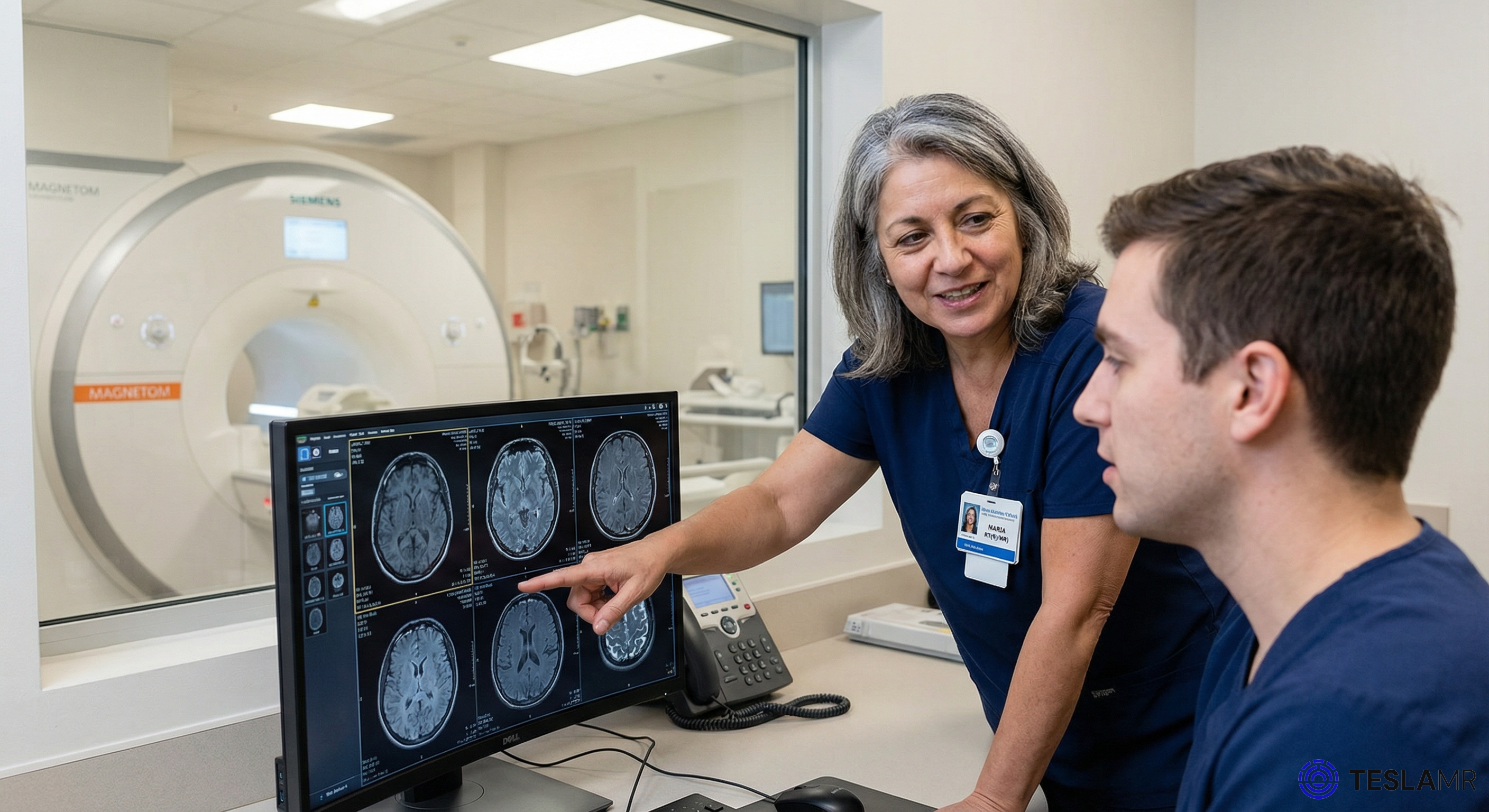
The math gets even more favorable when you consider retention. An employee you trained is significantly more likely to stay. They have roots at your facility. They feel invested in. They didn’t just take the highest signing bonus available. They grew into the role with your team’s support.
One more thing to consider. When you recruit externally, you fill one position. When you build a training pipeline, you create a repeatable system. Train two techs this year, two more next year, and suddenly you’re not scrambling every time someone retires or relocates.
Key Takeaway
Training costs $15,000-$40,000 vs. recruiting at $23,000-$50,000. But the real value is retention—trained employees stay longer because you invested in their growth, creating a stable, loyal team.
How to Train MRI Technologists In-House: Identifying the Right Candidates
Not everyone on your staff is a good fit for MRI training. You need people with the right mix of aptitude, motivation, and baseline qualifications. Here’s what to look for.
Strong candidates from your existing team:
- CT technologists who want to add MRI to their skills. They already understand cross-sectional anatomy and imaging workflows. The transition is natural.
- Radiologic technologists (X-ray techs) looking for career growth. They have foundational imaging knowledge and patient handling experience.
- Medical assistants and patient care technicians with science backgrounds. They know clinical environments and patient interaction. They’ll need more physics and anatomy education, but programs are designed to provide that.
- Ultrasound technologists interested in cross-training. Like CT techs, they bring relevant anatomy knowledge.
- Non-clinical staff with strong science education. A front desk coordinator with a biology degree might surprise you.
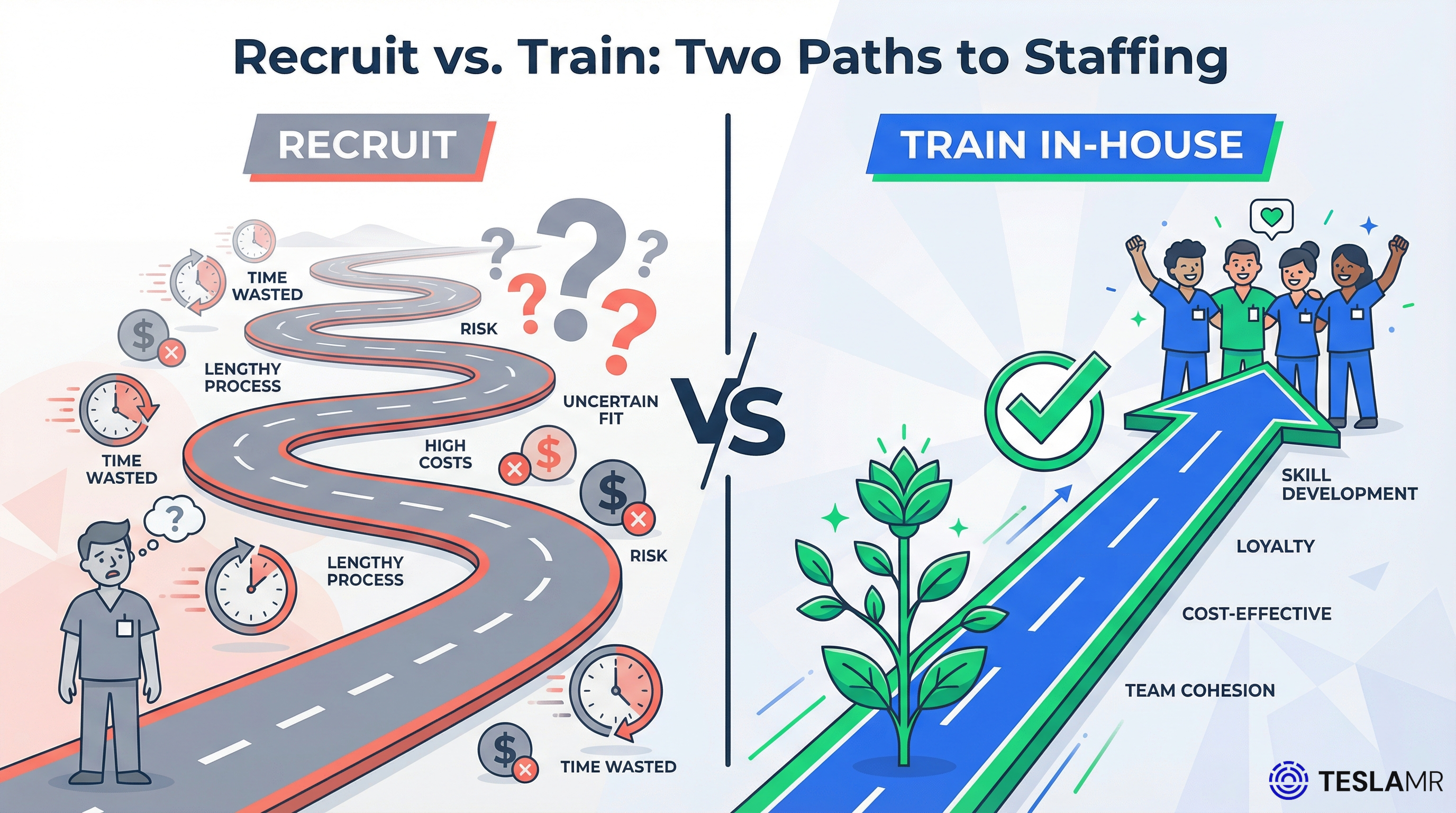
What to look for in personality and aptitude:
- Attention to detail. MRI is precise work. Image quality depends on exact positioning and protocol selection.
- Comfort with technology. MRI scanners are complex machines with extensive software interfaces.
- Patient interaction skills. You’re working with anxious people in a loud, confined space for 30 to 60 minutes at a time.
- Self-motivation. The didactic portion requires consistent independent study.
- Problem-solving ability. Not every patient fits the textbook. Good techs adapt.
Red flags:
- Someone who just wants a pay raise but shows no genuine interest in MRI.
- Poor attendance or reliability in their current role. Training requires showing up consistently.
- Inability to commit to the study hours outside of work.
A realistic conversation with candidates is better than an enthusiastic one. Be honest about the workload, the timeline, and the expectations. You want someone who’s still excited after hearing the hard parts.
Employer Tip
The best MRI trainees often come from unexpected backgrounds. A medical assistant with strong science skills and motivation can outperform an experienced RT who’s just looking for a pay bump. Focus on aptitude and commitment over current credentials.
Clinical Training at Your Own Facility
One of the biggest advantages of in-house MRI training is that your facility becomes the clinical site. This eliminates a major pain point in traditional MRI education, where students often struggle to find clinical placements and may end up commuting to a site an hour away.
Here’s what clinical training looks like when it happens at your own imaging center.
The preceptor model. One or more of your experienced MRI technologists serve as clinical preceptors. They supervise the trainee, demonstrate techniques, evaluate competencies, and provide feedback. Most programs require preceptors to have at least two years of MRI experience and may provide brief preceptor training materials.
This does add some responsibility to your existing techs’ workload. But most experienced techs actually enjoy mentoring. It breaks up the routine, and there’s professional satisfaction in teaching someone the craft. Be transparent with your team about the plan and involve them in selecting candidates.
Progressive responsibility. Clinical training follows a structured progression. Early clinical hours focus on observation and basic tasks like patient screening, coil selection, and positioning assistance. The trainee gradually takes on more responsibility, advancing to performing routine exams under direct supervision, then performing exams with the preceptor available but not standing at the console.
Programs typically require 1,000 clinical hours in total. That’s about 11 months at 20 or more hours per week of clinical time. By the end, the trainee should be able to independently perform common MRI exams including brain, spine, knee, shoulder, and abdomen protocols.
Impact on your department. Let’s be honest. Having a trainee in your MRI suite does slow things down, especially in the early months. Your preceptor tech may take a few extra minutes per exam while teaching. Your schedule might need slight adjustments.
But this effect diminishes quickly. By the midpoint of clinicals, most trainees are adding capacity, not reducing it. They can handle straightforward exams while your experienced techs focus on complex cases. Some facilities report a net increase in scan volume during the later stages of clinical training.
Timeline: From Enrollment to Certified MRI Technologist
Understanding the timeline helps you plan staffing and set expectations. Here’s a realistic breakdown of what to expect when you train MRI technologists in-house through a structured program.
Phase 1: Online Didactic Foundation (approximately 2 months) The trainee studies MRI physics, safety, anatomy, and basic imaging principles through online coursework. This requires about 5 or more hours per week and can be done entirely outside of work hours. Your operations aren’t affected at all during this phase. The employee keeps doing their current job while studying on evenings and weekends.
Phase 2: Advanced Didactic and Simulation (approximately 5 months) Coursework intensifies to 10 or more hours per week. The trainee gets into more advanced topics including pulse sequences, image optimization, contrast agents, and pathology recognition. Some programs include MRI simulator exercises during this phase, which bridge the gap between theory and hands-on scanning.
This is where you might start having the trainee observe in your MRI suite for a few hours per week. Not required by most programs at this stage, but it helps build familiarity.
Phase 3: In-Person Clinical Training (approximately 11 months) This is the big phase. The trainee needs 20 or more hours per week in your MRI suite, completing 1,000 total clinical hours. They progress from observation to assisted scanning to supervised independent scanning.
During this phase, you’ll need to adjust the trainee’s work schedule. Some facilities keep the trainee in their original role part-time while they do clinicals. Others transition them fully into the MRI department. The right approach depends on your staffing situation.
Total timeline: 12 to 18 months from enrollment to certification eligibility.
After completing the program, the trainee sits for their certification exam. Once certified, they’re a fully credentialed MRI technologist ready for independent practice.
A 12-to-18-month investment to solve a problem that traditional recruiting often can’t solve at all. That’s a trade-off most radiology directors will take.
Ready to explore in-house MRI training for your facility? Connect with Tesla MR Institute to discuss how we can turn your facility into a clinical site and train your existing staff.
How to Evaluate Training Program Partners
Not all MRI training programs are created equal. If you’re going to invest in training an employee, you need a program partner that delivers results. Here’s what to evaluate.
Accreditation. This is non-negotiable. The program should hold accreditation from a recognized body. For MRI-specific programs, look for ARMRIT accreditation. Accreditation means the curriculum meets established standards, the clinical requirements are appropriate, and the program undergoes regular review.
Certification pass rates. Ask directly: what percentage of graduates pass their certification exam on the first attempt? A good program should be able to share this data. If they dodge the question, that’s a problem.
Clinical site network. If you’re planning to use your facility as the clinical site, the program needs to support that. Ask how many clinical sites they work with. A program with 300 or more active clinical sites has established processes for onboarding new sites, evaluating preceptors, and managing clinical documentation. A program with 10 sites is still figuring things out.
Curriculum structure. Review the course outline. Does it cover MRI physics in enough depth? Does it include patient safety, contrast administration, and emergency procedures? Is the content delivered by qualified instructors with actual MRI experience?
Support for the facility. You’re not just enrolling a student. You’re becoming a clinical partner. A good program should provide preceptor guidance, clinical competency checklists, regular progress updates, and a point of contact for questions or issues.
Cost transparency. Get a complete picture of costs upfront. Tuition, fees, books, exam prep materials, certification exam fees. No surprises. Programs that can’t give you a clear total cost number aren’t organized enough to manage your trainee’s education.
Flexibility. Your MRI department runs on a schedule. Your trainee has a life. The program needs to accommodate working adults. Look for online didactic options, flexible clinical scheduling, and the ability to pace the program around your department’s needs.
The ARMRIT Certification Path: Why It Matters for Employers
If you’ve been in radiology management for a while, you probably think of ARRT as the default certification body for MRI technologists. And ARRT certification is excellent. But it comes with a prerequisite that creates a bottleneck: candidates must first be registered radiologic technologists, meaning they need to complete an accredited radiography program and pass the ARRT radiography exam before they can even start MRI-specific training.
That’s a 2-year radiography program plus MRI training on top. For an employer trying to build an in-house MRI workforce development pipeline, that’s a deal-breaker for most candidates.
ARMRIT (American Registry of Magnetic Resonance Imaging Technologists) offers a different path. ARMRIT certification is MRI-specific from the start. There’s no requirement for prior radiologic technology credentials. A candidate can enter an ARMRIT-accredited training program, complete the required education and clinical hours, and sit for the ARMRIT certification exam.
For employers, this changes the candidate pool dramatically. Suddenly you’re not limited to people who already spent two years in radiography school. You can take a motivated medical assistant, a patient care tech, or a career changer with a science background and put them on a direct path to MRI certification.
Is ARMRIT accepted everywhere? In most places, yes. The majority of hospitals, imaging centers, and outpatient facilities accept ARMRIT certification. Some states have specific licensing requirements that you should verify, but ARMRIT-certified technologists are working in facilities across all 50 states.
The practical difference. A traditional ARRT MRI path might take 3 to 4 years total (radiography program plus MRI training). An ARMRIT path through a program like Tesla MR Institute takes 12 to 18 months. Same endpoint: a certified MRI technologist performing diagnostic exams in your facility. Very different timeline and investment.
For a radiology director trying to fill an open MRI position this year, not in three or four years, the ARMRIT pathway is the practical choice.
Key Takeaway
ARMRIT certification eliminates the prerequisite for radiography credentials, shortening the path from 3-4 years to 12-18 months. This opens your candidate pool to medical assistants, patient care techs, and others who want direct MRI training.
Getting Started: Steps to Launch Your In-House MRI Training Initiative
You’re convinced the model makes sense. Here’s how to actually make it happen.
Step 1: Assess your need and capacity. How many MRI tech positions do you need to fill? How many can your department support as trainees simultaneously? Most facilities start with one trainee and scale from there. You need at least one experienced MRI tech willing to serve as a preceptor, and enough scan volume to provide diverse clinical experience.
Step 2: Identify candidates internally. Review your current staff. Talk to department managers about employees who have expressed interest in career growth. Post the opportunity internally before looking outside. You might be surprised by who raises their hand.
Step 3: Select a training program partner. Do your due diligence using the evaluation criteria outlined above. Talk to other facilities who’ve used the program. Understand the costs, timeline, and requirements thoroughly.
Step 4: Structure the employment and training agreement. Work with HR and legal to create a training agreement. Key elements include who pays tuition (employer, employee, or shared), schedule adjustments during clinical training, commitment period after certification (typically 2 to 3 years), and repayment terms if the employee leaves early.
Step 5: Prepare your MRI department. Brief your MRI team. Get preceptor buy-in. Set expectations about the training timeline and the temporary impact on workflow. Enthusiasm from your existing techs makes a huge difference in the trainee’s success.
Step 6: Enroll and begin. The trainee starts online coursework while continuing their current role. You have several months before clinical hours begin, giving you time to finalize scheduling and logistics.
Step 7: Monitor progress and provide support. Check in regularly with the trainee and their preceptor. Address problems early. Celebrate milestones. This person is your future MRI technologist. Their success is your department’s success.
The first trainee is the hardest. Once you’ve done it once, the second and third are much smoother. You’ll have processes in place, your team will know what to expect, and you’ll have proof that it works.
Why More Imaging Centers Are Choosing to Train MRI Technologists In-House
The shift toward in-house MRI training isn’t happening because it’s trendy. It’s happening because the math works and the alternatives don’t.
Recruiting costs keep climbing. The candidate pool keeps shrinking. Travel tech rates keep rising. Meanwhile, you have staff members who are loyal, capable, and eager to grow their careers. Training them is the intersection of good business and good management.
The shift toward in-house training represents a fundamental change in how smart imaging centers approach workforce development. Instead of reacting to staffing crises, they’re building sustainable pipelines. Instead of competing for talent, they’re creating it.
Tesla MR Institute: Built for Clinical Partnerships
Tesla MR Institute was designed specifically for facilities that want to train their own MRI technologists. Here’s what sets us apart:
- ARMRIT-accredited program with nationally recognized certification
- Under $15,000 total tuition cost
- 329+ clinical sites across the US—yours can be next
- 284+ current students training in 38+ states
- 100% online didactic coursework for working professionals
- Dedicated clinical site support and preceptor guidance
Your facility becomes the training ground. Your team becomes the mentors. Your employee becomes your next certified MRI technologist—loyal, skilled, and ready to grow their career where they started it.
Ready to become a clinical site? Contact Tesla MR Institute to discuss bringing in-house MRI training to your facility →
Frequently Asked Questions
How much does it cost to train an MRI technologist in-house?
Program tuition typically runs under $15,000 per student. When you factor in the employee’s wages during training and minor productivity adjustments, total investment usually falls between $30,000 and $50,000 per technologist. That’s significantly less than the $60,000 to $90,000 you’d spend on recruiting, signing bonuses, and agency fees for an experienced hire.
How long does it take to train an MRI tech from scratch?
Most programs take 12 to 18 months from enrollment to certification eligibility. The first several months are online didactic coursework, followed by hands-on clinical training. Expect your trainee to be performing supervised scans within 7 to 8 months and working toward independent operation by month 12 to 14.
Do candidates need an X-ray or radiology certification first?
Not necessarily. Some certification paths, like ARMRIT, do not require prior radiologic technology credentials. This opens the door for you to upskill medical assistants, patient care techs, and other clinical staff who don’t hold RT(R) certification.
Can my facility serve as the clinical training site?
Yes. Many training programs are specifically designed for this. Your facility becomes the clinical site, and your existing MRI technologists serve as clinical preceptors. The student completes their required clinical hours (typically 1,000 hours) on your equipment, scanning your patients, under your team’s supervision.
What is ARMRIT certification, and is it accepted by employers?
ARMRIT (American Registry of Magnetic Resonance Imaging Technologists) is an accredited certification body specifically for MRI. It is recognized in most states and accepted by the majority of hospitals and imaging centers. Unlike ARRT MRI certification, ARMRIT does not require candidates to first become registered radiologic technologists.
Will the trainee be useful during the training period?
Trainees become progressively more useful. After the initial online coursework phase (about 7 months), they enter clinical rotations at your facility. During clinicals, they’re actively performing scans under supervision, which means they’re contributing to your workflow while learning. Many facilities report that trainees are handling routine exams with minimal oversight by month 10 or 11.
What if the employee leaves after we pay for their training?
This is a valid concern. Most employers address it with a training agreement that includes a commitment clause, typically requiring the employee to stay for 2 to 3 years after certification or repay a prorated portion of training costs. These agreements are standard practice and legally enforceable in most states.
How do I know if a training program partner is legitimate?
Look for programmatic accreditation (ARMRIT accreditation for MRI-specific programs), transparent pricing, a track record of graduate certification pass rates, and an established clinical site network. Ask for references from other facilities that have used the program. Avoid any program that can’t clearly explain their accreditation status or certification outcomes.
Frequently Asked Questions
Program tuition typically runs under $15,000 per student. When you factor in the employee's wages during training and minor productivity adjustments, total investment usually falls between $30,000 and $50,000 per technologist. That's significantly less than the $60,000 to $90,000 you'd spend on recruiting, signing bonuses, and agency fees for an experienced hire.
Most programs take 12 to 18 months from enrollment to certification eligibility. The first several months are online didactic coursework, followed by hands-on clinical training. Expect your trainee to be performing supervised scans within 7 to 8 months and working toward independent operation by month 12 to 14.
Not necessarily. Some certification paths, like ARMRIT, do not require prior radiologic technology credentials. This opens the door for you to upskill medical assistants, patient care techs, and other clinical staff who don't hold RT(R) certification.
Yes. Many training programs are specifically designed for this. Your facility becomes the clinical site, and your existing MRI technologists serve as clinical preceptors. The student completes their required clinical hours (typically 1,000 hours) on your equipment, scanning your patients, under your team's supervision.
ARMRIT (American Registry of Magnetic Resonance Imaging Technologists) is an accredited certification body specifically for MRI. It is recognized in most states and accepted by the majority of hospitals and imaging centers. Unlike ARRT MRI certification, ARMRIT does not require candidates to first become registered radiologic technologists.
Trainees become progressively more useful. After the initial online coursework phase (about 7 months), they enter clinical rotations at your facility. During clinicals, they're actively performing scans under supervision, which means they're contributing to your workflow while learning. Many facilities report that trainees are handling routine exams with minimal oversight by month 10 or 11.
This is a valid concern. Most employers address it with a training agreement that includes a commitment clause, typically requiring the employee to stay for 2 to 3 years after certification or repay a prorated portion of training costs. These agreements are standard practice and legally enforceable in most states.
Look for programmatic accreditation (ARMRIT accreditation for MRI-specific programs), transparent pricing, a track record of graduate certification pass rates, and an established clinical site network. Ask for references from other facilities that have used the program. Avoid any program that can't clearly explain their accreditation status or certification outcomes.