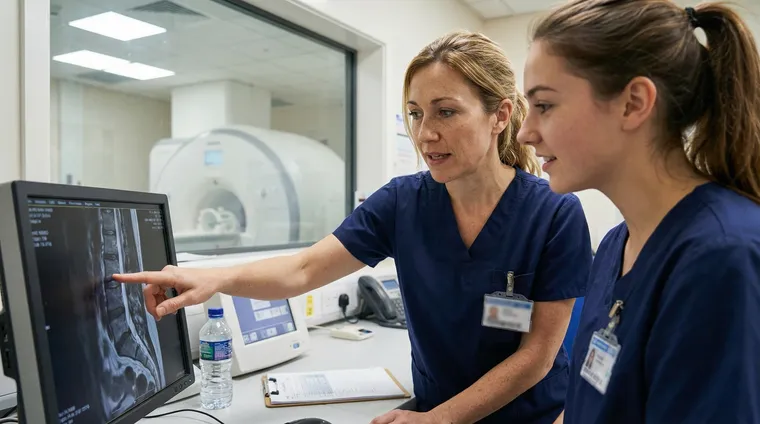
If you’re searching for MRI tech programs near you, here’s what you need to know: you don’t have to live near a campus to get quality training. Hybrid MRI programs combine online coursework with clinical rotations at imaging facilities in your area, so you can train locally without relocating. Programs with national clinical networks place students across 38 or more states — including areas with no traditional MRI school.
The real question isn’t which program is closest. It’s which program will get you credentialed, clinically competent, and hired. This guide covers how to evaluate MRI tech programs by accreditation, clinical support, format, and cost — whether you’re comparing local campus options or hybrid programs with placements near you.
Your Three Options for MRI Tech Training
When you search for MRI tech programs near you, results typically fall into three categories. Each has trade-offs worth understanding before you apply.
| Format | Coursework | Clinical Training | Best For |
|---|---|---|---|
| Campus-based | In person | On-site hospital or clinic | Students who live near a program with open seats |
| Hybrid | Online | Clinical placement near your home | Working adults, career changers, rural students |
| Accelerated | Online (condensed) | Intensive clinical block | Healthcare workers adding MRI in 12–18 months |
Campus-based programs are tied to a specific college or hospital. They work if you live nearby and can get off the waitlist — popular community college MRI programs often have 1–2 year waits.
Hybrid programs pair online education with clinical placements matched to your location. This is how most students train when local options are limited, full, or nonexistent. Programs with large clinical networks can place students in areas that campus-based schools simply can’t reach.
Accelerated programs compress the timeline for students who already have healthcare experience. If you’re a radiologic technologist, medical assistant, or nurse looking to add MRI, an accelerated track may be the fastest path.
What Makes an MRI Program Accredited
Accreditation determines whether you can sit for credentialing exams and whether employers take your training seriously. Two paths exist:
ARRT MRI Certification
- Requires existing ARRT credentials in another modality (typically radiologic technology)
- Program must meet ARRT’s educational requirements
- Best for registered rad techs adding MRI as a specialty
ARMRIT Certification
- Designed for career changers and healthcare workers without prior ARRT credentials
- Programs must be ARMRIT-accredited or meet ARMRIT eligibility requirements
- The primary path for medical assistants, patient care techs, nurses, and people entering healthcare for the first time
When evaluating any program, ask:
- Which credential does this program prepare me for?
- What is the program’s exam pass rate?
- Is the clinical component structured with dedicated mentorship, or am I on my own?
Learn more about certification paths and requirements.
How to Evaluate MRI Tech Programs in Your Area
Whether you’re comparing a local campus program or a hybrid option with clinical placements near you, these factors separate strong programs from weak ones.
Clinical Placement Support
This is the single biggest differentiator. Some programs secure clinical sites for you. Others hand you a list and say good luck.
Ask specifically:
- Does the program place me at a clinical site, or do I find my own?
- How many clinical sites does the program work with?
- What happens if my assigned site doesn’t work out?
- Will I have a dedicated clinical mentor at my site?
Programs with extensive clinical networks can place students in locations that campus-based schools can’t reach. Tesla MR Institute, for example, operates over 334 clinical training sites across 38 states, placing students within driving distance of their homes regardless of whether a traditional MRI school exists nearby.
Curriculum Depth
A solid MRI tech program covers:
- MRI physics — how magnetic resonance imaging actually works
- Cross-sectional anatomy — what you’re looking at on every scan
- MRI safety protocols — screening, zones, ferromagnetic hazards, emergency procedures
- Patient positioning and communication — managing patient anxiety, accurately positioning for each exam type
- Protocol selection and image optimization — adjusting parameters across different exam types
- Administrative responsibilities — documenting patient history, equipment QA, exam room preparation
Programs that skip physics or gloss over safety are cutting corners in ways that show up on your credentialing exam and in your clinical competence.
Cost and Financial Transparency
MRI program tuition ranges from roughly $5,000 to $20,000. Budget an additional $1,000 to $2,000 for clinical requirements: background checks, immunizations, scrubs, liability insurance, and credentialing exam fees.
Programs that don’t publish their pricing upfront are worth questioning. Transparency about cost is a basic indicator of how the program operates overall.
For a detailed breakdown, see our MRI tech program cost guide.
Finding MRI Tech Programs by State
MRI program availability varies significantly by state. States with large healthcare systems (California, Texas, Florida, New York) tend to have more campus-based options. Smaller states may have one or two programs, and some have none.
Here’s how to search effectively:
- Check your state’s licensing board. Some states require specific licensure for MRI technologists. Know your state’s requirements before choosing a program.
- Search the ARMRIT directory. ARMRIT maintains a list of accredited and approved programs.
- Look at community college MRI programs. Many offer MRI certificates or associate degrees, though waitlists are common.
- Consider hybrid programs with national clinical networks. If local options are limited, this may be your best path to quality training without relocating.
Tesla MR Institute currently has clinical sites in 38 states, with the largest concentrations in Texas, California, Florida, New York, and Illinois. Students in rural areas or states with few traditional programs can complete their clinical hours at a nearby imaging facility while studying online.
For state-specific requirements, see our guide on how to become an MRI technologist. We also have detailed state guides including MRI tech programs in Texas, MRI tech programs in Maryland, and MRI tech programs in Virginia.
What to Expect from Clinical Rotations
Clinical hours are where MRI education becomes real. Regardless of which program you choose or where it’s located, here’s what a strong clinical experience includes:
Patient interaction. You’ll work with real patients from day one of clinicals — positioning them for different exam types, managing anxiety, educating them on what to expect, and collaborating with radiologists and nursing staff.
Hands-on scanning. You’ll operate MRI equipment under supervision, learning to select protocols, adjust parameters for image quality, and escalate safety concerns when something doesn’t look right.
Documentation and QA. A significant part of the job involves documenting patient history, cleaning and maintaining equipment, and performing quality assurance checks. Good programs make sure you’re competent in these areas, not just scanning.
Progressive responsibility. You start by observing, move to assisted scanning, and eventually handle exams with decreasing supervision. By the end of your clinical hours, you should be functioning near the level of an entry-level technologist.
Most programs require 750 to 1,000 or more clinical hours. Learn more about what to expect from MRI clinical rotations.
Online vs. In-Person MRI Programs: Which Is Better?
Neither format is inherently better. What matters is the quality of the clinical component and the support structure around it.
Online/hybrid programs work well when:
- The program has a large, established clinical network
- You have a dedicated clinical mentor (not just a site that agreed to take students)
- Coursework is rigorous and covers MRI physics, safety, and anatomy in depth
- There’s real accountability — exams, competency checks, progress tracking
In-person programs work well when:
- You live near the school and clinical site
- You prefer face-to-face instruction for technical subjects
- The program has available seats without a long waitlist
The biggest risk with any program isn’t the format — it’s inadequate clinical support. A student at an online program with a dedicated mentor and structured curriculum will outperform someone at a campus program that treats clinicals as an afterthought.
Read more about online MRI technologist courses and what to look for.
How Tesla MR Institute’s Hybrid Model Works
Tesla MR Institute trains students across 38 states through a hybrid model: online coursework paired with clinical placements at over 334 imaging facilities nationwide. Students range from career changers with no healthcare background to registered radiologic technologists adding MRI as a post-primary specialty.
The program prepares students for ARMRIT certification (for career changers and non-ARRT healthcare workers) or supports ARRT MRI exam preparation (for already-credentialed technologists).
What makes this model work for students searching for MRI tech programs near them: instead of requiring you to move to a campus, the clinical network brings training to your area.
Key Takeaways
- Don’t limit your search to what’s geographically closest. The best MRI tech program for you might be a hybrid option with clinical sites in your area.
- Accreditation is non-negotiable. Verify the program prepares you for ARRT or ARMRIT certification.
- Clinical placement support is the most important factor. Ask how the program handles site placement, mentorship, and what happens if your site doesn’t work out.
- Compare total cost, not just tuition. Factor in clinical requirements, exam fees, and any travel costs.
- Check your state’s requirements first. Licensing varies by state, and some states have specific MRI technologist requirements.
The right MRI tech program isn’t necessarily the closest one — it’s the one that gets you credentialed, competent, and employed.
Related Reading
- Accelerated MRI tech programs — fast-track options for career changers
- Community college MRI programs compared — campus-based options and what to expect
- How to become an MRI technologist — full career path overview
- MRI certification programs online — online-first program options
- Online MRI technologist courses — what to look for in online programs
Frequently Asked Questions
Start by checking your state's licensing requirements, then look for programs accredited by ARMRIT or those that prepare you for the ARRT MRI exam. Online and hybrid programs with local clinical placements can give you access to quality education regardless of where you live. Tesla MR Institute operates clinical sites in 38 states.
The classroom portion of most MRI programs can be completed online, covering MRI physics, anatomy, safety protocols, and imaging procedures. However, clinical rotations must be completed in person at a real imaging facility. Hybrid programs pair online coursework with local clinical placements.
Online and hybrid MRI programs solve this problem. You complete coursework remotely and the program places you at a clinical site near your home. Programs with large clinical networks, like Tesla MR Institute's 334 sites across 38 states, make this possible even in rural areas.
Most MRI programs require 750 to 1,000 or more clinical hours at an approved imaging facility. These hours are essential for developing hands-on skills in patient positioning, protocol selection, image optimization, and MRI safety. The clinical component is what separates credentialed technologists from classroom-only training.
Quality depends on the program, not the format. The best online programs pair rigorous coursework with structured clinical rotations and dedicated mentorship. What matters most is clinical placement support, exam preparation, and whether graduates pass their credentialing exams and find employment.
Yes. Hybrid MRI programs let you complete coursework online on your own schedule. Clinical rotations require in-person hours at an imaging facility, but many programs offer flexible scheduling to accommodate working students. Accelerated programs can be completed in 12 to 18 months.