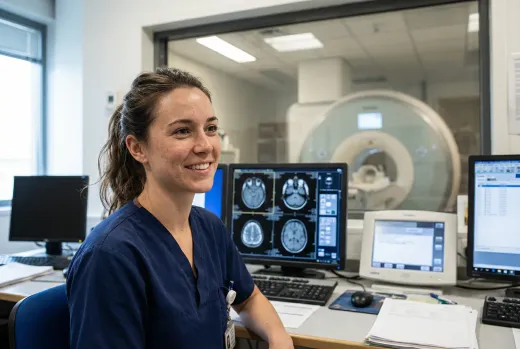
Three MRI tech programs serve Maryland students:
| Program | Duration | Prerequisites | Cost | Best For |
|---|---|---|---|---|
| Johns Hopkins School of Medical Imaging | 6 months | ARRT(R) required | Contact for tuition | Existing rad techs |
| Community College of Baltimore County | ~1 year | ARRT(R) required | $5,000-$8,000 | Existing rad techs, flexible schedule |
| Tesla MR Institute | 12-18 months | None (high school diploma/GED) | Starting at $11,500 | Career changers, no radiology background |
Maryland MRI techs earn $70,000-$100,000 depending on region. The DC metro corridor pays the highest at $99,910 mean annually (BLS). The state has 75+ clinical training sites and no state MRI license requirement.
This guide covers program details, licensing, salary data by metro area, and clinical training site locations across Maryland. Whether you are a career changer or an existing rad tech, Maryland has a pathway for you.
Maryland MRI technologist licensing: what you need to know
Maryland does not require a specific state license for MRI technologists. This is different from states like California and New Jersey that have their own licensing boards for imaging professionals.
That said, the lack of a state license requirement does not mean credentials are optional. Virtually every employer in Maryland requires national certification, and the two options are ARRT (American Registry of Radiologic Technologists) and ARMRIT (American Registry of MRI Technologists).
Which certification Maryland employers accept
Both ARRT and ARMRIT are accepted in Maryland. Here is how that breaks down in practice:
- Johns Hopkins system: Typically requires ARRT for MRI positions, though individual departments may evaluate ARMRIT candidates
- University of Maryland Medical System: Accepts both ARRT and ARMRIT across most facilities
- MedStar Health: Accepts both certifications, with growing openness to ARMRIT-certified techs
- Independent imaging centers and outpatient facilities: Generally accept either certification, with many specifically welcoming ARMRIT candidates to fill open positions faster
The practical reality is that Maryland employers are hiring. The MRI staffing shortage has made most facilities more flexible about certification pathways than they were five years ago.
Key Takeaway
Maryland has no state MRI license requirement. Employers require national certification (ARRT or ARMRIT). Both are widely accepted, with growing ARMRIT acceptance driven by staffing needs.
MRI tech programs in Maryland
Maryland has several distinct pathways into MRI, ranging from post-primary certificates for existing rad techs to standalone programs for career changers.
Johns Hopkins School of Medical Imaging
The Johns Hopkins MRI Technologist Training Program is a six-month, full-time program based in Baltimore. It is a post-primary program, which means you need existing ARRT credentials in another modality (typically radiography) before you can apply.
Key details:
- Duration: 6 months, full-time
- Prerequisite: Current ARRT certification in radiography or another primary pathway
- Location: Johns Hopkins Hospital, Baltimore
- Outcome: Prepares for the ARRT MRI post-primary exam
- Strength: Clinical training at one of the top hospitals in the country
- Limitation: Not open to career changers without existing radiology credentials
Community College of Baltimore County (CCBC)
CCBC offers an MRI certificate program designed for working radiologic technologists. Like Johns Hopkins, this requires prior ARRT certification.
Key details:
- Duration: Approximately 1 year (part-time friendly)
- Prerequisite: Current ARRT(R) certification
- Location: CCBC campuses in Baltimore County
- Outcome: Prepares for ARRT MRI post-primary exam
- Strength: More affordable than hospital-based programs, flexible scheduling
Howard Community College
Howard CC offers a CT and MRI program through its continuing education division in partnership with the credit Health Sciences Division. This is another option for existing technologists looking to add cross-sectional imaging to their credentials.
Tesla MR Institute (hybrid, statewide)
Tesla MR Institute’s program takes a different approach. It is designed for people entering MRI directly, including career changers, healthcare workers without radiology backgrounds, and MRI tech aides looking to advance.
Key details:
- Duration: 12-18 months
- Prerequisite: None. No prior radiology credentials required. Healthcare experience helps but is not mandatory.
- Format: Online didactic coursework combined with in-person clinical rotations at local sites
- Clinical sites in Maryland: 79 facilities across the state (details below)
- Certification: Prepares for ARMRIT certification
- Strength: Accessible to career changers, flexible schedule for working professionals
- Limitation: Prepares for ARMRIT, not ARRT. If your target employer specifically requires ARRT, this is not the right path.
Tip
If you already have ARRT credentials in radiography, the Johns Hopkins or CCBC programs are efficient six-month to one-year paths to add MRI. If you are entering MRI without prior radiology credentials, Tesla MR Institute’s ARMRIT pathway is the most direct option available in Maryland.
Choosing between ARRT and ARMRIT pathways
This decision comes down to where you are starting from. For a detailed side-by-side breakdown, read our ARRT vs ARMRIT comparison guide.
Choose the ARRT pathway if:
- You already hold ARRT certification in another modality
- You want to add MRI as a post-primary certification
- Your target employer specifically requires ARRT(MR)
Choose the ARMRIT pathway if:
- You do not have prior radiology credentials
- You are a career changer from another healthcare field (or outside healthcare entirely)
- You want to enter MRI as quickly as possible
- You are willing to work at employers that accept ARMRIT, which is the majority in Maryland
MRI technologist salary in Maryland
Maryland MRI technologists earn above the national average, with significant variation between the Baltimore metro, the DC corridor, and rural areas.
Salary by region
| Region | Mean Annual Wage | Mean Hourly Wage | Notes |
|---|---|---|---|
| Washington-Arlington-Alexandria (DC-VA-MD) | $99,910 | $48.03 | Highest paying, includes Montgomery/Prince George’s counties |
| Baltimore-Columbia-Towson | $90,000-$95,000 | $43-$46 | Largest employment base in MD |
| Hagerstown-Martinsburg | $75,000-$82,000 | $36-$39 | Western MD, lower cost of living |
| Eastern Shore (Salisbury, Easton) | $70,000-$80,000 | $34-$38 | Rural, fewer positions, lower COL |
Source: Bureau of Labor Statistics, Occupational Employment and Wage Statistics, May 2023. DC metro data includes MD, VA, and DC portions.
The DC metro premium is significant. An MRI tech working in Bethesda or Silver Spring can earn $10,000-$15,000 more per year than one in Baltimore, though cost of living is also higher. The national median for MRI technologists is $95,480 according to May 2025 BLS data, putting Maryland’s DC corridor well above the national benchmark.
Salary by experience level
Entry-level MRI technologists in Maryland typically start between $65,000 and $75,000. With 3-5 years of experience and specialty skills (cardiac MRI, breast MRI, pediatric), salaries commonly reach $90,000-$105,000. Travel MRI techs working Maryland assignments can earn $2,000-$2,800 per week, though these positions are temporary and do not include benefits.
For a deeper dive into MRI tech compensation, see our MRI technologist salary guide and salary by state breakdown.
Clinical training sites in Maryland
This is where Maryland stands out. The state’s concentration of major hospital systems and imaging networks means there are clinical training opportunities across the state, not just in Baltimore.
Tesla MR Institute has 19 active partner sites and 60 additional potential clinical training sites across Maryland. Partner sites are facilities where students are currently training or have trained. Potential sites are affiliated facilities within our healthcare network partners that can accept students as demand grows.
Active Partner Sites (19)
These facilities currently have clinical training agreements with Tesla MR Institute:
RadNet / Advanced Radiology (8 locations)
- Advanced Radiology — St. Joseph’s (Towson)
- Advanced Radiology — Fisher Medical Building (Westminster)
- Advanced Radiology — Columbia 100 Parkway
- Advanced Radiology — Lutherville
- Advanced Radiology — Pomona Square (Pikesville)
- Community Radiology — Laurel
- Community Radiology — Montgomery Community MRI
- Radiology Imaging Associates
University of Maryland Medical System (2 locations)
- University of Maryland — main campus (Baltimore)
- University of Maryland — Capital Region (Largo)
- University of Maryland — MC Midtown Campus (Baltimore)
Chesapeake Medical Imaging (1 location)
- CMI — main (Annapolis)
Charter Radiology (2 locations)
- Charter Radiology — main
- Charter Radiology — Columbia
Solis / Washington Radiology (1 location)
- Washington Radiology — Greenbelt
The Radiology Clinic (2 locations)
- Rockville
- Main location
Potential Clinical Training Sites (60)
These are affiliated facilities within our partner networks that can accept students. If you need clinical training in a specific part of Maryland, there is likely a site near you:
Chesapeake Medical Imaging (CMI) — 12 locations Annapolis (Bestgate), Annapolis (Defense), Annapolis (Weems Creek), Bowie, Catonsville, Chestertown, Columbia, Easton, Fulton (Maple Lawn), Glen Burnie, Kent Island, Lutherville
RadNet / Advanced Radiology — 11 locations Aiello Center at BWMC, Annapolis, Crain Towers, Crossroads, Eldersburg, Owings Mills, Shipleys Choice, Timonium Crossing, UM St. Joseph Imaging, American Radiology (Calvert Medical Imaging Center, O’Donnell/Waldorf, Patuxent/Prince Frederick, Clinton)
MedStar Health — 7 locations Franklin Square Medical Center (Rosedale), Good Samaritan Hospital (Baltimore), Harbor Hospital (Baltimore), Montgomery Medical Center (Olney), Southern Maryland Hospital Center (Clinton), Union Memorial Hospital (Baltimore), Shah Medical Group / Calvert Arts (Prince Frederick)
University of Maryland — 7 locations BWMC (Glen Burnie), Charles Regional (La Plata), Easton, Mt. Washington Pediatric (Baltimore), Rehabilitation and Orthopedic (Baltimore), Shore Regional (Cambridge), St. Joseph (Towson), Upper Chesapeake (Bel Air)
Solis / Washington Radiology — 7 locations Bel Air, Bethesda, Germantown, Hagerstown, Olney, Potomac, Salisbury
RadX / Washington Open MRI — 5 locations Greenbelt, Owings Mills, Oxon Hill, Rockville, main location
Charter Radiology — 2 locations Clarksville, Reisterstown
UPMC — 1 location Western Maryland Hospital (Cumberland)
Tip
With 79 total sites (19 partner + 60 potential), Maryland has one of the densest clinical training networks of any state in our system. Most students in Maryland are placed within 30 minutes of their home.
Employer Tip
If you are a facility manager in Maryland interested in hosting MRI training students, Tesla MR Institute partners with hospitals and imaging centers across the state. Hosting students gives you a direct pipeline to trained, certified MRI technologists. See our clinical site partnership page for details.
Which sites have active students?
Eleven Maryland facilities currently have Tesla MR students in clinical training or have graduated students:
- Radnet Fisher Medical Building (Westminster) — 14 students placed, the most active clinical site in Maryland
- University of Maryland Easton — 5 students
- University of Maryland Charles Regional (La Plata) — 3 students
- MedStar Calvert Arts (Prince Frederick) — 2 students
- Radnet Clinton — 2 students
- MedStar Good Samaritan (Baltimore) — 2 students
- University of Maryland (Baltimore) — 1 student
- Radnet St. Joseph’s (Towson) — 1 student
- Radnet Medical Park Drive (Silver Spring) — 1 student
- University of Maryland BWMC (Glen Burnie) — 1 student
- MedStar Health (Columbia) — 1 student
Maryland has a 27% graduation rate among Tesla MR students, the highest of any state with a significant student population. That is not a coincidence. The density of clinical sites, the quality of partner facilities, and the proximity to major medical systems all contribute to stronger completion rates.
Tesla MR Institute has 75+ clinical sites across Maryland, from Baltimore to the Eastern Shore. Train locally while completing coursework online.
How to become an MRI tech in Maryland: step by step
Path 1: Career changers and new entrants (ARMRIT)
- Confirm eligibility. You need a high school diploma or GED. Healthcare experience is preferred but not required. MRI tech aides, patient care technicians, nursing assistants, and medical assistants are strong candidates.
- Enroll in an ARMRIT-approved program. Tesla MR Institute’s hybrid program lets you complete didactic coursework online while doing clinical rotations at a Maryland facility.
- Complete clinical hours. You will log supervised clinical training at one of 79 Maryland sites. Total clinical hour requirements vary but typically range from 750 to 1,500+ hours depending on the program.
- Pass the ARMRIT exam. After completing your program and clinical requirements, you sit for the ARMRIT certification exam. Study resources include practice tests and study guides.
- Apply for jobs. No Maryland state license application is needed. Your ARMRIT certification is your credential. Start applying to hospitals, imaging centers, and outpatient facilities.
Path 2: Existing rad techs (ARRT post-primary)
- Confirm ARRT eligibility. You need current ARRT certification in a primary pathway (typically radiography).
- Enroll in a post-primary MRI program. Johns Hopkins (6 months) or CCBC (approximately 1 year) are the main Maryland-based options.
- Complete structured clinical requirements. ARRT requires documented clinical experience in MRI procedures.
- Pass the ARRT MRI exam. This is the post-primary MRI specialty exam administered by ARRT.
- Update your credentials. Your ARRT(MR) certification goes on your resume alongside your existing credentials.
For a broader look at MRI tech requirements across all states, see our state-by-state guide.
Maryland MRI tech job market
Maryland’s job market for MRI technologists is driven by three factors:
1. Major hospital system concentration. Baltimore alone has Johns Hopkins, University of Maryland, MedStar, and LifeBridge, each running multiple MRI scanners across multiple campuses. The DC metro side adds Walter Reed, NIH, and Adventist HealthCare.
2. Federal medical facilities. Walter Reed National Military Medical Center in Bethesda and the National Institutes of Health create additional demand that most states do not have. Federal MRI positions often come with strong benefits packages and job security, though clearance requirements can slow the hiring process.
3. Aging workforce. Like the rest of the country, Maryland’s existing MRI technologist workforce is aging. The national projection is 6% employment growth for MRI techs through 2033 according to BLS, but states with older workforces will need to replace retiring techs on top of that growth.
The practical result: Maryland employers are hiring, and the combination of competitive salaries and program availability makes it one of the better states to enter the field.
Cost of MRI tech programs in Maryland
Program costs vary significantly:
| Program | Approximate Cost | Duration | Prerequisites |
|---|---|---|---|
| Johns Hopkins MRI | Contact for current tuition | 6 months | ARRT(R) |
| CCBC MRI Certificate | $5,000-$8,000 | ~1 year | ARRT(R) |
| Tesla MR Institute | under $13,000 (full program, payment plans available) | 12-18 months | None |
Tesla MR Institute’s tuition is transparent and includes all didactic coursework and clinical placement. There are no hidden fees for clinical site matching. Payment plans are available, and some students receive employer sponsorship, which our applicant data shows is the strongest predictor of student success.
For a detailed cost breakdown across different program types, see our guide on MRI tech school costs.
MRI programs by city in Maryland
Looking for MRI training in a specific Maryland city? See our detailed guides:
- MRI tech programs in Annapolis
- MRI tech programs in Baltimore
- MRI tech programs in Glen Burnie
- MRI tech programs in Hagerstown
- MRI tech programs in Prince Frederick
- MRI tech programs in Silver Spring
More resources
If you are still researching the MRI tech career path, these guides cover the broader picture beyond Maryland:
- How to become an MRI technologist covers every step from zero experience to your first job, regardless of state
- MRI technologist salary guide breaks down pay by state, setting, shift type, and experience level
- MRI technologist requirements explains what employers verify during hiring
Next steps
If you are ready to move forward:
- Research your pathway. Decide between ARRT (if you have existing credentials) and ARMRIT (if you are entering MRI directly). Our ARRT vs ARMRIT guide breaks down the tradeoffs.
- Check clinical site availability. Tesla MR has 79 Maryland sites, but site availability varies by semester. Apply early to get placed at your preferred facility.
- Talk to your employer. If you are currently working in healthcare, ask about tuition sponsorship. Employer-referred students have the highest enrollment and completion rates in our program.
- Apply. Tesla MR Institute accepts rolling applications. There is no application fee.