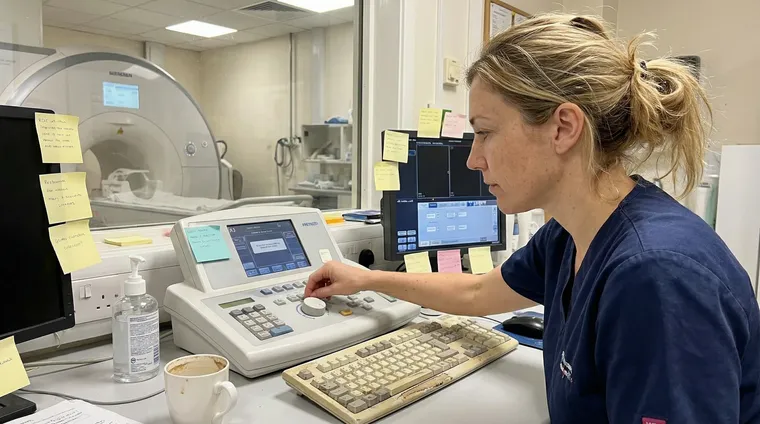
An MRI technologist is a healthcare professional who operates magnetic resonance imaging scanners to create diagnostic images of the body’s internal structures. MRI technologists screen patients for safety, position them in the scanner, execute imaging protocols, and ensure diagnostic-quality images. The role combines technical expertise with hands-on patient care. The median salary is $95,480/year, with 6% job growth projected through 2032.
Definition
An MRI technologist (also called MRI tech or MR technologist) is a healthcare professional who operates magnetic resonance imaging (MRI) scanners to produce diagnostic images of internal body structures. The role combines technical expertise with patient care skills.
In practice, the job involves:
- Screening patients for MRI safety (implants, metal, devices)
- Positioning patients and communicating with them to stay still during scans
- Executing imaging protocols appropriate to each clinical question
- Assessing image quality and troubleshooting issues
- Collaborating with radiologists and the healthcare team
MRI technologists do not interpret images (that’s the radiologist’s role), but they’re responsible for producing diagnostic-quality images safely.
Key Facts
| Attribute | Details |
|---|---|
| Median salary | $95,480/year (BLS, May 2023) |
| Job growth | 6% projected growth 2022–2032 |
| Typical education | 12–18 month MRI program or ARRT post-primary |
| Credentials | ARRT (MR) or ARMRIT |
| Work settings | Hospital, outpatient imaging, specialty clinics |
What MRI Technologists Actually Do
Safety Screening
The foundation of MRI work. Before any patient enters the MRI environment, technologists screen for:
- Implanted devices (pacemakers, cochlear implants, pumps)
- Metal fragments (occupational exposure, injuries)
- Surgical hardware
- Pregnancy
- Contrast contraindications
MRI uses powerful magnets. Certain metals or devices can be dangerous in the magnetic field. Screening is not a formality; it’s a safety-critical function.
Patient Positioning and Communication
MRI exams require patients to lie still for 20–60 minutes inside a confined scanner. Technologists:
- Position patients optimally for the exam being performed
- Explain the procedure to reduce anxiety
- Communicate with patients through the scan, especially those with claustrophobia
- Monitor patient comfort throughout the exam
Motion during MRI affects image quality. Patient communication directly affects image quality.
Protocol Execution
MRI technologists run imaging sequences appropriate to each exam:
- Select correct coils and positioning
- Execute protocol sequences (T1, T2, FLAIR, DWI, etc.)
- Adjust parameters when needed
- Administer contrast agents when ordered
- Monitor image quality in real-time
Image Quality Assessment
Technologists evaluate images as they’re acquired:
- Check for adequate coverage and positioning
- Identify artifacts and determine if sequences need repeating
- Ensure diagnostic quality before releasing the patient
MRI Technologist vs. Related Roles
| Role | Key Difference |
|---|---|
| Radiologic technologist | Broader scope across imaging modalities; MRI tech is specialized |
| CT technologist | Works with computed tomography; different technology and protocols |
| Radiologist | Physician who interprets images; MRI techs produce the images |
| Radiology nurse | Patient care focus; may assist with contrast but doesn’t run scans |
Why MRI Technologists Matter
MRI produces detailed images of soft tissues, the brain, spine, joints, and organs. This information shapes diagnoses and treatment decisions. The technologist’s work directly affects:
- Diagnostic accuracy: Poor image quality or incorrect protocols can miss pathology
- Patient safety: Screening errors can cause serious harm
- Patient experience: Effective communication makes a difficult exam tolerable
- Healthcare efficiency: Skilled techs keep schedules moving without sacrificing quality
Career Outlook
According to the Bureau of Labor Statistics, employment for MRI technologists is projected to grow 6% from 2022 to 2032. Industry data indicates over 85% of healthcare organizations report difficulty filling MRI positions, with approximately 15,000+ job openings expected annually.
Factors driving demand:
- Aging population requiring more diagnostic imaging
- Expanding clinical applications of MRI
- Replacement of retiring technologists
- Healthcare system growth
Related Reading
Frequently Asked Questions
Not exactly. Radiologic technologists work across imaging modalities (X-ray, CT, etc.). MRI technologists specialize specifically in MRI, with deep expertise in MRI safety, protocols, and patient management for magnetic resonance imaging.
Most employers require a recognized credential. Common options are ARRT post-primary MRI (for already-credentialed techs) or ARMRIT (common for career changers through MRI-specific programs).
Safety screening judgment, patient communication and managing patient anxiety, protocol execution, and image quality assessment. The job requires both technical competence and strong interpersonal skills.
Hospitals, outpatient imaging centers, specialty clinics (orthopedic, cardiac, neurological), and mobile imaging units. Work environment varies from fast-paced outpatient to complex hospital settings.
Most dedicated MRI training programs take 12–18 months. Timeline depends on clinical hour completion and whether you're a career changer or adding MRI to existing credentials.