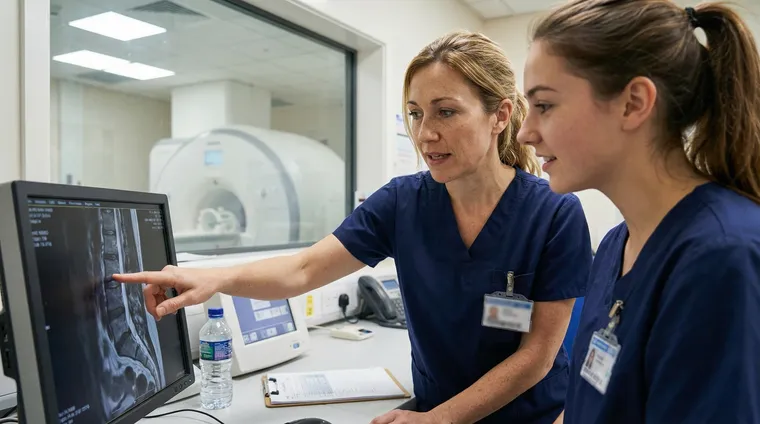
An MRI tech certificate program trains you specifically in MRI technology in 12–18 months, while a degree program (associate or bachelor’s) takes 2–4 years and includes broader radiologic science coursework. Both lead to MRI certification, but certificate programs are faster, cheaper, and designed for career changers who want to enter MRI directly without studying X-ray, CT, or other modalities.
This guide breaks down what MRI tech certificate programs are, who they are designed for, how they compare to degree programs, and what to look for when choosing one.
What Is an MRI Tech Certificate Program?
An MRI tech certificate program is a focused training pathway that covers everything you need to become a credentialed MRI technologist without the general education requirements of a full degree. The curriculum typically includes:
- MRI physics and principles of magnetic resonance imaging
- Cross-sectional anatomy relevant to MRI procedures
- MRI safety, including ferromagnetic screening, Zone IV protocols, and implant compatibility
- Patient positioning and communication, including managing patient anxiety and educating patients on what to expect during their exam
- Protocol selection and image optimization for various body regions
- Clinical rotations at approved imaging facilities, where you gain hands-on experience under a qualified mentor
Certificate programs generally take 12 to 18 months to complete. They are built for people who want to focus on MRI specifically and enter the workforce faster than a traditional degree path allows.
Who Are MRI Certificate Programs For?
Certificate programs serve a wider range of students than many people realize:
- Career changers from outside healthcare who want a direct path into medical imaging
- Medical assistants, patient care techs, and tech assistants who already work in healthcare and want to move into MRI
- Nurses and allied health professionals looking to transition into imaging
- Radiologic technologists pursuing MRI as a post-primary credential through the ARRT
- Anyone seeking the ARMRIT credential through the primary eligibility pathway
If you already hold an ARRT credential in another modality (radiography, nuclear medicine, radiation therapy, or sonography), you may qualify for a shorter post-primary MRI certificate. If MRI is your first imaging credential, you will follow the primary pathway.
Certificate vs. Associate Degree: How They Compare
This is the most common question prospective students ask. Here is a straightforward comparison.
Timeline
Certificate programs typically run 12 to 18 months. Associate degree programs run 18 to 24 months. The difference comes from general education coursework (English, math, social sciences) required by degree programs but not by certificates.
Cost
Certificate programs generally cost $5,000 to $20,000. Associate degrees range from $10,000 to $40,000 or more at private institutions. The savings with a certificate come from fewer credit hours and shorter enrollment.
Credential Eligibility
Both pathways can qualify you for the same credentialing exams. The ARRT MRI exam and the ARMRIT exam do not require a specific degree. They require completion of an approved educational program and the appropriate clinical hours. What matters is whether your program meets the credentialing body’s education requirements, not whether it awards a certificate or a degree.
Career Prospects
Most MRI employers hire based on credentials (ARRT MR or ARMRIT), clinical competence, and experience. Some larger hospital systems and academic medical centers prefer or require an associate or bachelor’s degree. For outpatient imaging centers, orthopedic clinics, and many hospital positions, a certificate plus the right credential is sufficient.
The Bottom Line
If your primary goal is to become a credentialed MRI technologist and start working as quickly as possible, a certificate program is often the most efficient path. If you plan to pursue leadership roles, move into education, or want the flexibility of a transferable degree, an associate or bachelor’s program may be worth the additional time and cost.
What About CT and MRI Certificate Programs?
Some programs bundle CT and MRI training into a single certificate, which is worth considering if you want to be competitive in both modalities. Combined programs typically run 18 to 24 months and prepare you to sit for credentialing exams in both CT and MRI.
The advantage of dual credentials is clear: you are eligible for more positions, you can cross-train within a department, and your earning potential increases. The tradeoff is a longer program and higher tuition compared to a single-modality certificate.
If you are starting from scratch and not sure which modality to pursue, keep in mind that MRI and CT have different daily workflows. MRI exams take longer (often 30 to 60 minutes per patient), involve no ionizing radiation, and require strong patient communication skills. CT exams are faster, involve radiation dose management, and tend to be higher volume. Both are in demand.
How to Evaluate an MRI Certificate Program
Not all certificate programs are created equal. Here is what to look for:
Accreditation and Recognition
The program should be recognized by the credentialing body you plan to test with. For the ARRT MRI exam, the program must meet ARRT’s education requirements. For the ARMRIT exam, the program should be ARMRIT-recognized. Ask directly: “Will completing this program make me eligible to sit for the ARRT MRI exam or the ARMRIT exam?”
Clinical Placement Support
This is the make-or-break factor for many students. Some programs accept your tuition but leave you to find your own clinical site. Others have established clinical networks and place you at a site near your home.
Tesla MR Institute, for example, operates more than 334 clinical training sites across 38 states. Students are matched with a clinical site and a dedicated mentor, which eliminates one of the biggest barriers in MRI education: finding a facility willing to train you.
Clinical Hours
Most credentialing pathways require 750 to 1,000 or more clinical hours. Confirm how many hours the program requires and how those hours are structured. Are you completing rotations full-time or part-time? Is there flexibility for students who are working while enrolled?
Online vs. In-Person Coursework
Many certificate programs now offer the didactic portion online, which makes them accessible regardless of where you live. The key question is the quality of the online instruction: does it include video lectures, interactive content, and access to instructors, or is it just a collection of PDFs?
Clinical rotations are always in person. You cannot learn to accurately position patients, collaborate with radiologists, or manage patient anxiety from a screen.
Exam Preparation
Ask about the program’s pass rates on the ARRT MRI or ARMRIT exam. Strong programs build exam preparation into the curriculum rather than treating it as an afterthought. Look for programs that include practice exams, focused review sessions, and structured preparation in the final months of the program.
Student Support
MRI education is demanding. The curriculum covers physics, anatomy, safety protocols, and clinical skills simultaneously. Programs with academic advising, mentorship, and responsive faculty make a real difference, especially for career changers who may not have a healthcare background.
What Does MRI Certificate Training Actually Look Like?
A typical MRI certificate program includes two parallel tracks:
Didactic coursework covers the foundational knowledge you need before and during clinical rotations. This includes MRI physics (how magnetic resonance creates images), cross-sectional anatomy (understanding what you are imaging), safety protocols (screening patients for contraindications, managing the MRI environment), and imaging procedures (selecting protocols, adjusting parameters to optimize image quality, recognizing artifacts).
Clinical rotations put you in a working MRI department alongside experienced technologists. During rotations, you will practice patient positioning and communication, learn to operate MRI equipment, develop proficiency with common protocols (brain, spine, knee, shoulder, abdomen), perform quality assurance checks, document patient history, and collaborate with radiologists and clinical staff. You will also handle the administrative side of the role: cleaning and preparing the exam room, verifying patient information, and escalating safety concerns to the radiologist when they arise.
At Tesla MR Institute, students complete their clinical rotations with a dedicated mentor at one of more than 334 partnered sites. The program uses simulator-based training alongside real clinical hours to build competency progressively.
How to Find an MRI Tech Certificate Program Near You
If you are searching for an “MRI tech certificate program near me,” your options are broader than you might think. Online and hybrid programs with clinical placement networks mean you are not limited to programs in your immediate area.
Start by identifying which credential you want to pursue (ARRT MR or ARMRIT), then look for programs that meet those eligibility requirements. If local programs have long waitlists or limited availability, hybrid programs with national clinical networks offer a practical alternative.
Tesla MR Institute accepts students across 38 states, with clinical placements matched to your location. If there is an MRI facility near you, there is a good chance the program can place you there.
Frequently Asked Questions
The FAQ section above covers the most common questions about MRI tech certificate programs. If you have a specific question about program eligibility, clinical placement, or the credentialing process, reaching out to the program directly is always the best next step.
Related Resources
Frequently Asked Questions
An MRI tech certificate program is a focused training program that prepares students specifically for MRI technology, covering MRI physics, safety, patient communication, anatomy, and clinical rotations. Certificate programs typically take 12 to 18 months and are designed for career changers, healthcare workers looking to add MRI credentials, or anyone who wants a direct path to credentialing without a full degree program.
Yes. Many MRI certificate programs offer the classroom and didactic portion online, covering MRI physics, cross-sectional anatomy, safety protocols, and imaging procedures. However, the clinical rotation component must be completed in person at an approved imaging facility. Hybrid programs pair online coursework with clinical placements near your home.
MRI certificate program costs range from roughly $5,000 to $20,000 depending on the institution, program length, and whether it includes clinical placement support. Certificate programs are generally less expensive than associate degree programs because they focus exclusively on MRI-specific training without general education coursework.
In most cases, yes. What employers and credentialing bodies care about is whether you can pass the ARRT MRI or ARMRIT exam and hold the appropriate credential. A certificate from an accredited or recognized MRI program qualifies you to sit for these exams. Some employers prefer candidates with associate or bachelor's degrees, but many hire based on credentials and clinical competence.
CT and MRI are separate imaging modalities with different physics, safety considerations, and clinical workflows. CT certificate programs focus on computed tomography, ionizing radiation safety, and CT-specific anatomy. MRI programs focus on magnetic resonance physics, MRI safety (including ferromagnetic screening), and MRI-specific protocols. Some programs offer combined CT and MRI certificates for technologists who want dual credentials.