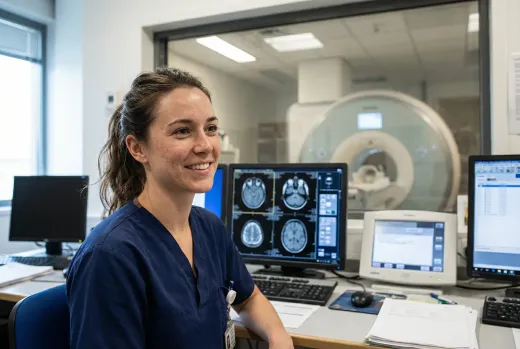
MRI technologist licensing in Wisconsin
Wisconsin does not require a specific state license for MRI technologists. MRI uses magnetic fields, not ionizing radiation, so it falls outside most state radiologic technology licensing requirements. Employers require national certification through ARRT or ARMRIT.
Both ARRT and ARMRIT certifications are accepted by most Wisconsin employers. The MRI staffing shortage has made facilities across the state increasingly flexible about certification type, with outpatient imaging centers and community hospitals leading the way in accepting ARMRIT-certified technologists.
Key Takeaway
Wisconsin does not require a state license for MRI technologists. Employers require national certification (ARRT or ARMRIT), and both are widely accepted across the state.
MRI tech programs in Wisconsin
Tesla MR Institute (hybrid, statewide)
Tesla MR Institute’s program is designed for people entering MRI directly, including career changers and healthcare workers without radiology backgrounds.
Key details:
- Duration: 12-18 months
- Prerequisite: None. No prior radiology credentials required.
- Format: Online didactic coursework combined with in-person clinical rotations at local Wisconsin sites
- Clinical sites in Wisconsin: 3+ facilities across the state
- Certification: Prepares for ARMRIT certification
- Cost: Starting at $11,000 (full program, payment plans available)
- Strength: Accessible to career changers, flexible schedule, affordable
Traditional pathway (ARRT)
If you already hold ARRT certification in radiography or another primary modality, you can add MRI as a post-primary specialty through structured clinical experience and the ARRT MRI exam. Contact local radiologic technology programs or your employer for post-primary training opportunities in Wisconsin.
Tip
For a detailed comparison of ARRT vs ARMRIT pathways, read our ARRT vs ARMRIT comparison guide.
MRI technologist salary in Wisconsin
MRI technologists in Wisconsin earn an average of approximately $78K per year, with salaries ranging from $65K-$90K depending on metro area, experience, and facility type.
The national median for MRI technologists is $88,180 according to May 2024 BLS data.
Entry-level MRI technologists in Wisconsin typically start at the lower end of this range. With 3-5 years of experience and specialty skills (cardiac MRI, breast MRI, pediatric), salaries move toward the upper range. Travel MRI techs working Wisconsin assignments can earn premium weekly rates.
For a deeper dive into MRI tech compensation, see our MRI technologist salary guide and salary by state breakdown.
Clinical training sites in Wisconsin
Tesla MR Institute has 20+ clinical training sites across Wisconsin, with concentrations in Pleasant Prairie, Platteville, La Crosse.
Most Wisconsin students are placed within 30-45 minutes of their home. The larger metro areas have the most available sites and the quickest placement timelines.
Employer Tip
If you are a facility manager in Wisconsin interested in hosting MRI training students, Tesla MR Institute partners with hospitals and imaging centers across the state. See our clinical site partnership page for details.
How to become an MRI tech in Wisconsin
Path 1: Career changers (ARMRIT)
- Confirm eligibility. You need a high school diploma or GED. Healthcare experience is preferred but not required.
- Enroll in an ARMRIT-approved program. Tesla MR Institute’s hybrid program lets you complete didactic coursework online while doing clinical rotations at a Wisconsin facility.
- Complete clinical hours. Log supervised clinical training at one of 3+ Wisconsin sites.
- Pass the ARMRIT exam. After completing your program and clinical requirements, sit for the ARMRIT certification exam.
- Apply for jobs. Your ARMRIT certification is your credential.
Path 2: Existing rad techs (ARRT post-primary)
- Confirm ARRT eligibility. You need current ARRT certification in a primary pathway.
- Complete post-primary MRI requirements. Through employer-sponsored clinical experience or structured education.
- Pass the ARRT MRI exam.
- Update your credentials. Your ARRT(MR) certification goes on your resume.
For a broader look at requirements across all states, see our state-by-state guide.
MRI licensing in Wisconsin
Wisconsin does not require a specific state license for MRI technologists. The state’s Department of Safety and Professional Services does not regulate MRI under its radiologic technology statutes since MRI does not involve ionizing radiation. Employers require ARRT(MR) or ARMRIT certification. Wisconsin’s well-established health system networks have standardized credentialing processes.
Employers throughout Wisconsin accept both ARRT(MR) and ARMRIT certification. Tesla MR Institute’s program prepares you for the ARMRIT exam, which does not require prior X-ray credentials.
MRI salary by metro in Wisconsin
MRI technologists in Wisconsin earn $68K-$94K per year depending on location and experience. Wisconsin MRI tech salaries are slightly below the national median of $88K, though the Milwaukee and Madison metro areas approach national parity and the state’s moderate cost of living provides strong purchasing power.
| Metro Area | Salary Range |
|---|---|
| Milwaukee-Waukesha-West Allis | $72K-$94K |
| Madison | $72K-$92K |
| Green Bay-Appleton | $66K-$86K |
| La Crosse-Onalaska | $66K-$86K |
Where MRI techs work in Wisconsin
Wisconsin’s healthcare market is defined by large integrated health systems that span the entire state, from Milwaukee through rural northern communities.
Milwaukee metro
Froedtert & Medical College of Wisconsin is Milwaukee’s academic medical center and the state’s only adult Level I trauma center. The MRI department operates 1.5T and 3T scanners handling complex neuro, cardiac, and oncology cases. Froedtert offers exposure to advanced imaging protocols and research sequences, making it a strong starting point for technologists who want academic medical center experience. Salaries at Froedtert run at the top of the Milwaukee range ($72K-$94K).
Advocate Aurora Health is one of the largest health systems in the Midwest, operating 15+ hospitals across Wisconsin. Aurora’s Milwaukee-area facilities handle high volumes of routine and specialty MRI. The system’s scale means internal transfer opportunities across locations and consistent scheduling.
Ascension Wisconsin operates several hospitals in the Milwaukee area, including Columbia St. Mary’s and St. Francis. They accept both ARRT and ARMRIT certification.
Madison metro
UW Health is the academic health system of the University of Wisconsin-Madison. The imaging department supports clinical care, medical education, and research. MRI techs at UW Health work alongside residents and fellows, which creates a teaching-oriented environment. The Madison market tends to be competitive, with strong demand and salaries approaching $92K for experienced techs.
SSM Health (St. Mary’s Hospital) and UnityPoint Health - Meriter also employ MRI technologists in the Madison area.
Greater Wisconsin
Marshfield Clinic Health System covers rural and central Wisconsin with a network of hospitals and clinics. Marshfield is nationally recognized for rural healthcare delivery, and MRI techs here see a broad case mix because there are fewer specialists to handle niche referrals. It is an excellent place to build general MRI skills.
Gundersen Health System (La Crosse) serves western Wisconsin and parts of Minnesota and Iowa. ThedaCare covers the Fox Valley region. Bellin Health and HSHS St. Vincent Hospital serve the Green Bay area.
Outpatient imaging
National and regional imaging networks operate across Wisconsin’s major metros. Outpatient centers typically offer predictable daytime hours and accept both ARRT and ARMRIT certification.
More resources
- How to become an MRI technologist — step-by-step career guide
- MRI technologist salary guide — pay by state, setting, and experience
- MRI technologist requirements — what employers verify
- ARRT vs ARMRIT certification — choose the right credential path