All body parts
MRI Anatomy Flashcards · Neuro

L-Spine Anatomy

Learn to identify every labeled structure on a L-Spine MRI, plane by plane.

Studying as a guest, so progress saves on this device only.

L-Spine anatomy, structure by structure

Lumbar spine MRI is one of the highest-volume exams a technologist runs, and clean images start with knowing the normal anatomy cold. This reference walks through every structure in our L-Spine flashcard deck across the two standard planes (sagittal and axial), with a plain-language definition, how each structure looks on MRI, and the pathology you will actually run into at the scanner.

Cord, conus and cauda equina

The neural contents of the lumbar canal. The cord tapers to the conus around L1, and the nerve roots below it float in CSF as the cauda equina, all best traced on the midline sagittal.

Spinal Cord labeled on a L-Spine MRI (Sagittal · Axial)

Spinal Cord

The continuation of the brainstem that carries motor and sensory tracts; in the lumbar region only its lower thoracic segments and tapering tip are present.

On MRI: A smooth, low-to-intermediate band running down the center of the canal on midline sagittal, surrounded by bright CSF on T2; on axial it is a rounded structure sitting in the middle of the thecal sac at upper lumbar levels.

Common pathology: Cord compression from a high lumbar disc or mass, conus-level tumors, and demyelination are assessed where the cord is still present above the conus.

Conus Medullaris labeled on a L-Spine MRI (Sagittal · Axial)

Conus Medullaris

The tapered lower end of the spinal cord, which in most adults terminates at about the L1 level.

On MRI: The pointed tip of the cord on midline sagittal, normally ending near the L1 vertebral body or the L1-L2 disc; on axial it is the last solid cord-like structure before only nerve roots remain.

Common pathology: A low-lying conus (below L2) raises concern for tethered cord; conus tumors and ischemia also localize here.

Tip: Find where the cord narrows to a point on the sagittal and read off the adjacent vertebral level; a tip below L2 is abnormal and worth noting.

Cauda Equina labeled on a L-Spine MRI (Sagittal · Axial)

Cauda Equina

The bundle of lumbar and sacral nerve roots that descend below the conus, named for their resemblance to a horse's tail.

On MRI: Fine linear roots layered in the dependent (posterior) part of the thecal sac on axial, dark against bright CSF on T2; on sagittal they appear as thin strands filling the canal below the conus.

Common pathology: Cauda equina syndrome from a large central disc herniation is an emergency; clumped or thickened roots suggest arachnoiditis or leptomeningeal disease.

Discs and ligaments

The intervertebral discs and the long ligaments that stabilize the spine, all running front to back along the midline sagittal.

Intervertebral Disc labeled on a L-Spine MRI (Sagittal)

Intervertebral Disc

The fibrocartilage cushion between adjacent vertebral bodies, with a soft central nucleus pulposus and a tough outer annulus fibrosus.

On MRI: A normal hydrated disc is bright on T2 with a visible central nucleus; it sits between the vertebral bodies and darkens as it degenerates and loses water.

Common pathology: Disc desiccation, bulges, and herniations are the most common findings on a lumbar MRI; a herniation can compress the thecal sac or an exiting nerve root.

Anterior Longitudinal Ligament labeled on a L-Spine MRI (Sagittal)

Anterior Longitudinal Ligament

The broad ligament running along the front of the vertebral bodies that limits extension of the spine.

On MRI: A thin dark line along the anterior surface of the vertebral bodies and discs on midline sagittal, blending with the adjacent cortex and annulus.

Common pathology: Injured in hyperextension trauma; ossifies in conditions such as DISH, which bridges the anterior bodies.

Posterior Longitudinal Ligament labeled on a L-Spine MRI (Sagittal)

Posterior Longitudinal Ligament

The ligament running along the back of the vertebral bodies inside the canal that limits flexion.

On MRI: A thin dark band along the posterior margin of the vertebral bodies and discs on midline sagittal, forming the front wall of the spinal canal.

Common pathology: Tented or stripped by a herniated disc; ossification of the posterior longitudinal ligament can narrow the canal.

Supraspinous Ligament labeled on a L-Spine MRI (Sagittal)

Supraspinous Ligament

The cord-like ligament connecting the tips of adjacent spinous processes along the back of the spine.

On MRI: A thin dark line along the posterior tips of the spinous processes on midline sagittal, at the very back of the imaged field.

Common pathology: Disruption is a sign of posterior ligamentous complex injury in flexion-distraction trauma, which affects spinal stability.

Posterior elements and facet joints

The bony arch behind the canal and the paired facet joints, best evaluated on axial images where they form the back wall of the canal.

Spinous Process labeled on a L-Spine MRI (Sagittal · Axial)

Spinous Process

The bony projection extending posteriorly from the vertebral arch, the bump you can feel along the back.

On MRI: A midline posterior bony spur on sagittal with bright fatty marrow on T1; on axial it points straight back from the lamina at the midline.

Common pathology: Fractures, the surgical target for laminectomy approaches, and edema (bone bruise) on fat-suppressed sequences after trauma.

Lamina of Vertebral Arch labeled on a L-Spine MRI (Axial)

Lamina of Vertebral Arch

The flat plates of bone that join to form the roof of the vertebral arch and protect the back of the spinal canal.

On MRI: Paired bony plates on axial sweeping back from the pedicles to meet at the spinous process, with bright marrow on T1 and a dark cortical rim.

Common pathology: Removed during laminectomy/laminotomy for decompression; the site of pars defects and post-surgical changes.

Superior Articular Process labeled on a L-Spine MRI (Axial)

Superior Articular Process

The upward-facing bony projection of the vertebral arch that forms the lower half of the facet joint with the vertebra above.

On MRI: On axial it is the more anterior and lateral of the two facet components, with its articular surface facing posteromedially toward the inferior articular process tucked inside it; bright marrow on T1 and a dark cortical edge.

Common pathology: Hypertrophy from facet arthropathy narrows the lateral recess and can compress the traversing nerve root.

Inferior Articular Process labeled on a L-Spine MRI (Axial)

Inferior Articular Process

The downward-facing bony projection of the vertebral arch that forms the upper half of the facet joint with the vertebra below.

On MRI: On axial it is the more posterior and medial facet component, nestled inside the superior articular process of the level below, with its articular surface facing anterolaterally.

Common pathology: Facet hypertrophy and joint degeneration here contribute to central and foraminal stenosis.

Zygapophyseal Joint labeled on a L-Spine MRI (Axial)

Zygapophyseal Joint

The paired synovial facet joint between the inferior articular process above and the superior articular process below at each level.

On MRI: A thin obliquely oriented joint space on axial between the two articular processes; normal cartilage and a small amount of fluid may be visible.

Common pathology: Facet arthropathy, joint effusions, and synovial cysts that can project into the canal and cause stenosis.

Tip: Trace the joint cleft between the two articular processes on axial; fluid bright on T2 in the joint often signals instability at that level.

Vertebral body and foramina

The weight-bearing block of bone in front and the openings through which the nerve roots exit the spine.

Vertebral Body labeled on a L-Spine MRI (Axial)

Vertebral Body

The large, weight-bearing cylindrical block of bone that forms the front of each vertebra.

On MRI: A large bony structure filled with bright fatty marrow on T1, intermediate on T2, bounded by a thin dark cortical rim; it anchors the disc above and below.

Common pathology: Compression fractures, metastases and marrow replacement (dark on T1), Modic endplate changes, and hemangiomas.

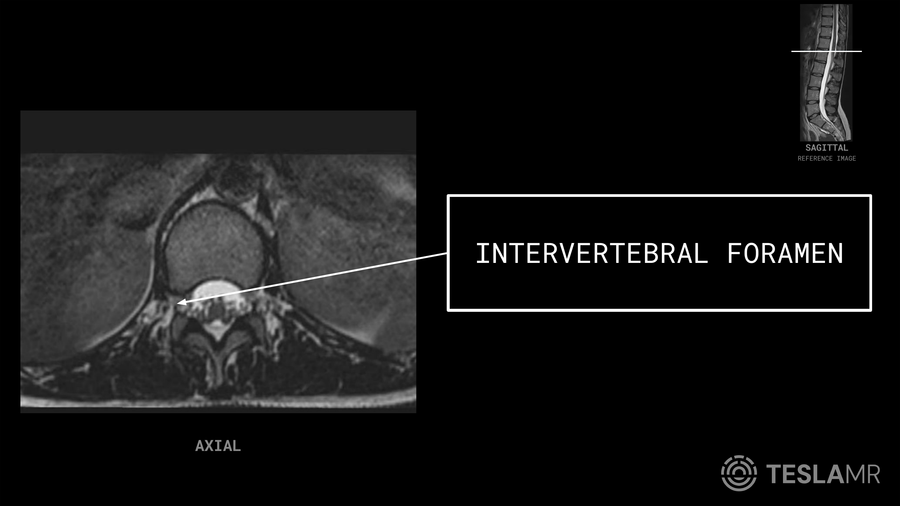
Intervertebral Foramen labeled on a L-Spine MRI (Axial)

Intervertebral Foramen

The bony canal on each side through which a spinal nerve root exits the spine, bounded by the pedicles, disc, and facet joint.

On MRI: Best seen as a fat-filled exit channel; on parasagittal it looks like a keyhole with the exiting nerve surrounded by bright fat, and on axial it opens laterally between pedicles.

Common pathology: Foraminal stenosis from disc bulge, facet hypertrophy, or loss of disc height compresses the exiting nerve root and causes radicular pain.

Frequently asked questions

What structures are seen on a lumbar spine MRI?

A standard lumbar spine MRI shows the lower spinal cord and conus medullaris, the cauda equina nerve roots, the intervertebral discs and the anterior and posterior longitudinal and supraspinous ligaments, the posterior elements (spinous process, lamina, and the superior and inferior articular processes that form the facet joints), and the vertebral bodies with the intervertebral foramina. This page labels all of them with their MRI appearance.

Which planes are used for lumbar spine MRI?

L-spine MRI is read primarily on sagittal and axial images. Sagittal images give the front-to-back overview of the cord, conus, discs, ligaments, and canal, while axial images through each disc level show the thecal sac, nerve roots, facet joints, and foramina. This deck uses sagittal and axial views.

Where does the spinal cord end on a lumbar MRI?

The spinal cord tapers into the conus medullaris and normally ends around the L1 vertebral level, near the L1-L2 disc. Below that, only the cauda equina nerve roots descend within the thecal sac. A conus that ends below L2 raises concern for a tethered cord.

What sequences make disc and nerve anatomy stand out?

T2-weighted images make CSF bright, so the dark nerve roots, discs, and ligaments stand out against it, which is why a hydrated disc looks bright and a degenerated one looks dark. T1-weighted images show the bright fatty marrow of the vertebral bodies and the fat in the foramina that outlines the exiting nerve roots.

Do I need an account to use these L-Spine MRI flashcards?

No. The interactive flashcards and this full labeled reference are open to use, with no account required to start. Creating an account lets you save your progress across devices and track which packs you have mastered.

Tesla MR Institute

Training to become an MRI technologist?

These flashcards come from our MRI tech program — learn online and train at a clinical site near you, in 12 to 18 months.

Explore the program