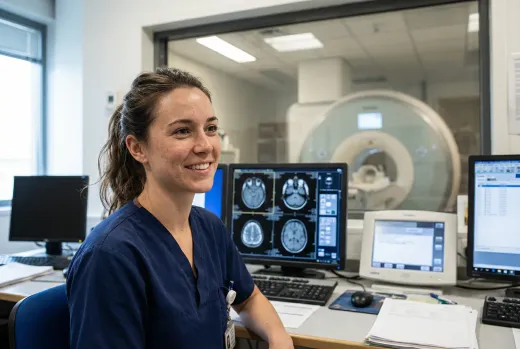
MRI training for Portland
Tesla MR Institute has 3 clinical training sites in the Portland metro area. Oregon converts prospective students at 4.5x the national average—Portland’s healthcare job market is strong and growing.
The program is fully hybrid: complete your didactic coursework online on your own schedule, then do hands-on clinical rotations at a facility in the Portland area. No commuting to a distant campus. No relocating. Train where you will eventually work.
Program details
- Duration: 12-18 months
- Prerequisites: None. High school diploma or GED. No prior radiology credentials required.
- Format: Online coursework + in-person clinical rotations in Portland
- Certification: ARMRIT (accepted by Portland-area employers)
- Cost: Starting at $11,500 (payment plans available)
For statewide details, see our Oregon MRI programs page.
MRI licensing in Oregon
Oregon does not require a specific state license for MRI technologists. The Oregon Health Authority regulates radiologic technologists who use ionizing radiation, but MRI operates on magnetic fields and radiofrequency pulses—no ionizing radiation involved. That means MRI techs fall outside state radiologic technology licensing requirements.
Employers require national certification. Both ARRT(MR) and ARMRIT are accepted at Portland-area hospitals and imaging centers. Tesla MR Institute’s program prepares you for the ARMRIT exam, which does not require prior X-ray credentials—a direct path into MRI without a 2-year radiology degree.
MRI technologist salary in Portland
MRI technologists in the Portland metro area earn approximately $75K-$100K per year. Entry-level positions start at the lower end, with experienced techs and those holding specialty certifications earning toward the top of the range. Oregon has no state sales tax, which adds to effective take-home pay.
The national median MRI tech salary is $95,480 (BLS, May 2025). Portland falls right around the national median at entry level and above it for experienced techs, with cost of living partially offset by the strong benefits packages offered by the city’s major health systems.
For detailed salary data, see our MRI technologist salary guide and Oregon MRI programs page.
How to become an MRI tech in Portland
- Enroll in Tesla MR Institute’s ARMRIT-approved hybrid program
- Complete coursework online at your own pace (MRI physics, anatomy, patient safety, cross-sectional imaging)
- Do clinical rotations at a Portland-area facility (hands-on scanner time with real patients)
- Pass the ARMRIT exam and earn your national certification
- Apply for positions at Portland hospitals, outpatient centers, and imaging groups
No prior radiology experience needed. Healthcare workers, career changers, veterans, and MRI tech aides are all strong candidates.
Where MRI techs work in Portland
Portland’s healthcare market is anchored by several major systems that employ MRI technologists:
- Oregon Health & Science University (OHSU) — the state’s only academic medical center and Level I trauma center, with high imaging volume across its main campus and outpatient locations
- Providence Health & Services — one of the largest employers in Oregon, operating Providence Portland Medical Center, Providence St. Vincent, and multiple outpatient imaging centers
- Legacy Health — Legacy Emanuel, Legacy Good Samaritan, and Legacy Meridian Park serve the Portland metro, all with active MRI departments
- Kaiser Permanente Northwest — integrated system with imaging facilities throughout the metro area
- PeaceHealth — serving the greater Portland/Vancouver corridor
- VA Portland Healthcare System — federal imaging positions for the veteran population
Portland’s position as Oregon’s largest metro means most of the state’s MRI job openings are concentrated here. The city also benefits from proximity to Vancouver, Washington, giving techs access to a cross-state job market.
More resources
- MRI tech programs in Oregon — statewide overview
- How to become an MRI technologist — complete career guide
- MRI technologist salary guide — pay data by location
- ARRT vs ARMRIT certification — credential comparison