Anatomical directions and patient position
Anatomical directions let people describe the same body location clearly, and every chapter after this one uses them. This chapter teaches the words on a person and on body illustrations, and the next chapter applies them to sections through the body.
By the end of this chapter you can
- Describe anatomical position and explain why every directional term is measured from it.
- Use the pairs superior and inferior, anterior and posterior, medial and lateral, proximal and distal, and superficial and deep to state where one structure lies relative to another.
- Tell ipsilateral from contralateral and bilateral from unilateral, and translate ventral, dorsal, cranial, and caudal into the standard directional terms.
- Name how a patient is lying on the table using supine, prone, right or left lateral decubitus, head first, and feet first.
- Describe a positioning adjustment to a supervising technologist using the patient's right and left instead of your own.
Start from anatomical position
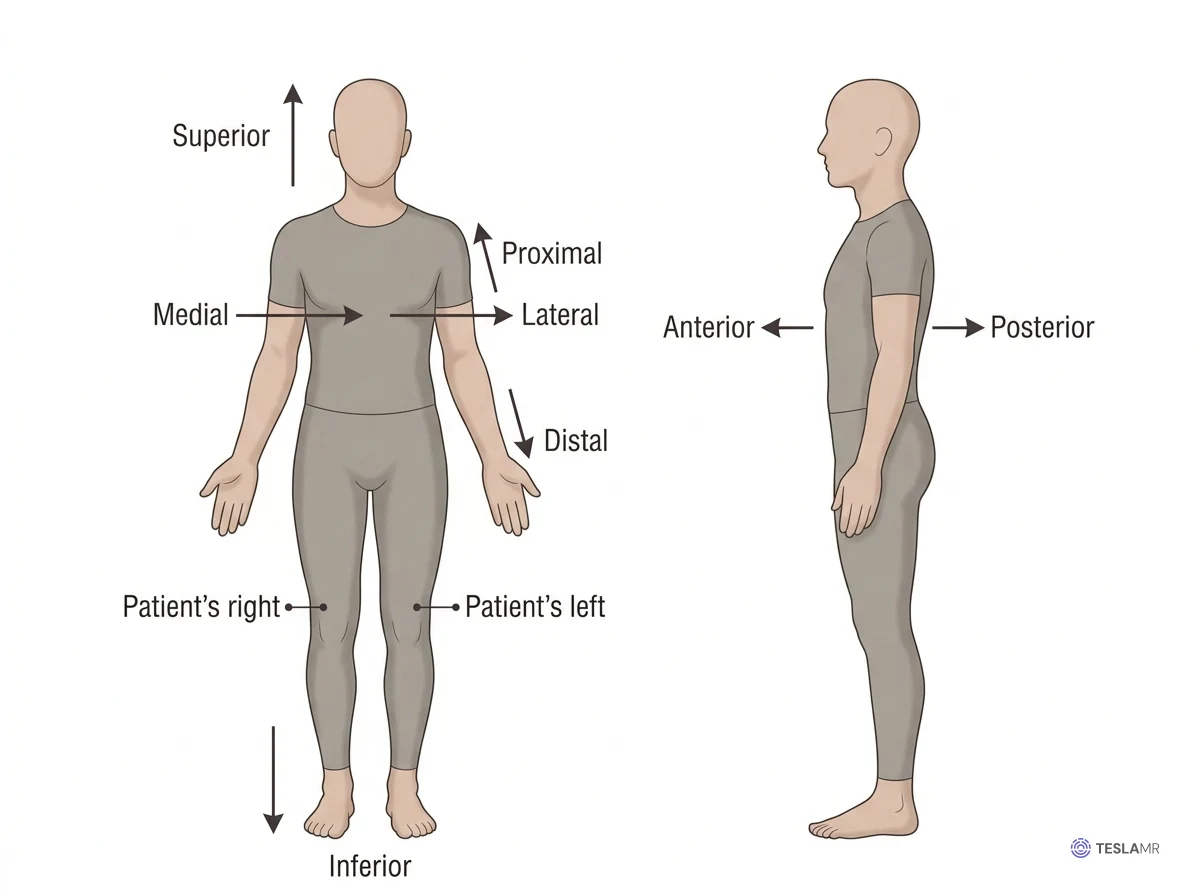
Every directional word in this chapter is measured from one reference pose, called and shown in the figure below. The person stands upright and faces forward, with the feet flat and slightly apart and the arms hanging at the sides. The palms turn forward and the thumbs point away from the body. This hand position keeps the two forearm bones side by side without crossing, and it puts each thumb on the outer edge of its hand.
Directional terms always refer to this one fixed pose, so they stay the same when a patient bends an elbow, turns the head, or rolls onto a side. When a report calls a lesion lateral, it means lateral as if the patient were standing in anatomical position, regardless of their position on the table.
Right and left belong to the patient
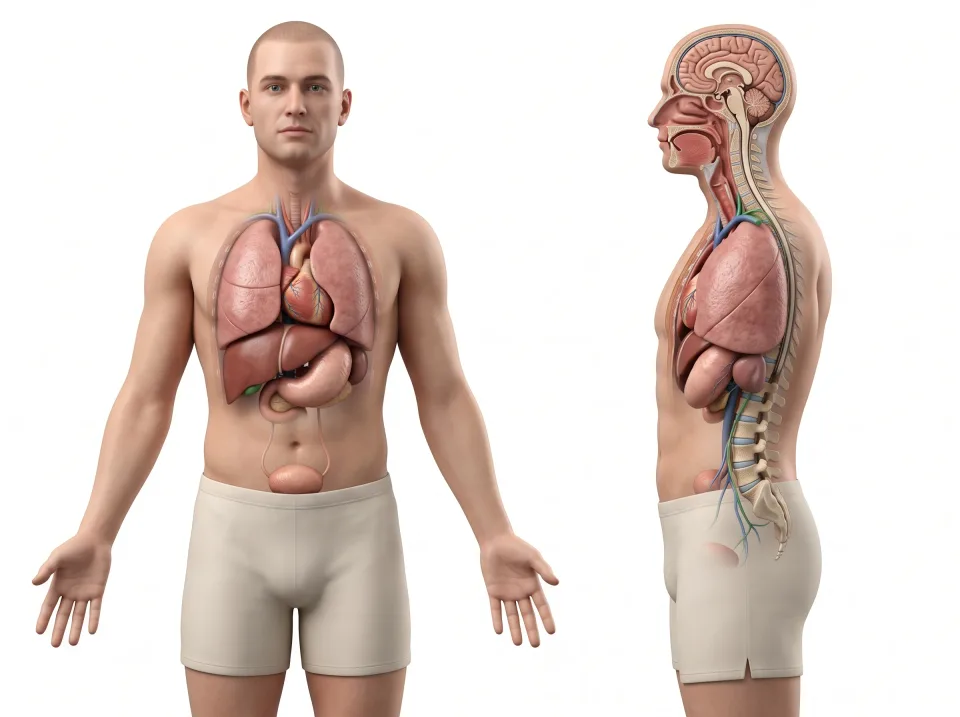
In anatomical language, right and left always mean the patient's right and left. When you stand at the foot of the table facing the patient, their right hand is on your left. If you walk around to the head end, that same hand is on your right, yet nothing about the patient's position has changed. The side names belong to the patient, so the liver stays on the patient's right wherever the observer stands.
Mistakes happen when people name sides from their own point of view. Two people on opposite sides of a table who hear "shift it left" will move in opposite directions. To prevent this, say the patient's side every time, even when it seems obvious. "Toward the patient's left" takes two extra words, and it means the same thing to everyone in the room.
"Over there" and "on this side of the picture" are just as unclear, because their meaning changes with every step the speaker takes. A clear description names the patient's side and a nearby landmark, as in "on the patient's left, just below the ribs". It works no matter which side of the table the listener stands on.
1.Right and left
Face the person: their right is on your left. The names do not change when you move.
2.Above and below
S = superior (above): the heart is above the stomach. I = inferior (below): the stomach is below the heart.
3.Front and back
The sternum is anterior to the heart. The spine is posterior to the heart.
Right and left always belong to the person. The heart and stomach help relate above and below.
Directions come in pairs
Directional terms are relationships, not addresses. Each one compares the positions of two structures, so a term such as always needs a partner structure after the word to.
The main directional terms come in three pairs: and , and , and medial and . The two terms in each pair are opposites, and Figure 1 at the start of the chapter shows each pair with arrows. For example, anterior means toward the front and posterior means toward the back. Anterior comes from the Latin ante, meaning before or in front, and posterior comes from post, meaning after or behind.
Medial and lateral are measured from the , the imaginary line that splits the body into equal right and left halves. Medial shares a root with the word middle, and in anatomical position the thumbs are lateral. The table below defines each term and gives an example.
| Term | Means | Example |
|---|---|---|
| Superior | Toward the head | The heart is superior to the stomach. |
| Inferior | Toward the feet | The stomach is inferior to the heart. |
| Anterior | Toward the front of the body | The sternum, or breastbone, is anterior to the heart. |
| Posterior | Toward the back of the body | The vertebral column is posterior to the heart. |
| Medial | Closer to the midline | The heart is medial to the lungs. |
| Lateral | Farther from the midline | The ears are lateral to the nose. |
Interactive model
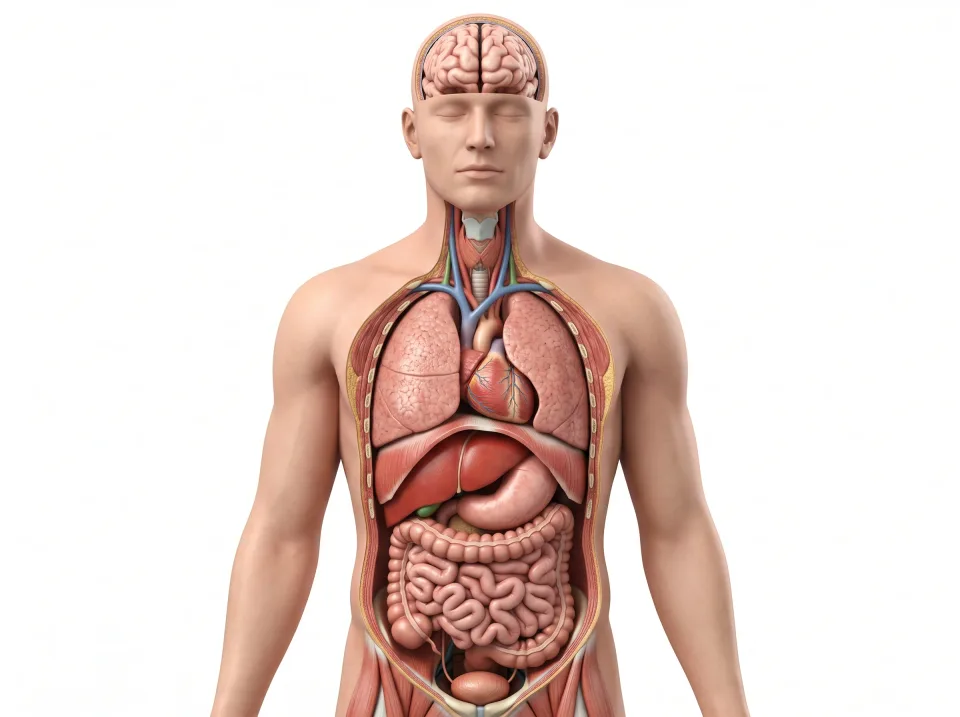
The liver is highlighted on the patient's right. Turn the model and describe its neighbors with this section's words: the right lung is superior to the liver, and the right kidney is posterior to it.
Body location map
Highlighted structure
Liver
Where: Mainly the right upper abdomen
Job: Processes nutrients, produces bile, and performs many metabolic functions.
Drag to turn. Pinch to zoom. Select a visible structure to learn about it.
Where it sits on a slice
Axial through the liver
Seen from the feet, so the patient's right is on your left.
Limbs, depth, and sides
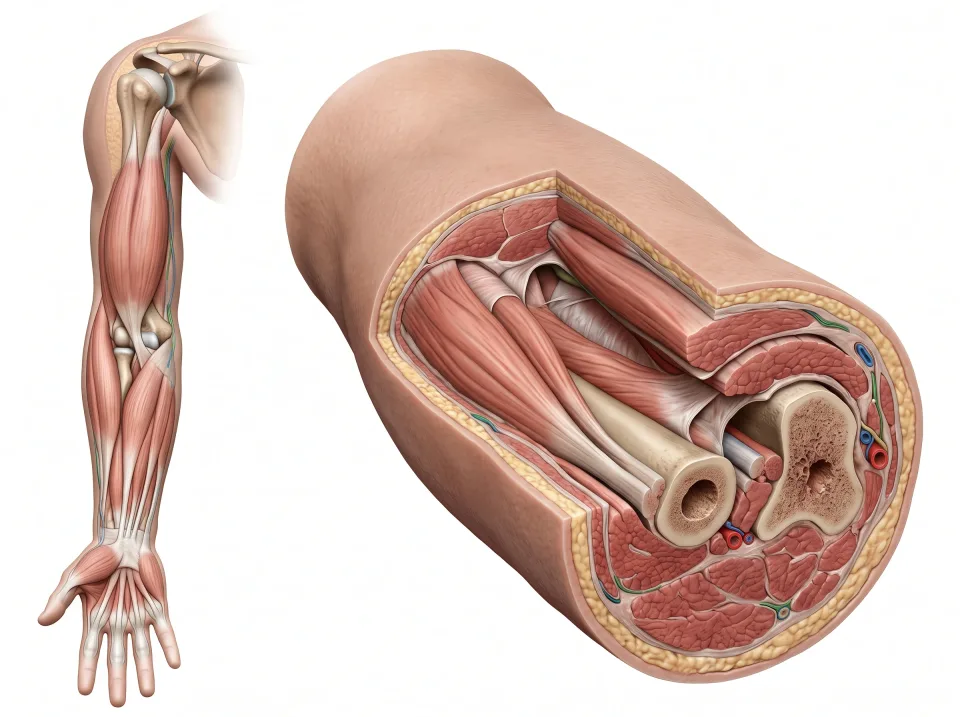
On a limb, means closer to where the limb attaches to the trunk, and means farther from that attachment. The elbow is therefore proximal to the wrist. The proximal femur is the hip end of the thigh bone, and the distal femur is the knee end. The distal radius is the wrist end of the radius, a forearm bone.
Proximal and distal are measured along the limb, not against the floor or the ceiling. If a patient raises an arm above the head, the wrist ends up higher than the shoulder but stays distal to the elbow.
means closer to the body surface, and means farther from it. Skin is superficial to muscle, and the lungs are deep to the ribs. Depth says nothing about right or left, because a deep structure can lie on either side.
means on the same side of the body, and means on the opposite side. A scar on the left knee is ipsilateral to left hip pain and contralateral to the right hip. Height does not matter: the left hand is contralateral to the right shoulder even though the hand is far inferior to it. means both sides, as in the bilateral kidneys, and means one side.
On an axial slice through the knee, the kneecap is anterior and the tendons behind the knee are posterior. Medial is the side nearer the other knee, however the leg happens to be turned. Skin and fat are superficial, and the bone at the center of the slice is the deepest structure on it.
1.Proximal
Closer to the limb’s attachment: the elbow is proximal to the wrist.
2.Distal
Farther from the attachment: the wrist is distal to the elbow, even with the arm raised.
3.Superficial and deep
Skin is superficial to muscle. Bone lies deeper. Depth is distance from the surface.
Proximal and distal are measured from the limb attachment. The cutaway is magnified.
Older words you will still hear
Four older directional terms still appear in reports and in conversation, and each one matches one of the standard terms. means toward the head, and means toward the tail end of the trunk, where a tail would attach. In the trunk, cranial matches superior and caudal matches inferior, so the chest is cranial to the pelvis and the pelvis is caudal to the chest. A radiologist who writes that a finding "extends caudally from the kidney" means that it extends inferiorly, toward the feet.
comes from the Latin word for belly, and comes from the Latin word for back. A dorsal fin sits on the back of a fish, and the dorsum of the hand is the back of the hand. In the human trunk, ventral is the same as anterior and dorsal is the same as posterior. The ventral surface of the abdomen is therefore the belly wall, and the dorsal surface is the back.
How the patient lies on the table
Positioning words describe how the whole body rests on the table. means the patient is lying on their back facing up. Most MRI exams are done in this position. means the patient is lying on their front facing down. Breast MRI exams are done in this position.
means lying on one side, and decubitus is Latin for lying down. The named side is the side that is down. The left lateral decubitus position places the patient's left side on the table, and the right lateral decubitus position places the patient's right side on the table.
and add one more detail: which end of the patient leads the way into the scanner. A brain or shoulder patient usually goes in head first, and a knee or ankle patient usually goes in feet first. A full description therefore sounds like "supine, feet first" or "prone, head first".
None of these positioning words changes an anatomical direction, because directions stay fixed to the body as it moves. When a supine patient rolls prone, the chest is still anterior to the spine. The patient's right is also still the patient's right, even though it now faces the other wall. A positioning word describes how the body lies, and a directional term describes where structures sit within it.
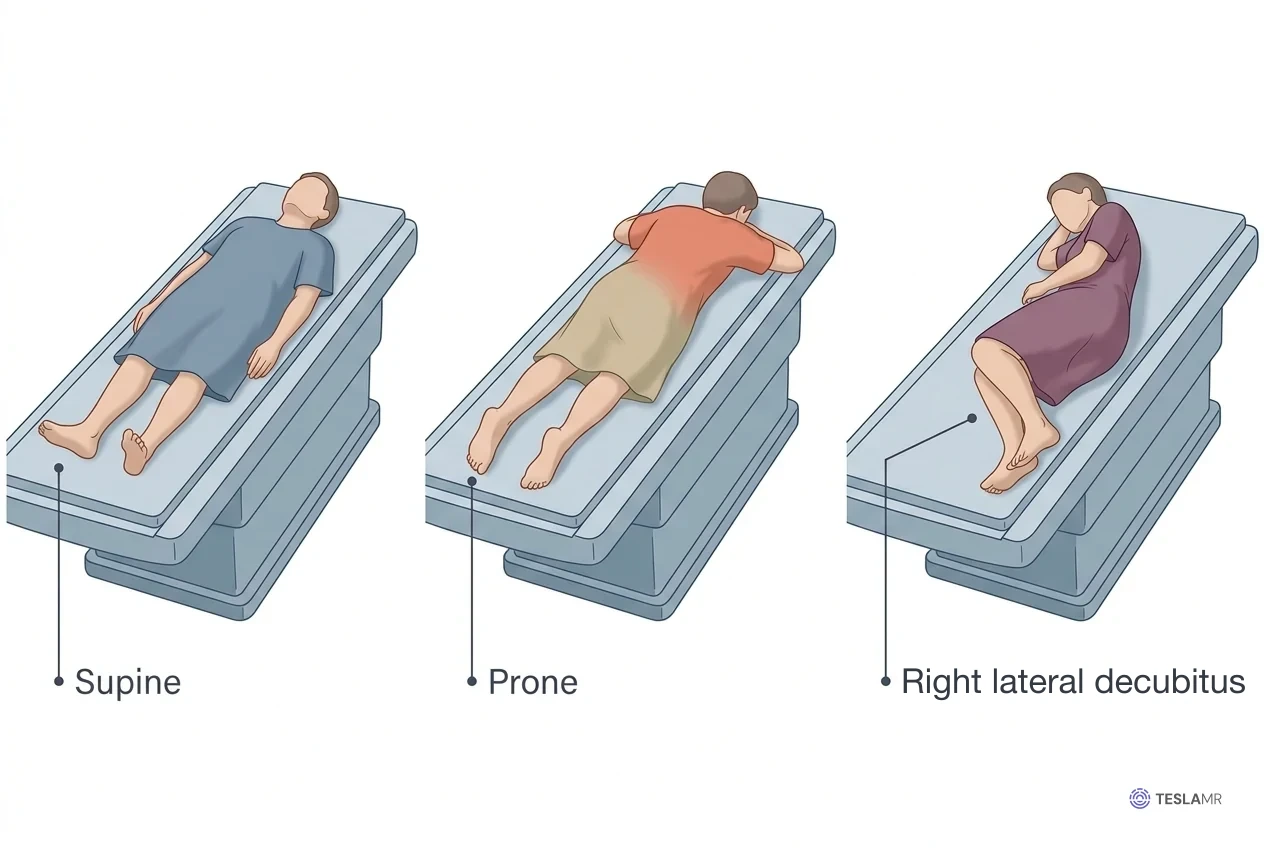
Supine, feet first: on the back, face up, and the feet go into the scanner first. The heart is still anterior to the spine, and the patient's right is still their right.
Try it
- Lay the patient on their side with the left side down. Not done yet.
- Face down, with the feet going into the scanner first. Not done yet.
- Face up, with the head going in first. Not done yet.
Key ideas to remember
- Right and left always mean the patient's right and left.
- Every directional term is a relationship measured from : superior to, anterior to, medial to.
- Proximal and distal run along a limb from its attachment, and raising the limb does not change them.
- is face up, is face down, and the named side in is the side that is down.
Check what you learned
Twenty-five questions from this chapter, two of them illustrated, each with the answer, the reasoning, and a memory aid.